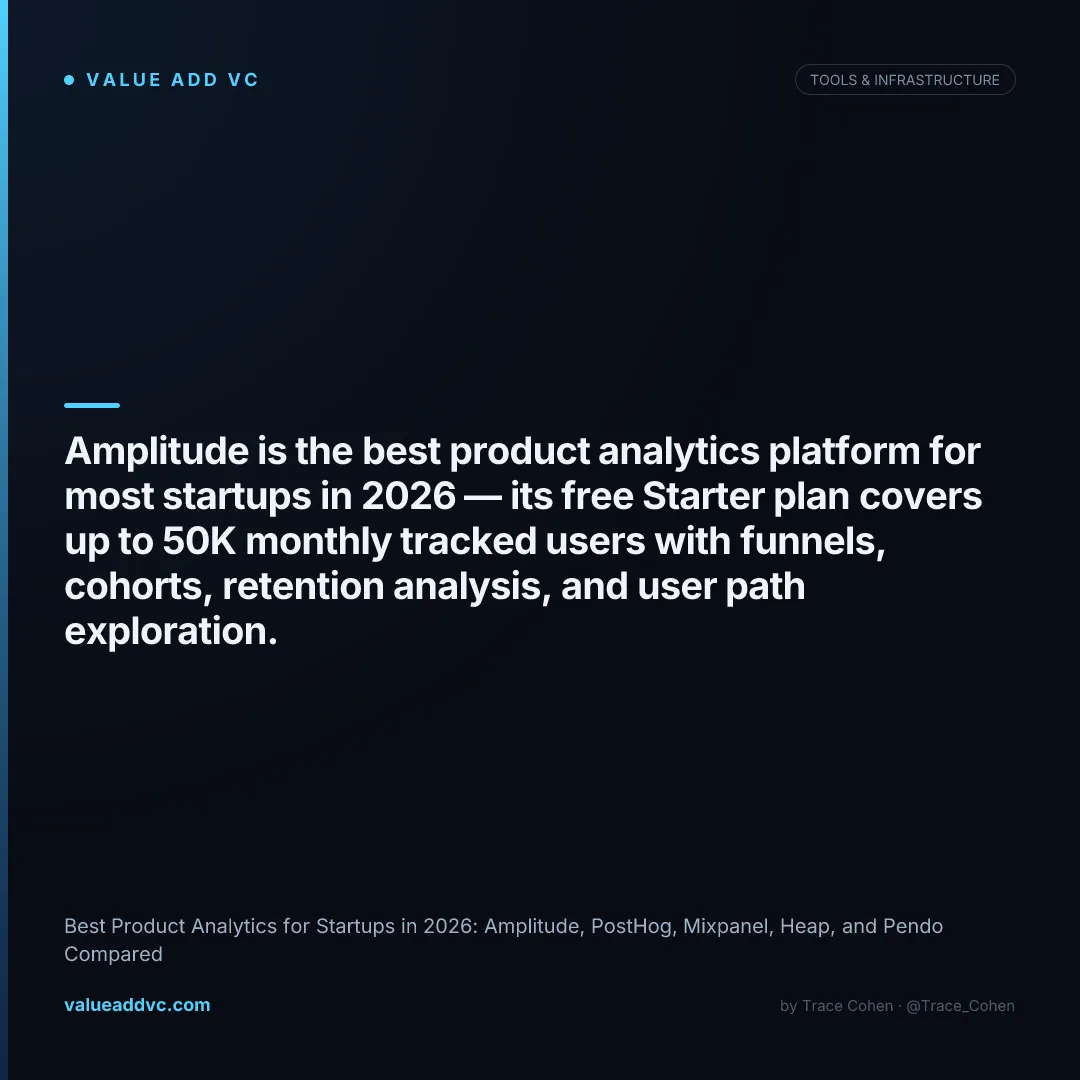
I have seen startups raise Series A rounds on vanity metrics — total signups, page views, DAUs — that collapse the moment an investor asks about activation rate, D7 retention, or feature adoption. Product analytics is the difference.
Some links on this site may earn us a commission — this never affects rankings. See our editorial standards.
Product analytics answers one question: what do users actually do inside your product, and does that behavior predict retention and revenue? The market in 2026 is split between event-based platforms that require instrumentation (Amplitude, Mixpanel), auto-capture platforms that record everything (Heap), open-source alternatives that bundle multiple tools (PostHog), and PM-focused platforms that combine analytics with in-app engagement (Pendo). The right choice depends on your team's technical capacity and what you need beyond pure analytics.
The Best Product Analytics for Startups in 2026, Ranked
How to Choose by Team and Product Type
Technical team / data ownership
PostHog
Self-host on your own infra, own your data, and get analytics + feature flags + session recording + A/B testing in one platform. The all-in-one consolidation saves $30K–50K/year versus buying each tool separately. Best when you have an engineer who can maintain the deployment.
Data-literate PM / PLG focus
Amplitude
The deepest behavioral analysis in the market. Amplitude's cohort-driven analysis answers questions like 'which actions in the first 48 hours predict 90-day retention?' — the kind of insight that shapes product strategy. Worth the learning curve if you have someone who will use it daily.
Small team / quick answers
Mixpanel
Mixpanel's interface is the simplest path from question to answer. The 20M events/month free tier means you will not hit a paywall for a long time. If you want product analytics without a learning curve, start here.
Non-technical PM team
Heap or Pendo
Heap auto-captures everything so you do not need engineering to instrument events. Pendo adds in-app guides and surveys so PMs can act on what the analytics reveal without filing engineering tickets. Both are PM-first tools.
The Metrics That Actually Matter
Having reviewed analytics setups at dozens of portfolio companies, the startups that get the most value from product analytics track these five metrics consistently:
- •Activation rate — percentage of new signups who complete your 'aha moment' action within the first session
- •D1/D7/D30 retention — percentage of activated users who return on day 1, 7, and 30 after signup
- •Feature adoption — percentage of active users who use each major feature, and which features correlate with retention
- •Time-to-value — median time from signup to first value-generating action (shorter is always better)
- •Expansion signals — which user behaviors predict account upgrades or seat expansion (for B2B SaaS)
Every platform on this list can track these. The question is whether your team will actually build the dashboards and review them weekly. See our SaaS Valuations Dashboard for how these metrics translate into company valuation multiples. None of these tools replace a company-wide KPI dashboard, though — for that layer, see how Databox's AI-assisted BI tooling compares to traditional reporting.
Product analytics does not make your product better.
It makes you unable to ignore what is broken — and that discomfort is what drives the right product decisions.
Track SaaS and startup benchmarks on Value Add VC. Follow @Trace_Cohen for more startup tooling breakdowns.
Latest from the Pulse
Get VC data most people never see
— free to subscribe
Trace's notes on venture, AI and startups, a few times a week. Join 5,000+ subscribers. No spam.