
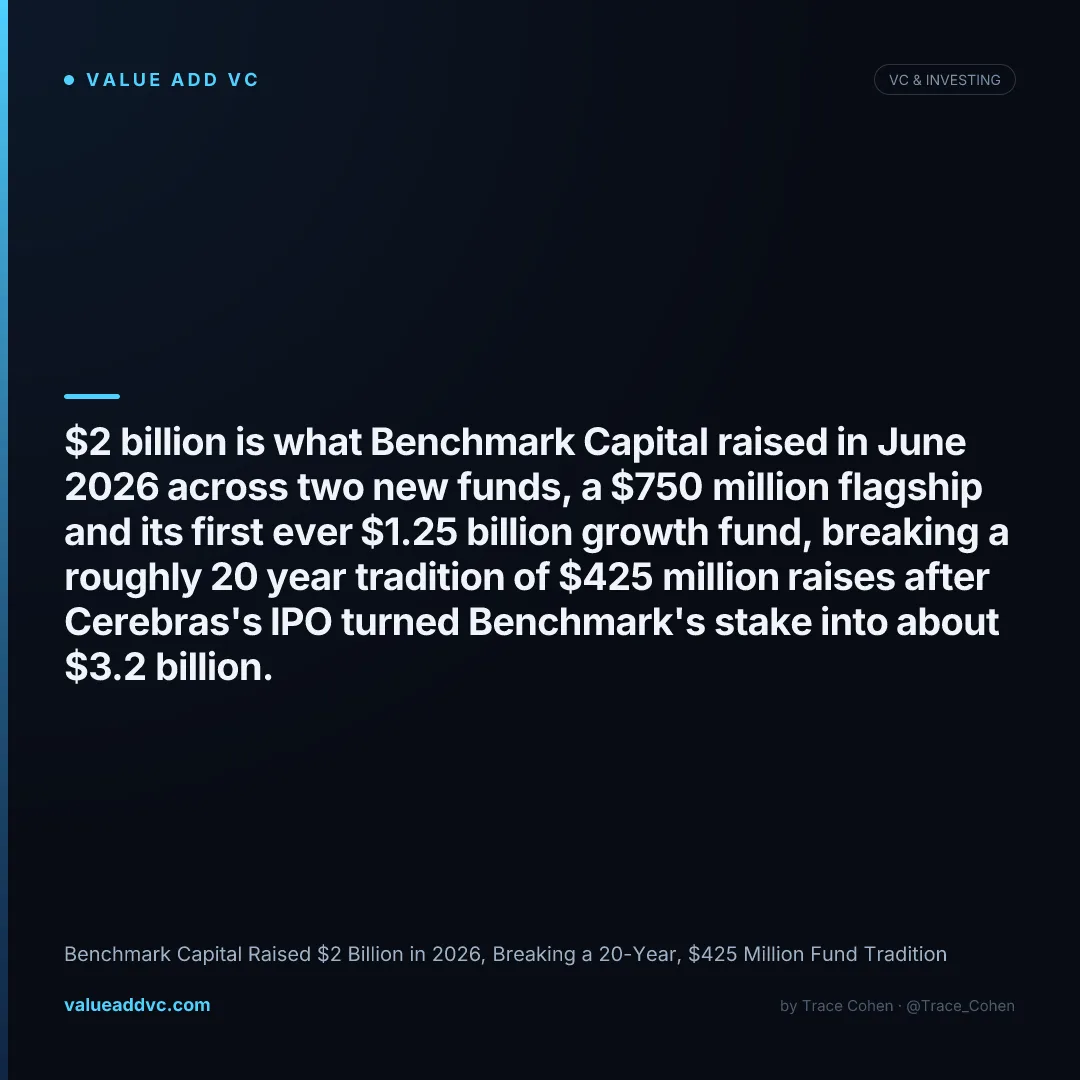
$2 billion is what Benchmark Capital raised in June 2026 across two new funds — including a growth vehicle it had never raised before — ending a roughly 20-year run of keeping its flagship fund near $425 million.
Benchmark spent about two decades telling limited partners the same story: stay small, keep the partnership to a handful of general partners, and let concentrated ownership in a few great companies do the work. In 2025 that model looked shakier than it had in years, with the partnership down to three full-time GPs after two departures. Then Cerebras went public, Benchmark's stake turned into billions on paper, and the firm did something it had never done before — raised a dedicated growth fund. Here is what actually happened, in order, and what the new structure does and doesn't prove yet.

Benchmark Capital Fund Size in 2026: Inside the $2 Billion Raise
Benchmark Capital's fund size in 2026 is $2 billion split across two vehicles: a $750 million flagship early-stage fund and a $1.25 billion fund dedicated to later-stage, growth-round investing — a vehicle the firm had never raised before. Combined, that is roughly 4.7 times the size of any single flagship Benchmark fund since at least 2013, when the firm's eighth fund also closed near $425 million.
According to TechCrunch's June 3, 2026 report on the raise, Benchmark had gone roughly two decades keeping its flagship near $425 million even as peers like Andreessen Horowitz and Sequoia scaled into multibillion-dollar multi-strategy platforms — one of the few remaining top-tier firms without any dedicated later-stage vehicle at all. The growth fund breaks that pattern directly: it exists so Benchmark can keep writing checks into its own winners as they raise late-stage rounds, instead of watching its ownership get diluted by outside growth investors once a seed or Series A bet starts working.
Not every bet gets that follow-on treatment, though. Manus, the AI agent startup Benchmark led a $75 million round into in April 2025, raised more than $500 million in October 2026 from an entirely different investor group after China forced Meta to abandon a roughly $2 billion acquisition of the company — a reminder that even a firm with fresh growth-stage capital doesn't automatically get to keep writing every winner's checks.
The Cerebras Payout That Funded the Pivot
The growth fund didn't come out of nowhere. Cerebras Systems priced its IPO at $185 a share on May 14, 2026, raising $5.55 billion in what became the year's biggest AI-chip listing. Bloomberg reported the same day that Benchmark held roughly 8.1% of Cerebras after the debut — a position worth about $3.2 billion at the IPO price, or close to a 12x return on the roughly $268 million Benchmark had put in across Cerebras's earlier funding rounds. Three weeks later, Benchmark announced the $2 billion raise. The timing is the clearest evidence that a single blockbuster mark, not a broader strategy shift, is what actually unlocked the firm's first growth vehicle.
That $3.2 billion figure is a snapshot, not cash in hand. Cerebras stock has moved a long way from its IPO price since — the stock opened at $350 and touched an all-time high of $386.34 the same day, then slid to a $160.81 low by late June before a partial recovery, according to our own tracking in Cerebras Stock Since the IPO. Whatever Benchmark's stake is actually worth today depends on which of those prices you use and whether the firm has distributed any shares to its own limited partners yet — a detail neither Bloomberg's report nor Benchmark itself has disclosed.
A Partnership That Shrank to Three, Then Rebuilt to Five
The fund raise lands right after a rough stretch for Benchmark's own team. Sarah Tavel, the firm's first woman general partner, moved to a venture-partner role in April 2025, and Victor Lazarte announced on July 24, 2025 that he was leaving to start his own firm — two years to the day after he had joined. That left Peter Fenton, Eric Vishria, and Chetan Puttagunta as the only full-time general partners, prompting a widely-discussed Newcomer analysis in August 2025 that argued Benchmark's minimalist, small-partnership model — six investors at its peak, three by mid-2025 — needed a rebuild to compete for AI deals against firms with much larger teams.
Benchmark answered that gap on February 17, 2026, hiring Jack Altman — the Lattice co-founder and Sam Altman's brother — as a new general partner after his own AI-focused fund, Alt Capital, produced a run of markups Bloomberg described as having "surged." Altman brought his Alt Capital team with him and kept his existing board seats; a majority of Alt Capital's roughly $275 million second fund reportedly will not be drawn down from its own limited partners as a result. By September 2026, TechCrunch listed five Benchmark general partners: Jack Altman, Peter Fenton, Chetan Puttagunta, Everett Randle, and Eric Vishria. The table below tracks who was actually in the partnership at each point in the story.
| General partner | At Benchmark since | 2025–2026 status | Notable investments |
|---|---|---|---|
| Peter Fenton | 2006 | Active throughout | Twitter, Yelp, Zendesk, Elastic, Sierra |
| Eric Vishria | 2014 | Active throughout | Cerebras, Confluent, Amplitude, Benchling |
| Chetan Puttagunta | 2018 | Active throughout | Cursor, Elastic, LangChain, Airbyte |
| Sarah Tavel | 2017 | → Venture partner, Apr. 2025 | Chainalysis, Hipcamp, 11x |
| Victor Lazarte | 2023 | Departed Jul. 24, 2025 | Mercor, HeyGen, Decart AI |
| Jack Altman | 2026 | Joined Feb. 17, 2026 | Lattice (founder), Alt Capital portfolio |
| Everett Randle | Not disclosed | General partner as of Sept. 2026 (TechCrunch) | Anthropic, SpaceX, Rippling, Flock Safety |
Sources: TechCrunch, Bloomberg, Forbes, and Newcomer reporting on Benchmark's partnership moves, 2023–2026. "Active throughout" reflects continuous general-partner status across the period; it does not imply these partners joined in the years shown for departed or transitioned partners.
Still Small Next to the Mega-Funds
Even at $2 billion, Benchmark's new capital is a fraction of what the largest venture firms have raised in the same stretch, according to fund-size figures reported by Bloomberg and TechCrunch. Andreessen Horowitz closed a $15 billion raise in early 2026 that pushed its total assets under management past $90 billion, and Lightspeed Venture Partners raised $9 billion of its own in 2026. Benchmark's $2 billion is real money and a real departure from its own history, but it puts the firm in a different weight class entirely from the multi-strategy platforms it's nominally now competing with for growth-stage allocations.
What the Headline Misses
The "Benchmark breaks tradition" framing skips over a harder question: does a growth fund actually fit a firm whose entire brand is six-ish partners doing deep, board-level work on a small number of companies? Growth investing rewards a different skill set — underwriting later-stage financials and competitive position across a wide set of checks, not sitting on a board for years. Benchmark has never run that motion at scale, and the $1.25 billion fund is, for now, an unproven bet on a team of five general partners who mostly built their reputations doing something else.
There's also a concentration problem underneath the headline number. The entire rationale for the growth fund traces back to one holding — Cerebras — whose value has already proven volatile enough to swing from a $386.34 high to a $160.81 low within six weeks of going public. If Cerebras's stock stays depressed, or if Benchmark's next few bets don't produce a similar mark, the growth fund's first vintage will be judged against a bar that one lucky, concentrated position happened to clear. And the rebuilt partnership itself is barely seven months old as of this writing: Jack Altman, Peter Fenton, Eric Vishria, and Chetan Puttagunta have not yet run a full fund cycle together.
The Bottom Line for Founders and LPs
For founders: Benchmark in 2026 is still the same small-partnership pitch at the early stage — a $750 million fund from five general partners who each want board seats and concentrated ownership — but now there's a real reason to expect the firm to keep writing checks into your company well past Series A or B, instead of getting crowded out by growth investors once you're working. That's a meaningfully different value proposition than it offered even two years ago, if you can get in the door with one of the five.
For LPs, the honest read is that this is a firm making a structural bet on the back of one enormous, still-unrealized win, at almost exactly the moment its own partnership had thinned to a historic low. The Cerebras mark is real and well documented, but a single 12x position funding a firm's departure from 20 years of discipline is a story worth watching for how it plays out over the next few vintages — not yet proof that the new growth fund will replicate what made the old, smaller Benchmark work.
Track venture fund activity on the VC Fund Performance dashboard at Value Add VC. Reach out at t@nyvp.com or @Trace_Cohen.
Latest from the Pulse
Get VC data most people never see
— free to subscribe
Trace's notes on venture, AI and startups, a few times a week. Join 5,000+ subscribers. No spam.
No spam, unsubscribe anytime. Sent via Substack · Privacy · or subscribe on Substack ↗