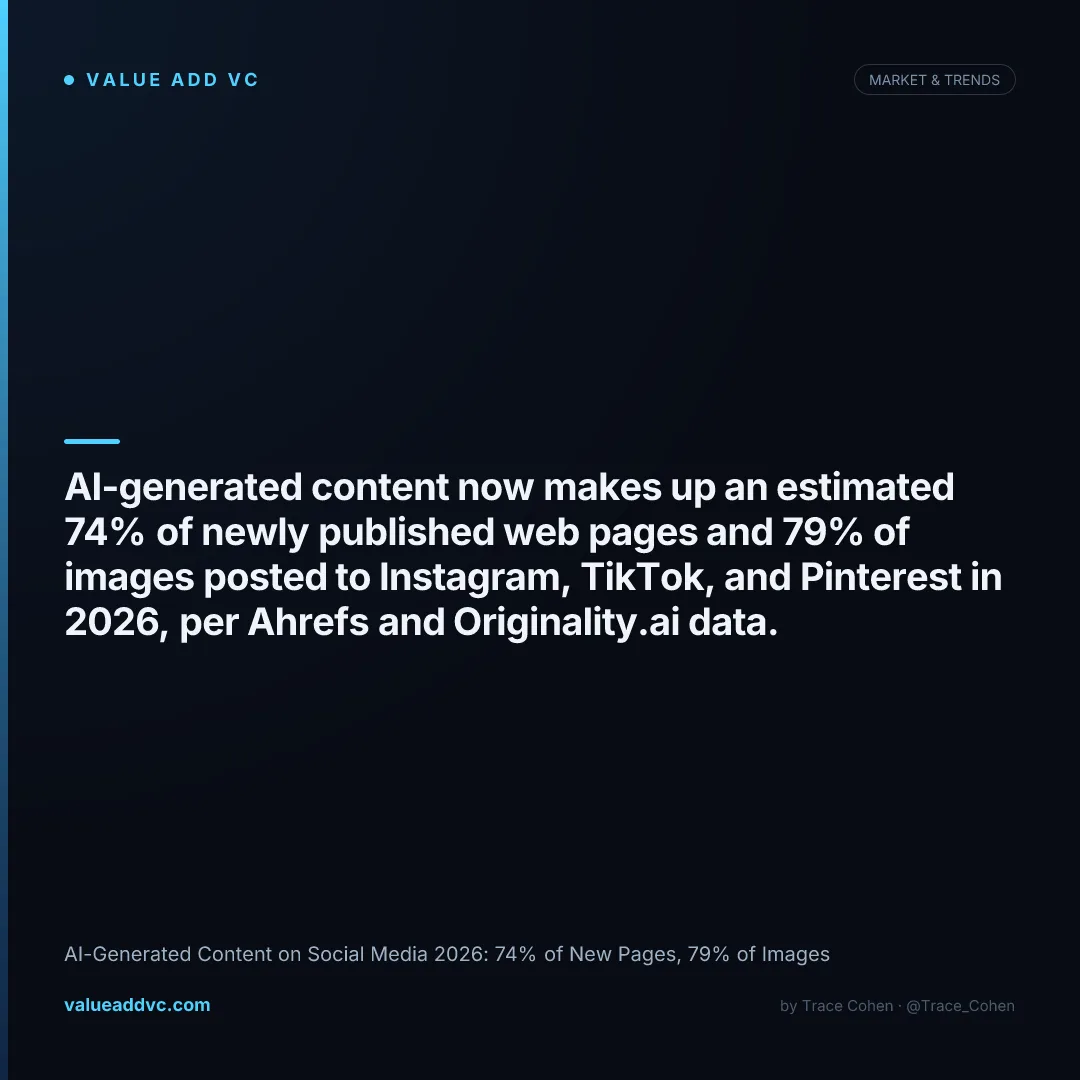
74% of nearly one million new web pages published in a single month tested positive for detectable AI generation, and 79% of images now posted to Instagram, TikTok, and Pinterest show the same signature. Meanwhile, platforms are only just starting to build the infrastructure to tell the difference.
Two years ago, "AI-generated content" mostly meant a handful of viral fake images. In 2026 it's the default state of the feed. Europol's Innovation Lab projects synthetic content could hit 90% of everything online by year-end, and the platforms that make money from engagement are now the same ones trying to figure out how much of that engagement is real. This is a market story as much as a content-moderation one — it touches ad pricing, creator economics, and which platforms investors should trust to still have a functioning trust layer in three years.
Figures compiled from Ahrefs, Originality.ai, Graphite, Sprout Social, and Europol Innovation Lab research published in 2025–2026.
How Much AI-Generated Content Is on Social Media in 2026?
79% of images posted to Instagram, TikTok, and Pinterest now show detectable AI generation, according to Originality.ai and Graphite's 2026 analysis, and the pattern holds across formats — not just images. Europol's Innovation Lab found synthetic content already at 52% of new online material in May 2025, with a trajectory pointing toward 90% by the end of 2026 if current adoption curves hold. Cloudflare's own 2026 network data adds a related but distinct data point: bots now generate 57.5% of all web requests globally, exceeding human traffic for the first time — meaning even the audience consuming this content is increasingly synthetic, not just the content itself.
The shift is fastest on platforms built around short-form visual content. TikTok, Instagram Reels, and Pinterest boards are cheap to fill with AI-generated images and video clips, and the algorithms on those platforms historically rewarded volume and novelty — exactly the two things generative tools are best at producing at scale.
Which Platforms Have the Most AI-Generated Content Right Now?
LinkedIn shows the highest concentration among professional platforms: 53.7% of long-form posts from its own top 99 most-followed voices tested as likely AI-generated in Originality.ai's analysis of the platform's most influential accounts. Visual platforms run even higher — the 79% figure across Instagram, TikTok, and Pinterest images is roughly 25 points above LinkedIn's text-post rate, which tracks with how much cheaper AI image and video generation has become relative to AI text that still needs to sound like a specific person's voice to land.
What Are Social Media Platforms Doing About AI-Generated Content?
TikTok has gone furthest with automated enforcement: it uses C2PA Content Credentials to detect synthetic media even when a creator doesn't self-disclose, and it can auto-label, throttle distribution on, or remove flagged content depending on severity. That's a meaningfully different model than Meta's, which still relies primarily on creator self-declaration plus metadata partnerships with third-party AI tools, requiring explicit disclosure only for synthetic media touching political or social topics. YouTube sits in between — its AI disclosure policy, introduced in March 2024 and enforced since early 2025, requires creators to manually flag "realistic altered or synthetic content" in videos, Shorts, and livestreams, with penalties for repeated non-disclosure but no automated detection layer as aggressive as TikTok's.
| Platform | Detection Method | Labeling Requirement | Enforcement Action |
|---|---|---|---|
| TikTok | Automated (C2PA Content Credentials) | Required for realistic AI visuals/audio | Auto-label, reduced distribution, or removal |
| Automated (claimed ~94% accuracy) | No formal label; reach-based | Suppresses formulaic AI posts (since May 2026) | |
| YouTube | Manual creator self-flagging | Required for realistic altered/synthetic content | Penalties for repeated non-disclosure |
| Meta (FB/IG) | Self-declaration + metadata partnerships | Required only for political/social synthetic media | Limited automated enforcement |
| Partial metadata detection | Inconsistent across content types | Minimal disclosed enforcement | |
| X (Twitter) | Limited; engagement-pod overlap | No consistent requirement | ~1 in 3 trending posts tied to AI + pods (Sparktoro) |
Figures blended from platform policy documentation, Storrito, AuditSocials, InfluencerMarketingHub, and Sparktoro reporting as of 2026. Policies change frequently — verify current terms directly with each platform.
Is AI-Generated Content Actually Hurting Engagement and Trust?
50% of Gen Z users say they've unfollowed, muted, or blocked an account specifically because its content felt like AI slop, per Sprout Social's 2026 research — a meaningful signal that audience fatigue is now measurable, not just anecdotal. But the picture isn't fully clean: Sparktoro's analysis found engagement pods combined with AI-generated posts account for roughly one in three trending posts on X, which means some algorithms are still actively rewarding the exact behavior users say they dislike. That gap between stated preference and algorithmic reward is the core tension every platform is now navigating, and it's part of why only 41% of Americans currently believe what they read online is accurate and human-made.
The financial incentive to keep producing AI content at scale remains strong regardless of user sentiment. Kapwing's survey of 15,000 top YouTube channels found 278 that post nothing but AI-generated content, collectively pulling in about $117 million a year in ad revenue — proof that even low-trust content can be a real business as long as distribution algorithms keep surfacing it.
Which Platform Is Cracking Down Hardest on AI Slop in 2026?
LinkedIn is the clearest outlier. In May 2026 it became the first major platform with a confirmed policy that demotes — rather than removes — content specifically because it reads as generic AI, limiting flagged posts largely to the poster's first-degree network rather than the broader feed. LinkedIn says its detection system reached roughly 94% accuracy in early testing, a number worth treating with some skepticism until independently verified, but directionally it represents a different philosophy than TikTok's label-and-throttle model or Meta's disclosure-only approach.
What's Next for AI-Generated Content and Social Media?
The next twelve months look like a convergence toward TikTok's model rather than Meta's. Automated, metadata-based detection is cheaper to scale and harder to game than manual self-disclosure, and LinkedIn's move to reach-suppression in May 2026 suggests platforms are starting to treat "generic AI content" as a ranking-quality problem rather than purely a trust-and-safety one. Expect YouTube and Meta to face growing pressure to adopt similar automated detection as C2PA credentialing becomes more standardized across generation tools, especially as advertisers start asking platforms directly what percentage of the inventory they're buying against is verifiably human.
For investors, the signal worth watching is which platforms treat this as a growth lever versus a liability. A platform that can credibly tell advertisers "X% of our engagement is verified human" starts to command a trust premium the way privacy-forward products did a decade ago — and that premium shows up eventually in ad pricing and retention, the same metrics that drive the valuation work we track on our AI Valuations dashboard.
79% of images on Instagram, TikTok, and Pinterest are now AI-generated.
Only LinkedIn has actually started demoting it for reach — everyone else is still mostly asking creators to self-report.
My Take on AI-Generated Content and Social Media in 2026
I don't think the volume of AI content is the real problem — cheap content has always existed, from content farms to engagement bait to stock-photo listicles. What's different this cycle is speed and scale: 3,006 AI content farm sites across 16 languages didn't exist three years ago, and the tooling to spin up more of them keeps getting cheaper every quarter. That changes the economics of trust for every platform built on user-generated content, because the marginal cost of flooding a feed with synthetic material has collapsed toward zero.
The platforms that figure out real-time, automated provenance — not manual disclosure, not post-hoc fact-checking — are the ones that keep advertiser trust and, by extension, pricing power. LinkedIn moving first on reach-suppression is a tell. I'd expect the next generation of social and creator-economy startups we look at to pitch "verified human content" or provenance infrastructure as a category, not a feature, the same way we started seeing "AI-native" pitched as a category three years ago.
The Bottom Line
AI-generated content is no longer a fringe issue — it's 74% of new web pages, 79% of images on the biggest visual platforms, and on pace toward 90% of everything online by Europol's estimate. Platforms are responding with wildly different playbooks, from TikTok's automated detection-and-throttle system to Meta's lighter self-declaration model, and the gap between those approaches is starting to show up in user trust, with only 41% of Americans still confident what they read online is human-made.
Track how this shift is reshaping valuations across the broader AI and consumer-platform landscape on our AI Valuations tracker and Unicorn Tracker.
Track AI, platform, and consumer-tech valuation trends at Value Add VC. Reach out at t@nyvp.com or @Trace_Cohen.
Latest from the Pulse
Get VC data most people never see
— 100% free
Weekly benchmarks, valuations, and fund data. Join 5,000+ investors. No spam.