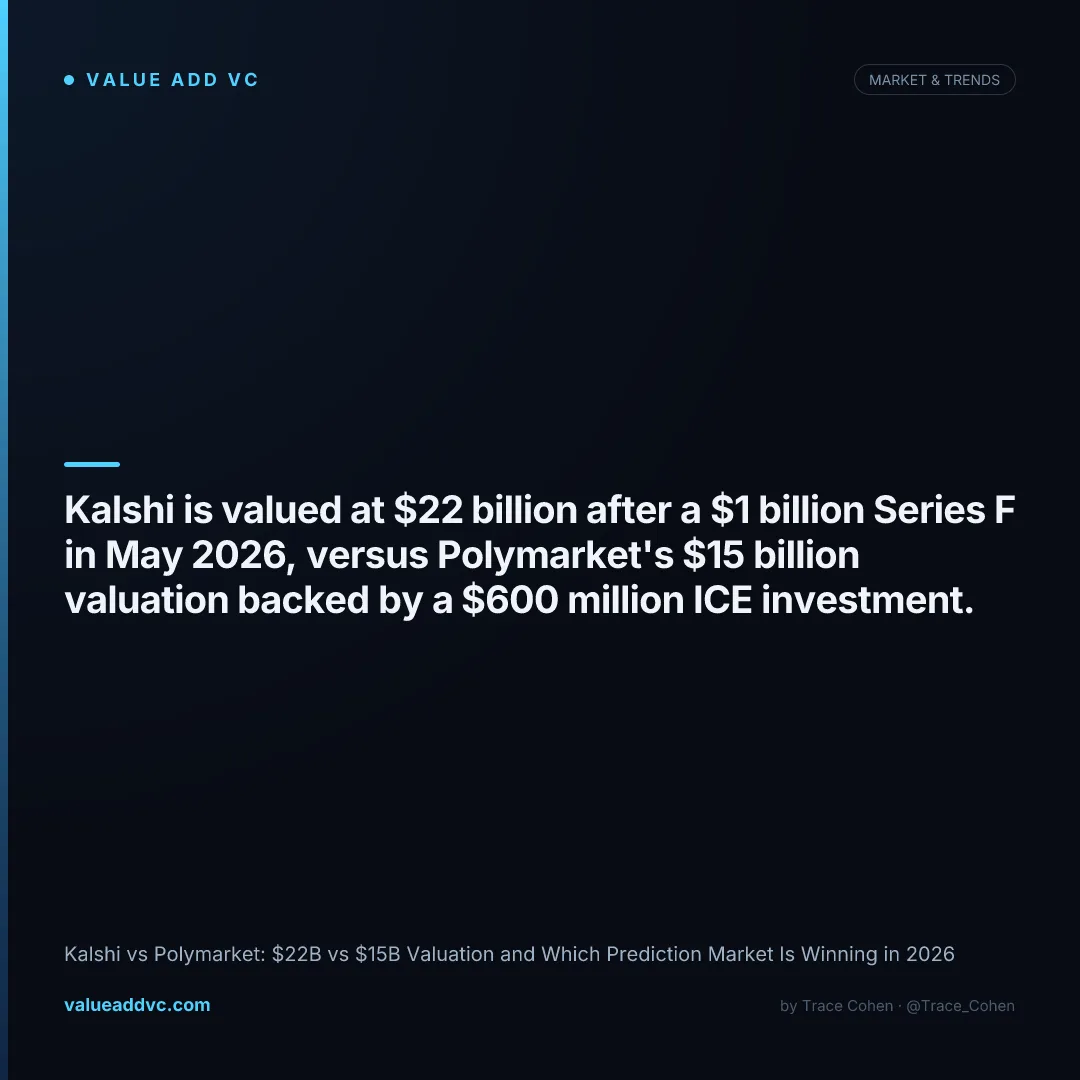
Kalshi is worth $22 billion. Polymarket is raising at $15 billion. The volume and revenue numbers don't fully agree with those valuations.
Prediction markets went from a niche crypto curiosity to a $44.8 billion-a-month category in about eighteen months, and two companies are capturing almost all of it. Kalshi has the regulatory head start, the bigger volume, and the bigger valuation. Polymarket has the global user base, a $600 million check from the parent company of the New York Stock Exchange, and a plan to close the regulatory gap. Both are now priced like the category has already been won — it hasn't.

Figures from Kalshi press releases, TechCrunch, The Block, and Bloomberg reporting as of July 2026.
Kalshi vs Polymarket: Valuation, Volume, and Funding Compared
Kalshi is valued at $22 billion after a $1 billion Series F in May 2026, led by Coatue with Sequoia, a16z, IVP, Paradigm, Morgan Stanley, and ARK Invest participating. Polymarket is in the middle of raising $400 million at a $15 billion valuation, its second major capital event in nine months after Intercontinental Exchange's initial investment and subsequent $600 million follow-on. The two companies are converging on similar prices for very different reasons — Kalshi on regulated-market dominance, Polymarket on global reach and a strategic partner with deep capital markets infrastructure.
| Metric | Kalshi | Polymarket |
|---|---|---|
| 2026 Valuation | $22B (Series F, May 2026) | $15B (seeking, mid-2026) |
| Prior valuation | $11B (Series E, Dec 2025) | ~$9B (Oct 2025, ICE deal) |
| Latest raise size | $1.0B Series F | $400M (in progress) + $600M ICE |
| Lead / anchor investor | Coatue | Intercontinental Exchange (ICE) |
| June 2026 trading volume | $31.5B | $10.8B |
| 2026 fee revenue (est.) | ~$850M | Not disclosed |
| Regulatory status | CFTC-regulated DCM | Offshore-origin, moving onshore via QCEX |
| US retail access | Full, since launch | Historically restricted, expanding |
Figures are 2026 estimates blended from company announcements, TechCrunch, The Block, Bloomberg, and Yahoo Finance reporting. Polymarket's $400M round was still in progress as of this writing; terms may change before close.
Kalshi's $22B Valuation: Inside the Series F
Kalshi raised $1 billion in a Series F closed in May 2026 at a $22 billion valuation — double the $11 billion price it commanded just five months earlier in its Series E, also a $1 billion round. That kind of back-to-back doubling on identical check sizes is unusual even by 2026 AI-cycle standards, and it's being driven by a specific catalyst: institutional demand accelerating faster than Kalshi's own revenue growth, according to the company's own funding announcement. Kalshi is reportedly already in talks for a follow-on round that could value the company near $40 billion as soon as Q3 2026, with CEO Tarek Mansour ruling out an IPO before 2027.
Polymarket's $15B Round and the ICE Bet
Polymarket's path to $15 billion runs through a very different investor than Kalshi's. Intercontinental Exchange — the parent company of the New York Stock Exchange — made an initial direct investment in Polymarket in October 2025 at a roughly $8 billion pre-investment valuation, then followed up with a $600 million direct cash investment plus additional planned purchases of Polymarket securities from existing holders. ICE isn't a typical venture investor: it runs futures exchanges, clearinghouses, and market data businesses, and its interest in Polymarket looks less like a bet on a hot startup and more like an attempt to own infrastructure in a category it thinks will eventually run through regulated exchange rails.
That's also the strategic logic behind Polymarket's 2025-2026 acquisition of QCEX, a CFTC-licensed derivatives exchange, which gives Polymarket a legal path to reopen to US retail traders under the same type of regulatory umbrella Kalshi has operated under from day one. If that transition completes cleanly, Polymarket's global brand recognition plus US market access could close the volume gap with Kalshi faster than the current $31.5B-vs-$10.8B split suggests.
Who Actually Has More Trading Volume: Kalshi or Polymarket?
Kalshi wins decisively on raw volume. Kalshi processed $31.5 billion in trading volume in June 2026, an 87.4% jump from $16.8 billion in May, driven almost entirely by World Cup sports contracts. Polymarket hit its own record of $10.8 billion in June — meaningful growth, but still less than a third of Kalshi's number. Combined, the two platforms moved $44.8 billion in a single month, up 75% from prior levels, entirely on the back of one recurring sporting event. That concentration is worth watching: both companies' 2026 growth curves are unusually dependent on a calendar of major sports events rather than steady organic adoption.
Kalshi vs Polymarket: Monthly Trading Volume, May–June 2026
Volume figures from The Block and Bitcoin.com News reporting on Kalshi and Polymarket monthly trading data, 2026.
Revenue and Market Share
Kalshi has generated roughly $1.15 billion in cumulative fee revenue since launch, with about $850 million of that landing in 2026 alone — sports contracts drove the bulk of it, with daily fee revenue reportedly topping $13 million on peak World Cup trading days. Polymarket does not disclose comparable revenue figures, in part because its fee structure and crypto-native settlement model differ meaningfully from Kalshi's regulated-exchange model. Kalshi's dominance shows up clearly in market share terms too: it held roughly 52.6% of combined 30-day prediction market volume as of March 2026, before the World Cup surge pushed its share even higher through June.
The Regulatory Gap Is the Real Story
Strip away the valuations and volume charts, and the entire Kalshi-vs-Polymarket contest comes down to one structural fact: Kalshi is a CFTC-regulated designated contract market, which means it can legally offer event contracts to any US retail trader without a workaround. Polymarket built its early user base offshore, historically blocked US IP addresses, and is now spending real capital — the ICE partnership, the QCEX acquisition — to buy its way into the same regulatory position Kalshi already occupies natively.
That gap explains the valuation premium investors are willing to pay for Kalshi relative to its trailing revenue, and it's also the single biggest swing factor for Polymarket's future value. If Polymarket completes its US regulatory transition cleanly in the next twelve months, the $15 billion price starts to look conservative relative to its global brand and crypto-native user base. If it stalls — through CFTC friction, state-level pushback, or execution risk on the QCEX integration — Kalshi's regulatory head start compounds into a durable moat that's much harder to value away.
It's worth remembering how recently this entire question was unsettled. Kalshi spent years in and out of court with state regulators over whether sports and election contracts even qualified as legal commodity derivatives, and it was CFTC clarity — not product superiority — that ultimately let it scale into a mainstream retail product. Polymarket is now effectively paying to replay that same legal and regulatory fight on a compressed timeline, using ICE's balance sheet and lobbying weight instead of years of litigation. Whether that shortcut works is the single largest unresolved variable in either company's valuation.
Kalshi has 3x the volume and a regulatory head start.
Polymarket has the New York Stock Exchange's parent company writing checks to close the gap.
The Take: Kalshi vs Polymarket in 2026
This doesn't look like a winner-take-all category the way some VCs are pricing it. Kalshi's regulatory position is real and durable, and its volume and revenue lead is not close — a 3x gap on trading volume in the same month is not a rounding error. But Polymarket's ICE partnership is a different kind of validation than a typical venture round: exchange operators don't put $600 million into a company unless they believe the underlying market structure is going to matter for a long time, and ICE has every incentive to help Polymarket clear the regulatory hurdles that currently separate it from Kalshi's US retail base.
The World Cup dependency in both companies' June numbers is the thing worth watching most closely. $44.8 billion in combined monthly volume driven substantially by one recurring sporting event is not the same as $44.8 billion in durable, diversified demand across politics, macro, entertainment, and weather markets. The next two or three quarters, without a major global sporting event propping up the totals, will tell us a lot more about which company actually built a sustainable business and which one built a very good World Cup product.
For now, Kalshi is the more defensible business at a lower relative price, and Polymarket is the higher-variance bet with a partner capable of removing its single biggest weakness. Both are being priced by investors who think prediction markets are a $200B+ category within a few years — Bernstein's own 2026 full-year volume projection sits near $240 billion — and at that scale, there's likely room for both companies to be right.
The Bottom Line on Kalshi vs Polymarket
Kalshi is valued at $22 billion on the back of $31.5 billion in June trading volume and roughly $850 million in 2026 fee revenue, built on a CFTC-regulated foundation it's held since launch. Polymarket is raising at $15 billion on $10.8 billion in June volume, backed by a $600 million strategic investment from Intercontinental Exchange and a pending acquisition designed to bring it into the same regulated US market Kalshi already dominates.
Neither valuation is crazy given a category tracking toward $240 billion in annual volume — the real question is how much of that growth stays concentrated in Kalshi versus how fast Polymarket's ICE-backed regulatory push closes the gap. Track prediction markets and other 2026 mega-rounds alongside broader startup valuation trends on our Unicorn Tracker.
See where Kalshi ranks among the highest-revenue private companies tracked in 2026.
Follow Kalshi, Polymarket, and other fintech mega-rounds on the Unicorn Tracker at Value Add VC. Reach out at t@nyvp.com or @Trace_Cohen.
Latest from the Pulse
Get VC data most people never see
— free to subscribe
Trace's notes on venture, AI and startups, a few times a week. Join 5,000+ subscribers. No spam.
No spam, unsubscribe anytime. Sent via Substack · Privacy · or subscribe on Substack ↗