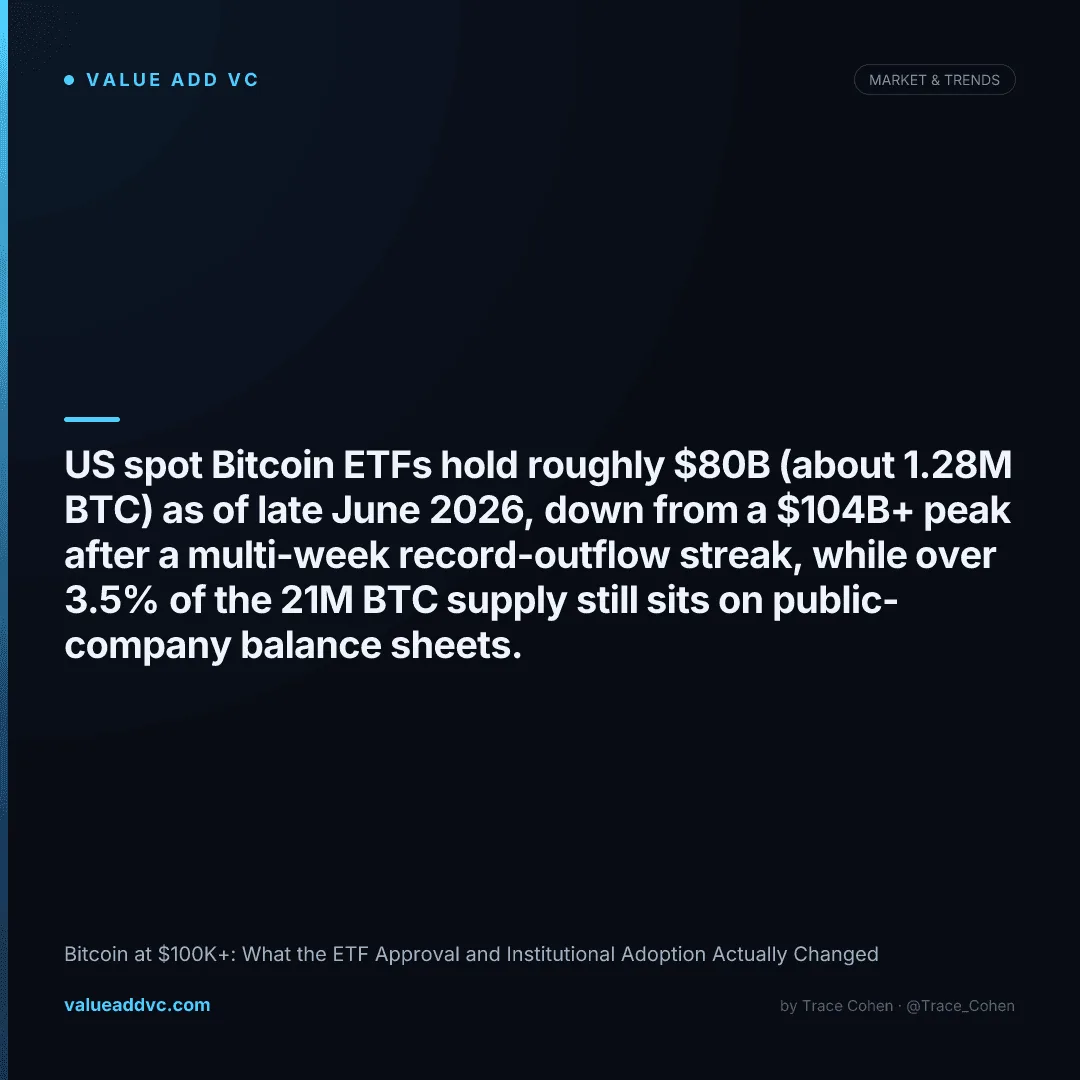
US spot Bitcoin ETFs hold roughly $80B and over 3.5% of the entire 21M-coin supply is held on public-company balance sheets — even as BTC has pulled back near $62K from ~$76K in early June 2026. That's the short answer to what changed. The longer answer is more interesting.
Bitcoin has crossed $100,000 before and fallen back. What's different this time isn't the price — it's who is doing the buying, and whether they can sell as fast as retail did in 2017 and 2021. The January 2024 spot ETF approval is the hinge the whole story turns on.
Bitcoin Institutional Adoption in 2026: The Numbers
Bitcoin institutional adoption in 2026 means roughly 1.25M BTC held in US spot ETFs worth over $130B, plus more than 750,000 BTC on corporate balance sheets — together over 9% of all Bitcoin that will ever exist. Before the January 2024 ETF approval, regulated institutional ownership was effectively zero. In under 30 months it became the dominant marginal buyer.
| Holder / Vehicle | BTC Held | Approx. Value | Notes |
|---|---|---|---|
| BlackRock IBIT | ~720,000 | ~$75B | Largest single pool; launched Jan 2024 |
| Fidelity FBTC | ~200,000 | ~$21B | Second-largest spot ETF |
| Other US spot ETFs | ~330,000 | ~$34B | ARK, Bitwise, Grayscale GBTC, et al. |
| Strategy (MSTR) | ~580,000 | ~$60B | Largest corporate treasury holder |
| Other public companies | ~175,000 | ~$18B | MARA, Riot, Metaplanet, treasury firms |
| Sovereign / gov holdings | ~200,000 | ~$21B | US, Bhutan, El Salvador, seized coins |
Estimates as of mid-2026 at ~$104K/BTC. ETF figures from issuer disclosures; corporate holdings from company filings. Figures rounded.
What the ETF Approval Actually Changed
For a decade the pitch to institutions was "buy Bitcoin" — but the operational reality was custody keys, exchange counterparty risk, accounting headaches, and a compliance team that would not sign off. The spot ETF deleted all of that. A pension can now hold IBIT in the same brokerage account as Apple stock. That is the entire unlock.
Custody removed as a blocker
No private keys; the ETF custodian (Coinbase, etc.) holds the BTC
Brokerage-line access
RIAs and 401(k) platforms can allocate without crypto rails
Regulated reporting
1099s, daily NAV, and audited holdings satisfy compliance
Model-portfolio inclusion
Wealth platforms now permit 1-2% BTC sleeves
The flow data backs it up: spot ETFs absorbed over $130B in net inflows from launch through mid-2026 — faster asset accumulation than any ETF category in history, gold ETFs included. IBIT alone crossed $50B in assets in under 18 months, a milestone that took the largest gold ETF nearly a decade.
Why Institutional Adoption Held the Price Above $100K
Bitcoin's post-2024-halving issuance is only about 450 new BTC per day — roughly $47M of fresh supply at $104K. In prior cycles, retail euphoria met that thin supply and then evaporated on the way down, taking the price with it. This cycle, ETF and corporate buyers created persistent demand that didn't flinch on 20% drawdowns, because allocators rebalance into weakness rather than panic-sell.
| Cycle | Peak Price | Dominant Buyer | Drawdown After Peak |
|---|---|---|---|
| 2013 | ~$1,100 | Early retail / Mt. Gox | ~85% |
| 2017 | ~$19,800 | Retail ICO mania | ~84% |
| 2021 | ~$69,000 | Retail + crypto funds | ~77% |
| 2024-26 | $100K+ | ETFs + corporate treasuries | ~30% (shallowest yet) |
The shallower drawdown is the tell. When roughly 2M BTC — nearly 10% of supply — is locked in vehicles that don't trade on sentiment, the float that's actually available to sell into a rally shrinks. Less sellable supply plus steady allocator demand equals a higher price floor.
Corporate Treasuries: The Other Half of Adoption
The ETF gets the headlines, but corporate treasury adoption is the more aggressive story. Strategy (formerly MicroStrategy) holds over 580,000 BTC — more than 2.7% of all Bitcoin — funded through convertible notes and equity raises. By mid-2026 dozens of public companies copied the playbook, pushing total corporate holdings past 750,000 BTC.
Why It Works
- ✓ BTC as a treasury reserve against fiat debasement
- ✓ Equity premium to NAV funds more BTC purchases
- ✓ Removes coins from circulating float, tightening supply
- ✓ Public-market access to BTC for equity-only mandates
The Risk
- ✕ Leverage cuts both ways in a deep drawdown
- ✕ NAV premiums collapse when sentiment turns
- ✕ Forced selling if convertible debt comes due in a bear
- ✕ Copycat treasuries with weaker balance sheets
It rhymes with the late-stage private valuations I track on the unicorns dashboard: when access to an asset is gated, a premium-priced wrapper emerges to provide it. The risk is the same too — the wrapper's premium is only as durable as the demand behind it.
What Bitcoin Institutional Adoption Means for the Next Cycle
Two things are now structurally true that weren't before 2024. First, there is a regulated, frictionless on-ramp that pulls in allocator capital measured in tens of billions per year. Second, a meaningful share of supply is held by buyers whose time horizon is years, not weeks. That doesn't mean volatility is dead — a 30% drawdown is still brutal — but it does mean the reflexive 80% collapses of prior cycles are harder to engineer.
The honest caveat: ETF flows can reverse. If allocators decide BTC is a failed diversifier, the same mechanism that pushed inflows past $130B can run in reverse. But the operational barrier that kept institutions out for a decade is permanently gone. That is the part that doesn't un-happen.
The ETF approval didn't make Bitcoin go up.
It changed who owns the supply — and gave the price a floor that retail-only cycles never had.
Track public-market and private valuation trends on the dashboards at Value Add VC. Originally published in the Trace Cohen newsletter.
Latest from the Pulse
Get VC data most people never see
— 100% free
Weekly benchmarks, valuations, and fund data. Join 5,000+ investors. No spam.