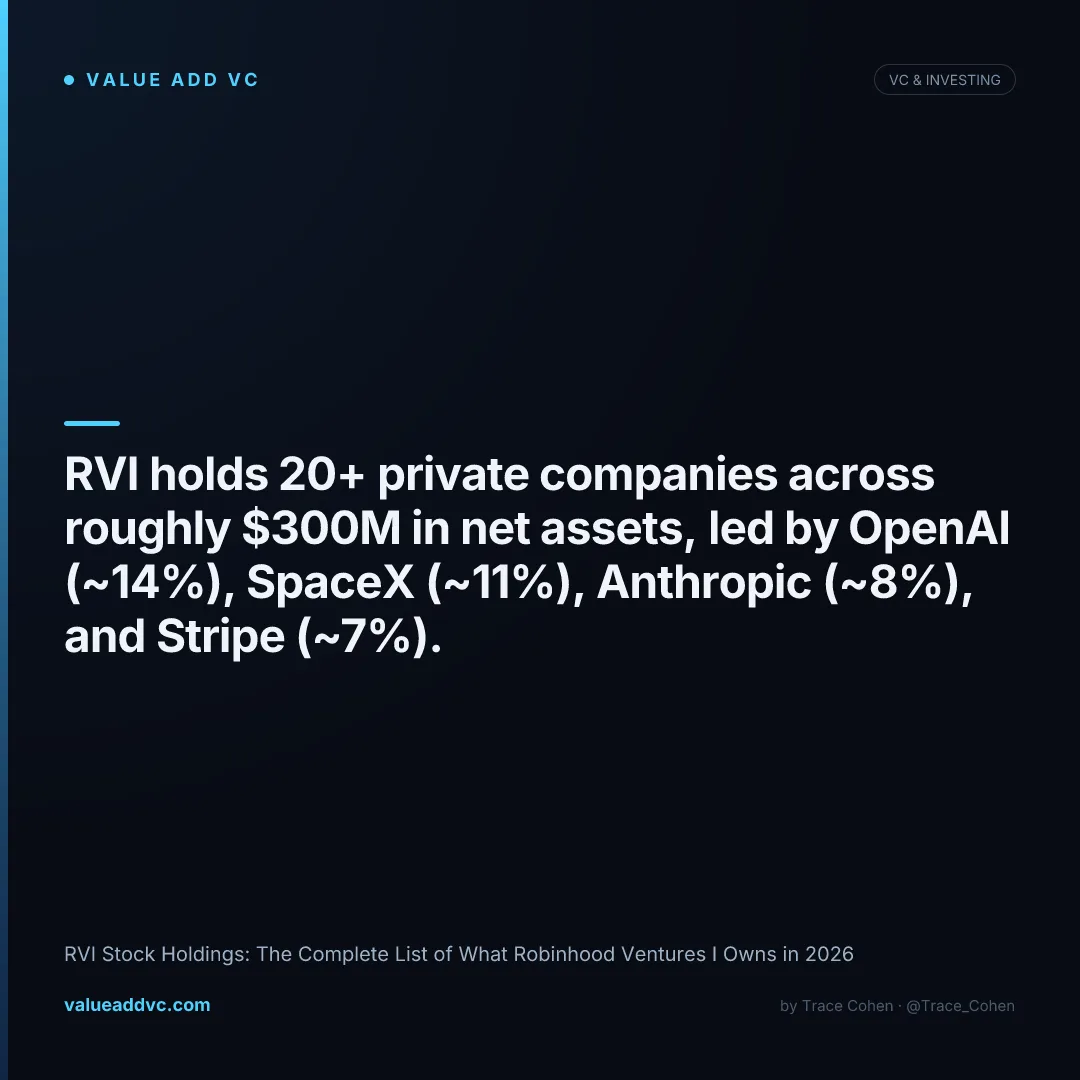
RVI holds 14 positions across $655.30M in assets, led by Databricks (12.71%) and OpenAI (11.00%), with Stripe at 4.33% and SpaceX down to 1.25% after its June IPO. The largest single line, though, is cash — 31.77% of the fund — and that is worth unpacking.
Robinhood Ventures Fund I gives retail investors something they could never buy before: a single ticker that holds equity in the most valuable private tech companies on earth. But "holdings" in a private-market fund work nothing like an S&P 500 ETF — the positions are illiquid, marked quarterly, and far more concentrated than most buyers realize.
RVI Stock Holdings: The Complete List for 2026
RVI's stock holdings are private, venture-stage companies — not public equities — with Databricks (12.71%), OpenAI (11.00%), Stripe (4.33%), and SpaceX (1.25%) as the largest named positions. The top 10 names make up roughly 70% of the fund's ~$655M net asset value, so a handful of frontier-AI and aerospace companies drive nearly all of RVI's returns — we go deeper on what that OpenAI position is actually worth.
| Company | Sector | Est. Weight |
|---|---|---|
| Cash & equivalents | Cash | 31.77% |
| Databricks | AI / Data Infrastructure | 12.71% |
| OpenAI | AI / Foundation Models | 11.00% |
| Stripe | Fintech / Payments | 4.33% |
| SpaceX | Aerospace / Satellite | 1.25% |
| Other positions (10) | Various | ~38.9% |
Estimated weights based on Robinhood's most recent shareholder disclosures and secondary-market marks as of mid-2026. Exact figures move between quarterly filings; see "How to verify" below.
What Kind of Holdings Are Inside RVI?
This is the part most retail buyers miss. When you buy 1 share of an S&P 500 ETF, you own a sliver of 500 freely-traded public companies whose prices update every second. RVI is the opposite: it holds private equity stakes acquired through secondary transactions, and those positions are marked to fair value — usually pegged to each company's last primary funding round — rather than traded continuously.
That has three consequences worth internalizing:
Stale marks
OpenAI's ~$500B mark only changes when a new round prices it. NAV can lag reality by months in either direction.
Lumpy moves
A single down-round at one top-3 holding can move RVI's NAV by 3–5% in a quarter.
No daily liquidity at the asset level
RVI trades on the NYSE, but the underlying stakes don't. The fund itself is the only liquidity.
How Concentrated Are RVI's Stock Holdings?
Extremely. The concentration is the single most important fact about RVI's holdings and the one least reflected in how people talk about it. Here is the rough breakdown of where the ~$655M sits:
| Slice of the fund | Share of NAV |
|---|---|
| Cash & equivalents | 31.77% |
| Top 5 holdings | ~46% |
| Top 10 holdings | ~70% |
| AI-related companies | ~45% |
| Stripe | 4.33% |
| Cash & equivalents | ~5% |
If you believe frontier AI keeps compounding, that concentration is a feature. If you wanted a diversified basket of 20 private companies, understand that ~30% of the portfolio is doing almost none of the heavy lifting. You can compare these private marks against public-market AI comparables on our AI Valuations dashboard.
The Cost of Owning These Holdings
Access isn't free. RVI charges a 2.5% management fee on net assets — roughly $7.5M a year on a $300M fund. That is an order of magnitude more than a 0.03% S&P 500 ETF and even pricier than ARKK's 0.75%. The justification is real (sourcing and pricing private secondaries is genuinely hard work), but the fee compounds against you every year you hold.
There's a second, sneakier cost: the NAV premium. Because closed-end funds trade on supply and demand, RVI's share price has at times sat above the underlying value of its holdings. Paying a 10% premium for a portfolio of OpenAI and SpaceX stakes means you're already 10% in the hole versus the marks. We track that gap in detail in our breakdown of RVI's NAV premium and discount history — though the gap hasn't only run one direction, and the fund has briefly dipped below net asset value too.
How to Verify the Official RVI Holdings List
Any holdings list you read online — including this one — is an estimate between filings. The authoritative source is the SEC. Here is exactly where to look:
RVI is not a diversified tech index. It's a concentrated bet on a dozen frontier names wrapped in a 2.5% fee.
Check the current disclosure before you buy. With 31.77% in cash and SpaceX down to 1.25%, the exposure on offer is not the one this fund is usually described as providing.
Track RVI's holdings, NAV, and premium on the Robinhood RVI Fund dashboard at Value Add VC. Originally published in the Trace Cohen newsletter. Holdings figures are estimates based on public disclosures and are not investment advice.
Latest from the Pulse
Get VC data most people never see
— 100% free
Weekly benchmarks, valuations, and fund data. Join 5,000+ investors. No spam.