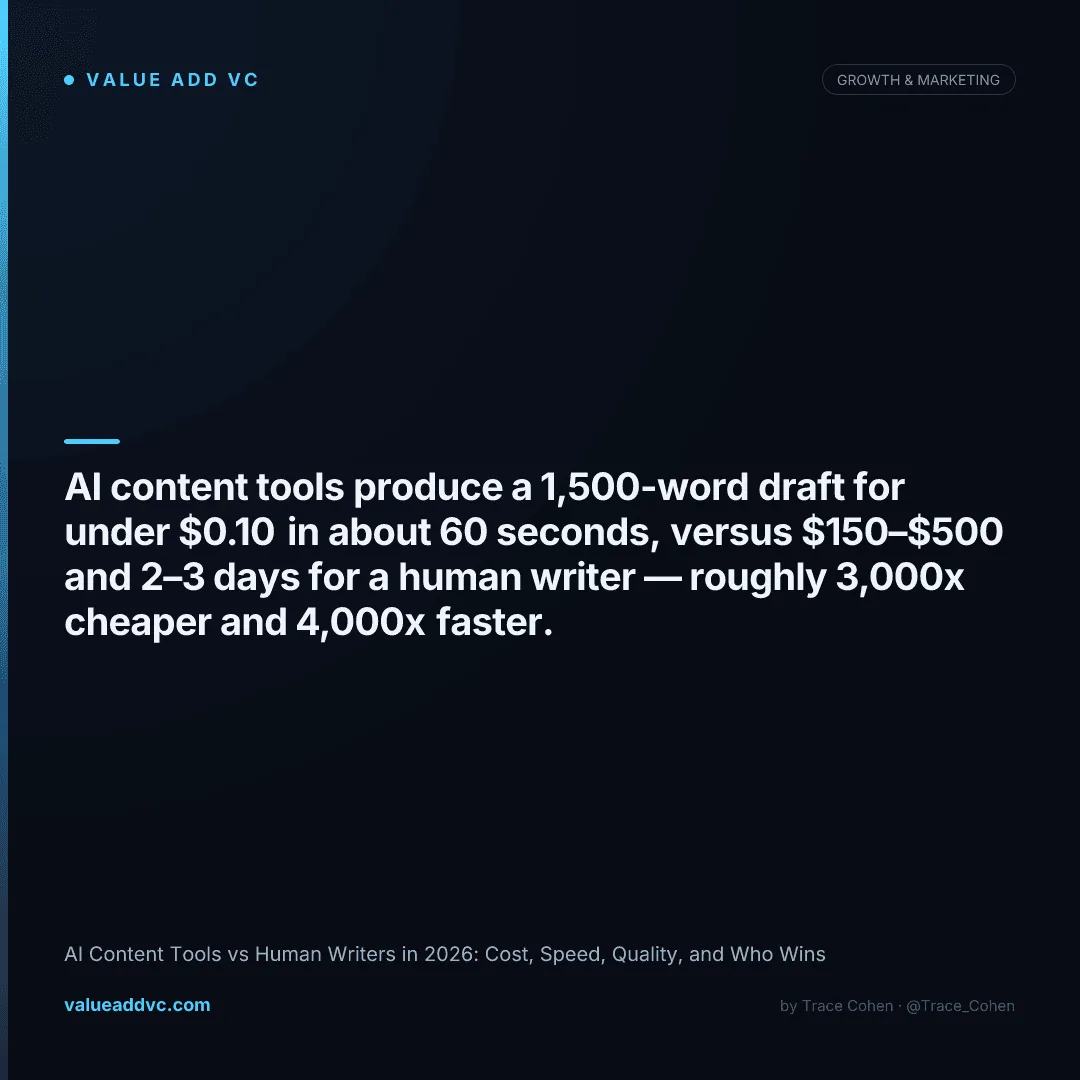
AI content tools draft a 1,500-word article for under $0.10 in about 60 seconds; a human writer costs $150–$500 and takes 2–3 days. But the cost gap is so extreme it has stopped being the interesting question.
I publish content daily across a 500-page SEO engine, and I still pay human writers every month. That isn't nostalgia — it's economics. By 2026 the real debate isn't "AI or human," it's "which 70% do I automate, and which 30% do I refuse to." This is the honest market breakdown, with the actual numbers behind it.
AI Content Tools vs Human Writers: The Side-by-Side Comparison
AI content tools beat human writers on cost, speed, and scale by orders of magnitude, while human writers beat AI on originality, accuracy, voice, and trust. AI produces a 1,500-word draft for under $0.10 in 60 seconds versus $150–$500 and 2–3 days for a human. Neither wins outright — each dominates a different column, which is why the market has converged on hybrid.
| Attribute | AI Content Tools | Human Writers |
|---|---|---|
| Cost per 1,500-word article | Under $0.10 (API) / ~$49–$125 mo seat | $150–$500 ($0.10–$0.33/word) |
| Turnaround time | ~60 seconds | 2–3 days typical |
| Output at scale (1,000 articles) | ~$100, days | ~$300,000, months |
| Original reporting / interviews | Cannot do it | Core strength |
| Factual accuracy | Hallucinates ~3–10% of claims | Accountable, verifiable |
| Brand voice consistency | Generic without heavy prompting | Distinctive, native |
| E-E-A-T / trust signals | Weak (no lived experience) | Strong (real expertise) |
| Best use case | Volume SEO, drafts, descriptions | Thought leadership, regulated content |
Where AI Content Tools Win Decisively
The AI content market is no longer a novelty. Jasper crossed an estimated $90M+ in ARR, Copy.ai and Writesonic each serve millions of users, and the underlying model cost has collapsed — generating a long article via API now costs cents because frontier-model token prices have fallen more than 90% since 2023. On three dimensions, AI isn't competitive with humans; it's in a different universe.
~3,000x
Cheaper
$0.10 vs $300 per long-form article
~4,000x
Faster
60 seconds vs 2–3 days
Unlimited
Scale
1,000 articles for ~$100, no hiring
For high-volume, low-differentiation content — product descriptions, meta tags, FAQ pages, programmatic location pages, first drafts of explainer posts — AI is the obvious answer. I built my own 500-page SEO engine on exactly this principle: the marginal cost of one more page approaches zero, so the question becomes distribution, not production. When production is free, you stop rationing it.
Where Human Writers Still Win in 2026
Human writers still win in 2026 on anything that requires original experience, accountability, or a distinctive point of view — exactly the signals Google's E-E-A-T framework rewards and that AI structurally cannot fake. AI models predict the most probable next token; they have never interviewed a founder, sat in a board meeting, or staked a reputation on a take. That gap shows up in four categories.
Humans Still Own This
- ✓ Original reporting, interviews, and proprietary data
- ✓ Contrarian opinion and thought leadership
- ✓ Regulated content (legal, medical, financial advice)
- ✓ Brand voice that a competitor can't replicate
Where Pure AI Fails
- ✕ Hallucinated stats and fake citations (3–10% of claims)
- ✕ Generic "in today's fast-paced world" filler
- ✕ No accountability when something is wrong
- ✕ Saturation — everyone has the same tool and prompts
There's also a market signal worth watching: as AI floods the open web with commodity content, the premium on verifiably human, expert content is rising. The same dynamic showing up in AI search — where engines cite sources rather than list links — rewards content with a real author, a real opinion, and real numbers. Scarcity is shifting from production to credibility.
The Hybrid Workflow That Beats Both
The winning 2026 model isn't AI content tools vs human writers — it's AI drafts plus human editing, which cuts cost per article 60–80% versus all-human while keeping the trust signals pure AI lacks. More than 80% of scaled content teams now run some version of this stack. Here's how the labor actually splits.
Generate structure, headers, and SEO scaffolding in seconds
Produce the full 1,500-word draft for under $0.10
Add proprietary numbers, quotes, and first-hand experience
Catch hallucinations, fix the 3–10% of claims AI gets wrong
Strip filler, inject the take only your brand would have
Auto-generate social, email, and meta variants at scale
The math is decisive. An all-human article costs ~$300 and takes 3 days. A pure-AI article costs $0.10 but ranks poorly and erodes trust. The hybrid costs roughly $60–$120 (one editor hour plus AI), ships same-day, and carries the E-E-A-T signals that actually rank. You don't pick a side — you assign each side the work it's 3,000x better at. For the distribution step, email platforms like Campaign Monitor make it easy to repurpose the finished article into a newsletter sequence at scale.
The Verdict: Who Wins AI Content Tools vs Human Writers
If you force a single winner for 2026, it's AI content tools — but only as a production layer, never as the finished product. AI has permanently won the cost and speed war; no human can compete at $0.10 and 60 seconds. But AI has structurally lost the trust war, and trust is what converts and what ranks. The defensible content strategy uses AI to make production free and humans to make it credible.
For founders and marketers, the practical takeaway: automate the 70% that's commodity, and reinvest the savings into the 30% that's irreplaceably human. See how AI is reshaping startup hiring trends. The teams losing in 2026 are the ones that picked a pure side — either drowning in undifferentiated AI sludge or paying $300 an article to hand-write content a model could have drafted in a minute. Track how this reshapes the broader AI tooling market and software multiples on the SaaS Valuations dashboard.
AI made content production free. That didn't make content valuable.
The winners use AI to draft the 70% that's commodity — and humans to own the 30% that competitors can't copy.
Explore AI tooling trends on the AI Landscape Dashboard at Value Add VC. Originally published in the Trace Cohen newsletter.
Latest from the Pulse
Get VC data most people never see
— 100% free
Weekly benchmarks, valuations, and fund data. Join 5,000+ investors. No spam.