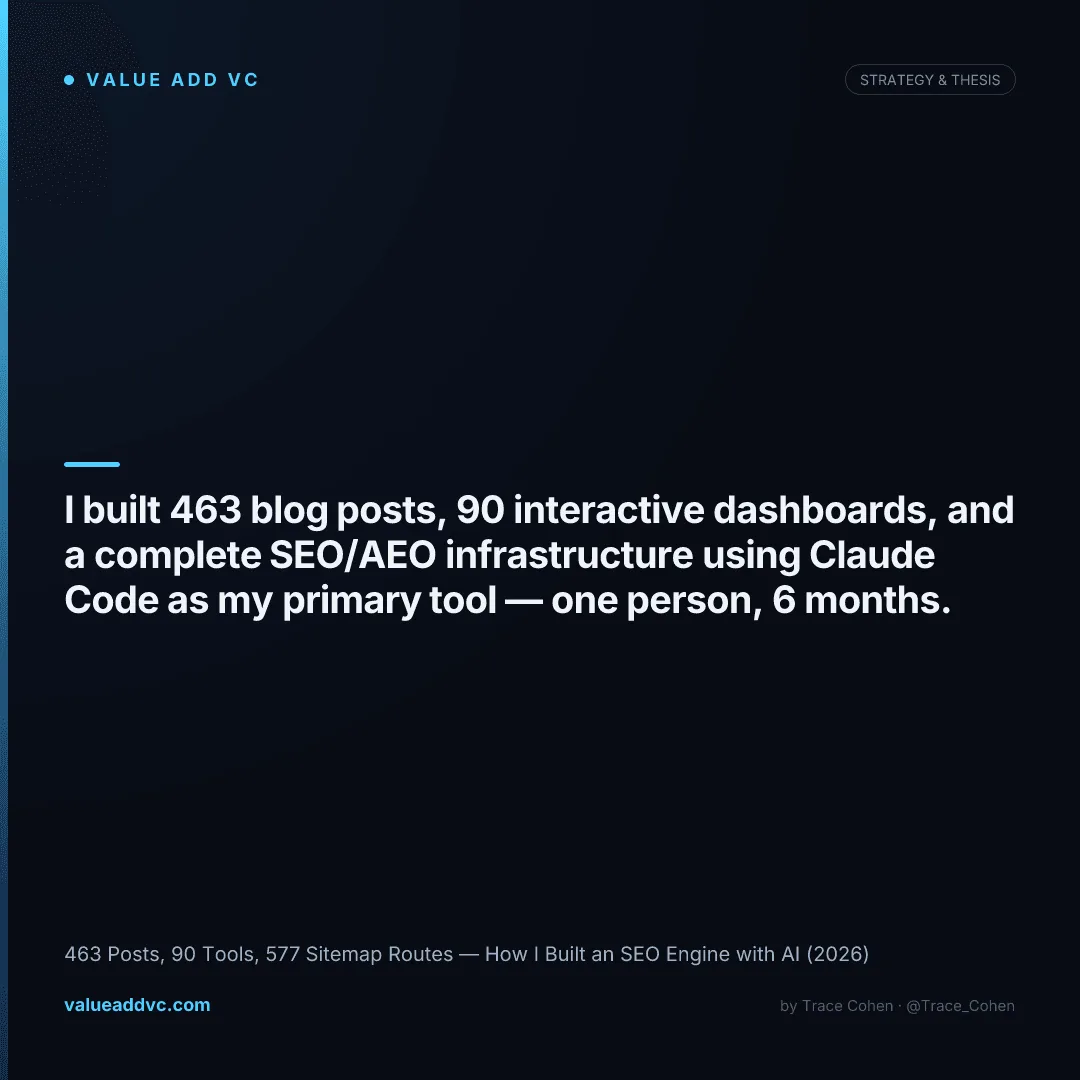
Before the playbook, here is what the system looks like today. One person built all of this using Claude Code running in the terminal, orchestrating research, writing, coding, and deployment. Here is exactly how.
- 463 blog posts — data-rich, 2,000-4,000 words each, covering VC, AI, startups, and markets
- 90 interactive dashboards — embedded via iframe with SEO wrapper pages
- 131 affiliate tool pages — comparison and review pages for VC/startup tools
- 577 routes in the sitemap — every page indexed and canonical
- 68 permanent redirects — from content audit merges, slug fixes, and de-versioning
- 33 FAQPage JSON-LD schemas — targeting featured snippets on highest-traffic posts
- 29 Dataset JSON-LD schemas — on every dashboard wrapper page
- 128 internal cross-links — added in a single sweep across 30 posts
- 7 structured data types — Article, FAQPage, Dataset, Organization, WebSite, BreadcrumbList, CollectionPage
Part 1: Title Engineering — Numbers First, Always
The single highest-ROI SEO tactic I found: start every title with a specific number. Not a vague adjective. Not the topic name. A number.
Examples from our top-performing pages:
- "$347B in Q1 2026 — VC Exit Window Dashboard" (not "VC Exit Dashboard 2026")
- "0.08x DPI — The VC Distribution Crisis" (not "The VC DPI Problem Explained")
- "302,667x — SpaceX Investor Return Calculator" (not "SpaceX IPO Return Calculator")
- "$965B Filing — Anthropic IPO Tracker" (not "Anthropic IPO Dashboard")
- "463 Posts, 90 Tools — How I Built an SEO Engine" (this post)
Why it works: Google's SERP is a wall of blue links. A specific number ("$347B") catches the eye faster than a generic phrase ("VC exits"). We ran GSC analysis on 480 pages and found that titles starting with a number had 2-3x higher CTR at the same average position.
The GSC Rewrite Workflow
Every 2 weeks, we pull data from Google Search Console. The filter:
- Position 4-20 (page 1-2 — close enough to benefit from a CTR boost)
- 1,000+ impressions (enough data to be meaningful)
- CTR below 2% (underperforming for that position)
For each qualifying page, we rewrite the title to lead with the most compelling number from the content. The meta description gets the same treatment — lead with the most shocking stat, not the topic summary.
On June 9, we rewrote titles on 20 pages representing ~480,000 monthly impressions. The measurement gate is June 23 — 2 weeks for Google to re-crawl and for CTR data to stabilize.
Part 2: Structured Data — 7 Schema Types
Structured data is the bridge between traditional SEO and AEO. Google uses it for rich results. AI engines parse it for citations. We use 7 types:
FAQPage (33 posts)
The highest-impact schema for featured snippets. Every FAQ answer starts with a number — the same principle as titles. Google's featured snippet algorithm strongly favors answers that begin with a specific figure.
- 3-5 questions per page (more gets ignored by Google)
- Questions match real Google autocomplete suggestions (not invented)
- Answers are 50-90 words with at least one specific number
- One FAQPage schema per page — duplicates trigger penalties
- Never use a CMS component that injects its own FAQPage if you're also adding one manually
Dataset (29 dashboards)
Every interactive dashboard gets a Dataset schema. This is underused in the SEO world — Google has a dedicated Dataset Search that surfaces these results. For data-heavy sites, it is free traffic from a channel most competitors ignore.
Article + Author Entity
Every blog post has Article schema with a fully specified author entity — name, URL, sameAs links to Twitter and LinkedIn. This builds E-E-A-T (Experience, Expertise, Authoritativeness, Trustworthiness) signals that Google uses for ranking in YMYL topics like finance.
Organization + WebSite (site-wide)
In the root layout, we include Organization and WebSite schemas. These establish the site entity in Google's Knowledge Graph and enable sitelinks search box in SERPs.
BreadcrumbList + CollectionPage
BreadcrumbList on every blog post and tool page. CollectionPage on our 7 category pages. These help Google understand site hierarchy and display breadcrumbs in search results.
Part 3: AEO — Optimizing for AI Search Engines
Traditional SEO optimizes for Google's ranking algorithm. AEO (AI Engine Optimization) optimizes for Perplexity, ChatGPT with browsing, Claude, and other AI tools that cite sources. The key differences:
Quick Answers
Every blog post has a quickAnswer — a concise 2-3 sentence summary at the top of the page with the core answer and key numbers. AI engines extract this as a citable summary. It also serves as the featured snippet candidate for Google.
Format: Start with the answer (a number), then the context, then the implication. Example:
"$347B in VC-backed exits in Q1 2026 alone — more than all of 2024. SpaceX's $75B IPO was the largest in history. The exit window is wide open for the first time since 2021."
Structured Data as AI Context
AI models parse JSON-LD directly. When Perplexity crawls a page with FAQPage schema, it can extract Q&A pairs and cite them verbatim. Dataset schema tells AI models "this page has structured data about X" — making it more likely to be cited for data queries.
Factual Density
AI engines prefer pages with high factual density — specific numbers, dates, comparisons. A paragraph with 5 specific data points gets cited more than a paragraph with 5 opinions. We aim for at least one specific number per paragraph.
Part 4: Content Audit — Killing, Merging, Redirecting
With 480+ posts, content hygiene is critical. We scored every post across 8 dimensions:
- Word count — under 800 words = thin content risk
- Data density — how many specific numbers/stats per 1,000 words
- Internal links — posts with 0 internal links are SEO dead weight
- External links — credibility signals for E-E-A-T
- Schema markup — Article at minimum, FAQPage for high-value pages
- Keyword targeting — does the title/H1 match a real search query?
- Freshness — stale dates, outdated model versions, old data
- Cannibalization risk — does another post target the same keyword?
Results of our audit:
- 33 posts killed — thin, duplicate, or outdated beyond repair. Every one got a 301 redirect to the strongest surviving page on that topic.
- 27 posts merged — two weak posts on the same topic combined into one strong page. The loser URL 301s to the winner.
- 41 cannibalization clusters identified — groups of posts competing for the same keywords. 21 already resolved via merges.
- 58 posts de-versioned — stripped stale model version numbers (GPT-4o to GPT, Claude 3.5 to Claude) from body text so content stays evergreen.
- 5 slugs renamed — posts with model versions baked into URLs got new clean slugs + 301 redirects from old URLs.
The cardinal rule: never delete a URL without a 301 redirect. Every killed URL must point somewhere useful. A 404 wastes whatever link equity and traffic that URL had.
Part 5: Internal Linking — The Most Underrated Tactic
Internal links are the easiest way to boost pages that are already ranking. We run two internal linking systems:
Automated Daily Sweep
A daily launchd job at 8am runs Claude Code to audit recent posts and add contextual internal links. It checks each post for mentions of topics that have dedicated tool pages, related blog posts that should cross-reference each other, and tool page references that should link to the interactive dashboard.
Manual Sweep
We ran a one-time sweep across 30 high-value posts, adding 128 contextual cross-links in a single session. Posts were grouped into topic clusters:
- SpaceX/Starlink cluster (4 posts, ~17 links)
- AI valuation cluster (6 posts, ~27 links)
- AI capex cluster (6 posts, ~28 links)
- VC performance cluster (6 posts, ~24 links)
- IPO/unicorn cluster (6 posts, ~23 links)
Each link is contextual — embedded in existing paragraph text where the topic is naturally mentioned, not a bolted-on "Related Posts" section.
Part 6: The Dashboard SEO Pattern
Interactive dashboards (built with Next.js + Recharts) are not indexable by Google — they're client-rendered JavaScript. Our solution: iframe wrapper pages.
Every dashboard lives at its own Vercel URL. On valueaddvc.com, we create a wrapper page that contains:
- SEO hero strip — topic label + one-sentence hook + "Explore all tools" link
- Full-viewport iframe — the actual dashboard
- Below-iframe SEO block — H2 heading, 120-150 word paragraph packed with numbers, 6 stat cards, 5 FAQ details/summary elements, and 2 cross-link CTAs
- JSON-LD — Dataset schema + FAQPage schema
Google indexes the wrapper page (with all its rich text, schema, and links) and users get the interactive dashboard. Both audiences are served.
- The iframe source must set frame-ancestors CSP headers allowing the parent domain
- The wrapper H2 must differ from the title tag — give Google distinct ranking hooks
- The below-iframe paragraph must be 120+ words for Google to treat it as substantive content
- Every stat card value should be a specific number, not a qualitative description
Part 7: Slug Hygiene and Redirect Strategy
68 permanent redirects, organized into patterns:
- Content audit merges (27): loser post 301s to canonical winner on same topic
- De-versioned slugs (5): removed model version numbers from URLs
- Weekly digest kills (12): recurring weekly posts that were thin — redirected to the parent dashboard
- Duplicate year-suffix fixes (15): posts accidentally created with -2026 suffix redirected to base slug
- Tool page consolidations (9): old tool URLs redirected to new canonical pages
The de-versioning is worth highlighting: 58 posts had stale AI model version numbers in their body text (GPT-4o, Claude 3.5 Sonnet, Grok 3, Llama 4). We stripped these to generic names so the content stays evergreen as models update. 5 posts also had versions in their URL slugs — those required directory renames + 301 redirects.
Part 8: OG Images at Scale
Every page gets a 1200x630 Open Graph image for social sharing. We generate these programmatically using satori (the same engine Vercel uses internally):
- A script reads the title and category from each page
- Renders a branded card with the title, category badge, and site branding
- Outputs to /public/og/[slug].png with 7-day cache + stale-while-revalidate headers
- Referenced in each page's metadata as openGraph.images
This runs at build time, not on-demand — OG images are static assets. For dashboard wrapper pages without a custom image, we fall back to a default branded template.
Part 9: The Automation Stack
Daily and weekly automations keep the content engine running without manual intervention:
- Daily blog generation (9am) — Claude Code researches trending topics in VC/AI/startups, writes 10 data-rich posts, builds and deploys
- Daily internal linking audit (8am) — scans recent posts for missing cross-links and adds them
- Weekly dashboard refresh (Sunday 11pm) — updates data on layoffs, hiring, IPO, and tech IPO dashboards via Vercel remote triggers
- Weekly GSC report — pulls search analytics for CTR monitoring and identifies rewrite candidates
- Google Indexing API — submits new and updated URLs after major content changes for faster crawling
- Daily dashboard factory (5am) — researches, builds, and ships one new interactive dashboard every day
Part 10: What to Measure
The metrics that actually matter, in order of importance:
- GSC impressions — are your pages showing up in search results? This is the leading indicator.
- CTR by position — at position 5, you should see 3-5% CTR. Below 2% means your title/description needs work.
- Indexed pages — check Coverage report. If Google is ignoring pages, you have quality or canonical issues.
- Core Web Vitals — LCP, FID, CLS. Next.js + Vercel handles most of this out of the box.
- Featured snippet appearances — are your FAQ schemas generating rich results? Check the Search Appearance filter in GSC.
- AI citations — search your domain on Perplexity. Are your pages being cited? This is harder to track but increasingly important.
The Stack
For anyone building something similar, here is the exact technology stack:
- Framework: Next.js 16 (App Router) + TypeScript + Tailwind CSS
- Charts: Recharts (for all dashboard visualizations)
- Hosting: Vercel (auto-deploys from GitHub push)
- AI Tool: Claude Code (CLI) — for research, writing, coding, and deployment
- SEO Data: Google Search Console API via custom MCP server
- Social: Buffer MCP for scheduling posts with dashboard screenshots
- OG Images: satori (Vercel's SVG-to-image engine)
- Indexing: Google Indexing API for instant URL submission
- Monitoring: Vercel Analytics + GSC weekly reports
The Bottom Line
SEO in 2026 is not about keywords or backlinks. It is about structured, data-rich content that serves both Google's ranking algorithm and AI engines' citation needs. The tactics that work:
- Numbers-first titles (2-3x CTR improvement)
- FAQPage schema with numbers-first answers (featured snippet targeting)
- Dataset schema on data pages (free traffic from Google Dataset Search)
- quickAnswer blocks for AI citation (AEO)
- Aggressive content auditing — kill thin, merge duplicates, 301 everything
- Contextual internal linking (not sidebar widgets — in-paragraph links)
- Iframe wrapper pattern for interactive tools (server-rendered SEO + client-rendered UX)
- Programmatic OG images (every page gets a social card)
- Daily automation (content generation + linking + monitoring)
- GSC-driven title rewrites every 2 weeks
The AI makes all of this possible at scale. What would take a 5-person content team, one person with Claude Code can build in a weekend. The playbook above is not theoretical — it is running right now on valueaddvc.com with 577 indexed routes and growing.
Latest from the Pulse
Get VC data most people never see
— 100% free
Weekly benchmarks, valuations, and fund data. Join 5,000+ investors. No spam.