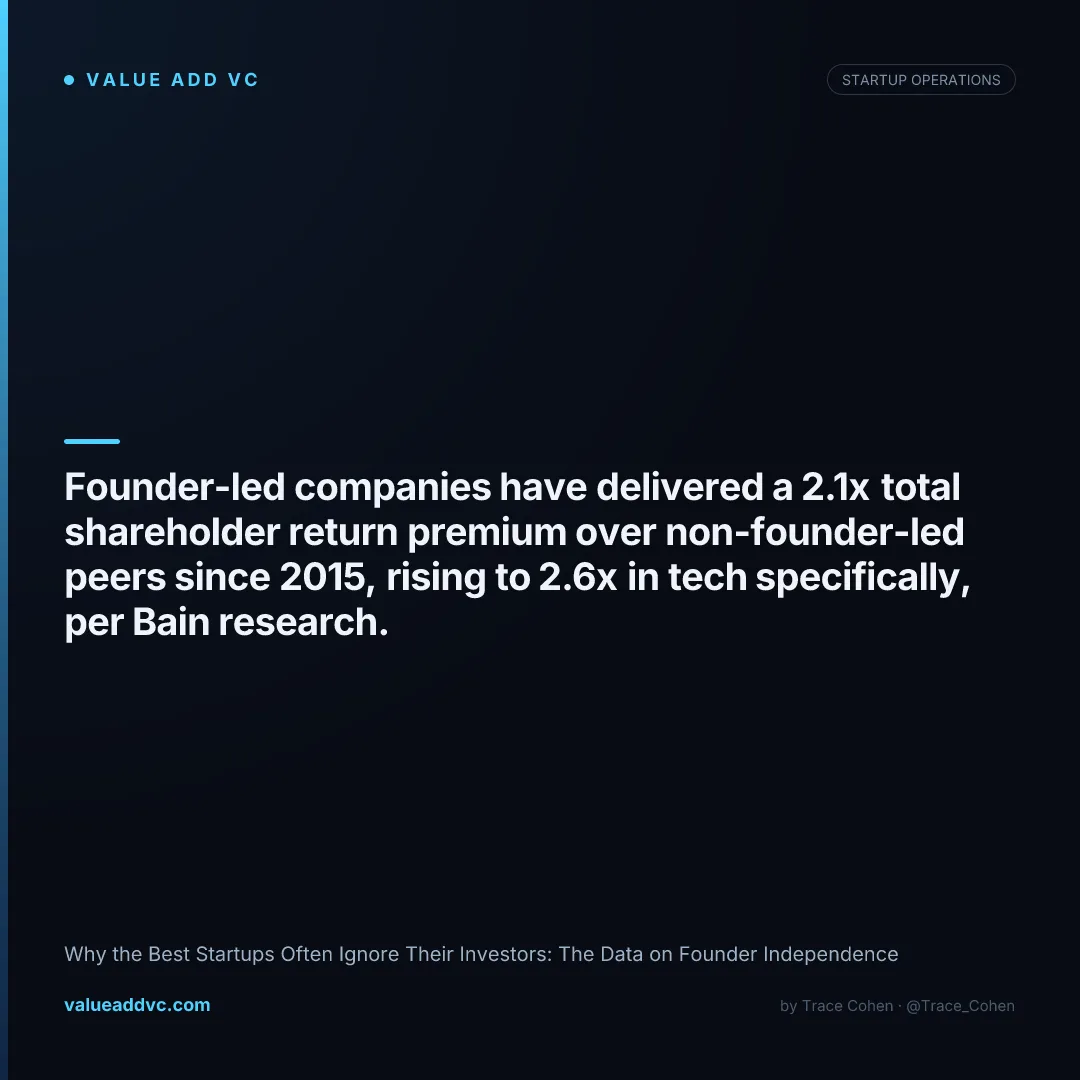
Founder-led companies have outperformed non-founder-led peers by 2.1x on total shareholder return since 2015 — and in tech specifically, that premium widens to 2.6x, according to Bain research. That's the short answer. The longer answer is that the founders posting those numbers are usually the same ones who kept enough board and voting control to ignore advice they didn't agree with.
Every founder eventually gets a piece of investor advice that feels wrong — pivot faster, hire a "real" VP of Sales, cut the roadmap in half. Some founders take it. The ones who build category-defining companies frequently don't, and the data on board control, dual-class shares, and CEO replacement explains exactly how they get away with it.
Figures blended from Bain & Company total shareholder return research (companies founder-led since 2015), Ziller Funds Management long-run founder-led performance data, and venture governance research on founder CEO replacement rates among tech unicorns.
Founder independence and investor advice: what the data actually shows
Founder independence from investor advice correlates with outperformance: founder-led companies have delivered 2.1x the total shareholder return of non-founder-led peers since 2015, and 2.6x in tech, per Bain & Company research. Separately, Ziller Funds Management found founder-led companies grew roughly 10x in value between 2006 and 2026, beating the MSCI All Country World Index by 3.3% per annum over two decades.
None of this means investor advice is worthless — it means the founders who compound the hardest tend to be the ones who filter that advice through their own judgment rather than defaulting to it. Bain's own framing is careful here: simply being founder-run doesn't guarantee better management than a professional CEO would deliver. What the data actually supports is narrower — founders who combine conviction with enough structural control to act on it outperform founders who don't have that option in the first place.
The board control timeline: how much power investors actually get
Board seats, not equity ownership, determine who actually controls a startup — a founder can own 60% of the cap table and still get outvoted by a board where investors hold the majority of seats. Founders typically retain every board seat through the seed stage and give early investors observer rights instead of a vote. By Series A, the industry-standard structure has become a five-person board: two founders, two investors, and one independent director.
That balance shifts fast. By Series B, boards commonly expand to six seats with investors holding three. By Series C, it's not unusual to see seven directors, with investors controlling three or more of those seats — enough, combined with one swing independent vote, to outvote the founders who still run daily operations and often still hold the largest single equity stake.
This is also where portfolio-level VC incentives matter: an individual board member is optimizing for that one fund's return profile and timeline, which doesn't always match what's best for the specific company sitting in front of them.
Dual-class shares: the legal tool behind founder independence from investor control
Board seats aren't the only lever. A dual-class share structure issues two or more classes of stock with different voting rights per share, letting a founder retain majority voting control while owning a fraction of total economic equity. As of 2026, dual-class control is essentially the default structure for any founder-led tech IPO — Alphabet, Meta, Palantir, and Roblox all use some version of it, and SpaceX's planned 2026 IPO is expected to follow the same playbook.
| Company | Founder(s) | Founder Voting Control | Share Structure | Status |
|---|---|---|---|---|
| SpaceX | Elon Musk | 25%+ (10 votes/share) | Dual-class, Class B super-voting | Planned 2026 IPO |
| Meta Platforms | Mark Zuckerberg | ~61% voting power | Dual-class, Class B (10 votes) | Public since 2012 |
| Alphabet | Larry Page & Sergey Brin | ~51% combined | Three-class (A/B/C) | Public since 2004 |
| Palantir | Karp, Thiel, Cohen | ~49-50% supermajority | Class F "founder shares" | Public since 2020 |
| Roblox | David Baszucki | ~70% voting control | Dual-class, Class B super-voting | Public since 2021 |
| Snap Inc. | Evan Spiegel & Bobby Murphy | ~99% combined | Three-class, non-voting public shares | Public since 2017 |
Voting control figures reflect company S-1/proxy filings and 2026 reporting on dual-class IPO structures (Reuters, The Star, Fortune). SpaceX figures reflect its reported planned 2026 IPO share structure and are subject to change before listing.
When ignoring investor advice backfires: the failed unicorn data
The data isn't a blanket endorsement of founder stubbornness. Among all unicorns founded in the past 15 years, 65% still have the original founder as CEO — but among failed unicorns specifically, only 47% were founder-led at the time they failed, versus 53% run by a professional CEO. That split shows founder control isn't a guarantee of good judgment; it's a structural variable that amplifies whatever judgment is already there, for better or worse.
Board-driven CEO removals cluster around a specific, recognizable set of circumstances: sustained poor growth or unit economics, a loss of investor confidence after repeatedly missed milestones, and a founder who can't scale the organization past a certain headcount or complexity. Research summarized by Harvard Business School has found that boards which do act on these signals — even against a resistant founder — often produce better outcomes for the company than boards that let a struggling founder keep full control indefinitely.
Founder independence and investor advice in practice: what actually correlates with good outcomes
The founders who navigate this well aren't the ones who reject every piece of board input on principle. They're the ones who treat investor advice as one input among several, weighted by whether that specific investor has actually operated at the stage the company is at right now — a growth-stage operator's advice on go-to-market usually deserves more weight than a partner three funds removed from ever running point-of-sale software, for example. Notably, the share of two-person founding teams splitting equity exactly 50/50 rose from 31.5% in 2015 to 45.9% in 2024, a shift that correlates with founders building more resilient internal alignment before they ever have to push back on a board as a unified front.
There's also a capital-allocation angle worth naming: roughly $70 of every $100 in institutional venture capital now goes to a GP the LP has already backed, and nearly 80% of dollars committed to U.S. venture funds in a recent year went to managers investors were already backing. That concentration means the investors sitting on your board are themselves under pressure to protect existing relationships and follow-on math — pressure that doesn't always align with the single highest-conviction path for your specific company, which is exactly the gap independent-minded founders are filling when they push back.
For founders deciding how much control to give up in the next round, the practical takeaway is to negotiate board composition and protective provisions as deliberately as valuation — the 2.1x performance gap belongs to founders who kept enough structural say to act on their own read of the business, not to founders who simply refused to listen.
How founders can actually negotiate for independence in the next round
The leverage to negotiate board composition exists almost entirely at the term sheet stage — it's far harder to claw back a board seat after the fact than to negotiate its terms before signing. Founders raising a priced round should treat three specific clauses as seriously as the valuation number itself: the size of the initial board, whether early investors get a seat or an observer right, and whether any protective provisions require investor sign-off on ordinary operating decisions rather than just major events like a sale of the company or a new financing round.
An independent board seat, in particular, is worth fighting for earlier than most founders think to ask for one. A credible, operationally experienced independent director can break a founder-investor deadlock in either direction — sometimes backing the founder against an investor pushing a bad idea, sometimes the reverse — and boards that add an independent seat proactively at Series A tend to avoid the two-against-one founder-versus-investor dynamic that shows up by default once a company reaches the standard five-person board.
None of this is about avoiding institutional capital or treating every investor as an adversary — the 2.1x outperformance data doesn't come from founders who refuse help. It comes from founders who negotiated for enough structural room to say no to specific advice when their own read of the business disagreed, and said yes to the advice that actually fit their situation. That distinction, not blanket defiance, is what the numbers in this piece actually measure.
Bottom line: Founder-led companies have outperformed non-founder-led peers by 2.1x on total shareholder return since 2015, and 2.6x in tech — but the mechanism isn't defiance for its own sake. It's structural: board seats that stay founder-majority through Series A, dual-class shares that keep voting control with founders like Musk, Zuckerberg, and Baszucki well past IPO, and a willingness to weigh investor advice rather than default to it. The failed-unicorn data (47% founder-led) is the reminder that control without judgment doesn't work either — the founders worth studying are the ones who earned the right to ignore advice, then used that independence carefully.
Latest from the Pulse
Get VC data most people never see
— free to subscribe
Trace's notes on venture, AI and startups, a few times a week. Join 5,000+ subscribers. No spam.
No spam, unsubscribe anytime. Sent via Substack · Privacy · or subscribe on Substack ↗