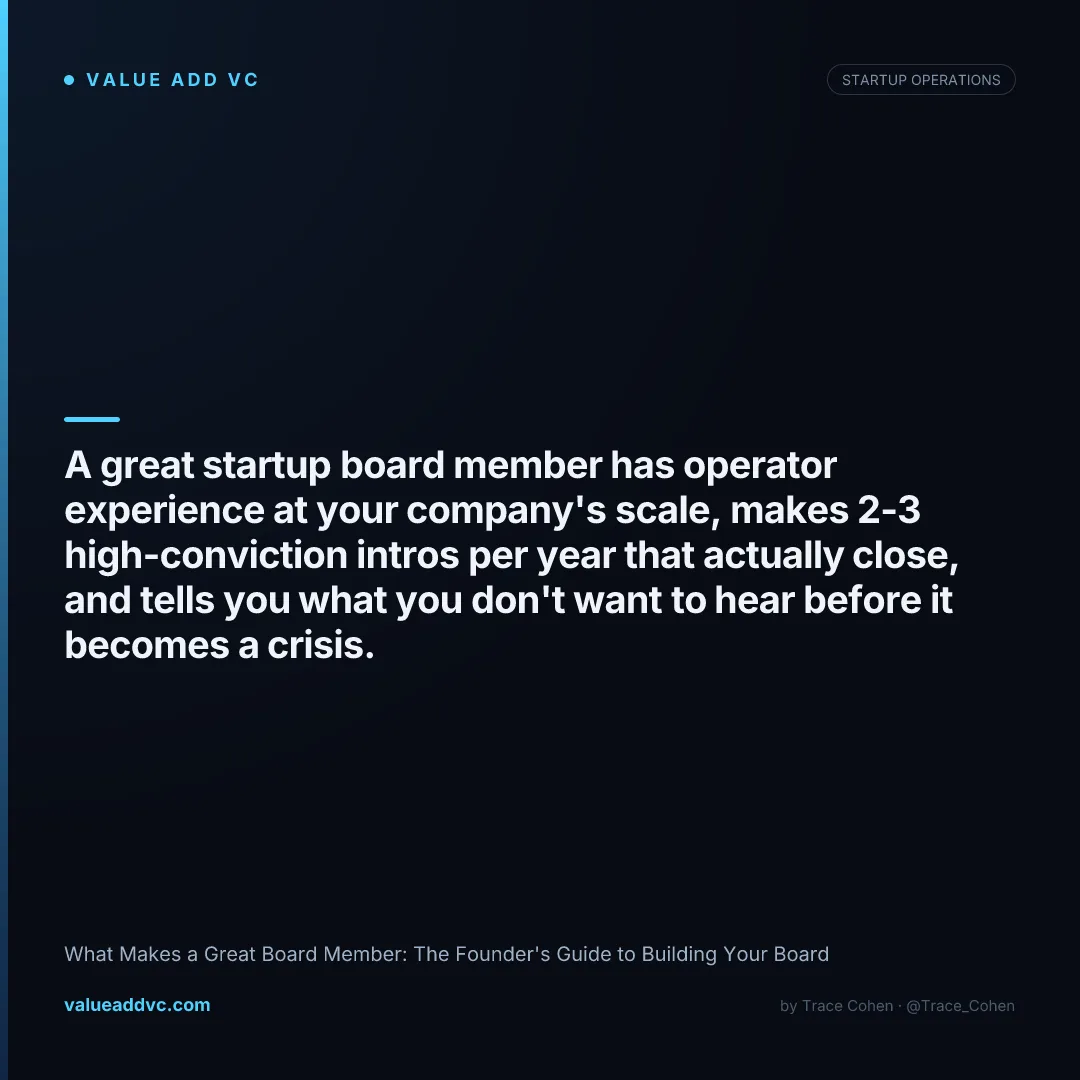
Most startup boards are assembled by accident. The VC who led your Series A gets a seat. Your co-founder gets a seat. You fill the fifth seat with someone impressive-sounding. That's not a board — that's a cap table with better attendance.
I've sat on both sides of this table. As a founder, I've had board members who changed the trajectory of my company with a single conversation — and board members who showed up unprepared, asked generic questions, and left without moving anything forward. The difference is not name recognition. It's a specific set of traits that translate into compounding value over years.
The Right Board Size at Every Stage
Board size is not a preference — it's a governance decision with downstream consequences. Too small and you lack perspective. Too large and you have a committee.
Advisory board only — 2-3 experienced operators for informal guidance
No equity board seats yet
2 founders + 1 lead investor
Keep it small. Add complexity later, not now.
2 founders + 2 investors + 1 independent director
The independent is the highest-leverage addition you'll make
2 founders + 2-3 investors + 1-2 independents
Seven is the practical ceiling before overhead exceeds value
What a Great Board Member for Startups Actually Does
There are five things a great board member consistently delivers. Most board members do two or three of them. The best do all five.
High-conviction intros
2-3 per year that actually close — not generic LinkedIn forwards. A great board member picks up the phone for you.
Operator pattern recognition
Has run a company at your scale or managed a function through hyper-growth. Knows the failure modes before they show up in your metrics.
Candor under pressure
Tells you the product isn't working before the data forces the conversation. Pushes back on the pitch you give your investors.
Availability and prep
Responds within 24 hours. Reads the board deck before the meeting, not during it. Shows up for 1:1s between formal sessions.
Governance fluency
Understands option pool mechanics, down-round dynamics, drag-along provisions, and M&A term sheets well enough to advise — not just observe.
Network that compounds
Their rolodex is relevant to your next stage, not just their peak career stage. Relationships with the funds likely to lead your next round matter more than relationships with funds that already passed.
Independent Directors: The Most Underutilized Board Seat
VC board members have fund economics. They are managing a portfolio of 20-40 companies, they have LPs to answer to, and their advice — even when excellent — is colored by their fund's position in your cap table. That's not a criticism. It's just structural reality.
Independent directors have none of that. They are compensated only in equity, which aligns their incentives purely with long-term company value. The best independents I've seen on startup boards are former operators who scaled a company through the exact inflection point you're approaching — $1M to $10M ARR, or $10M to $50M ARR, or through a market correction. They've already made the expensive mistakes. You're paying them to help you skip the tuition.
Standard Independent Director Compensation
- • Equity grant: 0.1%–0.25% of fully diluted shares, options at 409A fair market value
- • Vesting: 2–4 years, typically with a 1-year cliff
- • Cash retainer: $0 at seed/Series A; $10,000–$25,000/year at Series B+
- • D&O insurance: Required — any independent without it is a red flag on your legal hygiene
Where should you find them? Not on LinkedIn boards. The best independents come from your existing investors' networks (ask your lead VC specifically, not generally), from founders two stages ahead of you in your category, and from operators who have worked with your investors' other portfolio companies. Reference them like you would a co-hire: call three people who have reported to them, not just three people they worked alongside.
Red Flags: Board Members Who Will Slow You Down
I've seen as much damage done by the wrong board member as by any hiring mistake. The signs are usually visible before you give someone a seat.
Patterns That Hurt
- ✕ 30+ board seats: famous but unavailable — you're case #31
- ✕ Pure cheerleaders: validate every decision, never push back
- ✕ Stage mismatch: Fortune 500 operator who's never seen 0-to-1
- ✕ Strategic investor conflicts: corporate VC whose parent company is also your customer or competitor
- ✕ Meeting-driven engagement: only engages at quarterly board meetings, unresponsive in between
Patterns That Compound
- ✓ Ran your exact function: scaled sales from $0 to $20M ARR in your vertical
- ✓ Knows your next investors: has a strong relationship with 2-3 funds who would lead your next round
- ✓ Track record of candor: references say they delivered hard feedback early, not late
- ✓ Shows up between meetings: proactively sends relevant intel, makes intros unprompted
- ✓ Skin in the game: took equity (not just cash), which means they actually care about the outcome
Board Observers: When They Help and When They Add Overhead
Observer rights are a common negotiation outcome — smaller funds or angels who invested but didn't lead often ask for them. The upside: observers who are genuinely engaged can add network and perspective without holding a vote. The downside: every observer means another person receiving sensitive board materials, another person who can create awkward dynamics, and more cognitive overhead for you as the meeting preparer.
My rule: limit observers to people who will actively contribute between meetings, not just attend. If an observer hasn't made a useful intro or provided substantive input in the last six months, consider not renewing their observer rights at your next financing.
Track how your board and observers are performing against the benchmarks that matter — check the VC Performance dashboard at Value Add VC to understand what top-quartile funds expect from their portfolio governance.
How to Diligence a Prospective Board Member
Most founders do almost no diligence on board member candidates. They take a warm reference from their lead VC, meet once, and offer a seat. That's hiring a CXO based on one interview. The stakes are similar.
Here is the process that actually works:
Call three founders they've served
Ask specifically: What's one decision they pushed back on that turned out to be right? When did they go silent at a board meeting when you needed them to speak?
Map their actual network
Ask them to name the five most relevant intros they could make for you in the next six months. Vague answers reveal surface-level relationships.
Test their prep discipline
Send them a recent board deck as a "preview." See if they come back with specific questions — or nothing.
Ask about a company that failed on their watch
How they talk about failure reveals whether they'll give you useful signal during your own difficult periods, or deflect.
Verify governance experience
Ask them to walk you through a down-round protective provision or a drag-along clause. Real governance experience is immediately apparent; fake governance experience is also immediately apparent.
The best board members are not the most famous ones.
They are the ones who pick up the phone between meetings, tell you what you don't want to hear before it costs you, and whose network opens doors that wouldn't open otherwise.
Track VC and portfolio company benchmarks on the Benchmarking Dashboard at Value Add VC. Originally published in the Trace Cohen newsletter.
Latest from the Pulse
Get VC data most people never see
— 100% free
Weekly benchmarks, valuations, and fund data. Join 5,000+ investors. No spam.