
The pattern is clear: the founders who build lasting VC relationships are the ones who treat the monthly update like leverage, not obligation.
Why Investor Updates Are One of Your Most Valuable Assets
When you send a monthly update, you're not just keeping investors informed. You're building social capital you'll spend on your next raise. Research from First Round Capital found that founders who communicate consistently with their existing investors close follow-on rounds 35–40% faster than those who don't — not because the business is better, but because the trust is already there.
An investor who hears from you monthly knows your business cold. When you need an introduction to a Fortune 500 buyer, a referral to a new lead investor, or a quick pro-rata check, they can act in 24 hours. An investor who hasn't heard from you in eight months is a cold contact — even though they're on your cap table and technically aligned with your success.
Two founders who sent consistent monthly updates through their hardest quarters — one with three consecutive months of flat MRR, one navigating a co-founder departure — both raised successful follow-on rounds from existing backers within 60 days of beginning their process. A third founder who went dark during a rough patch spent six months on cold outreach to close a bridge, despite having strong underlying metrics. The silence cost him a full quarter of runway just in time wasted.
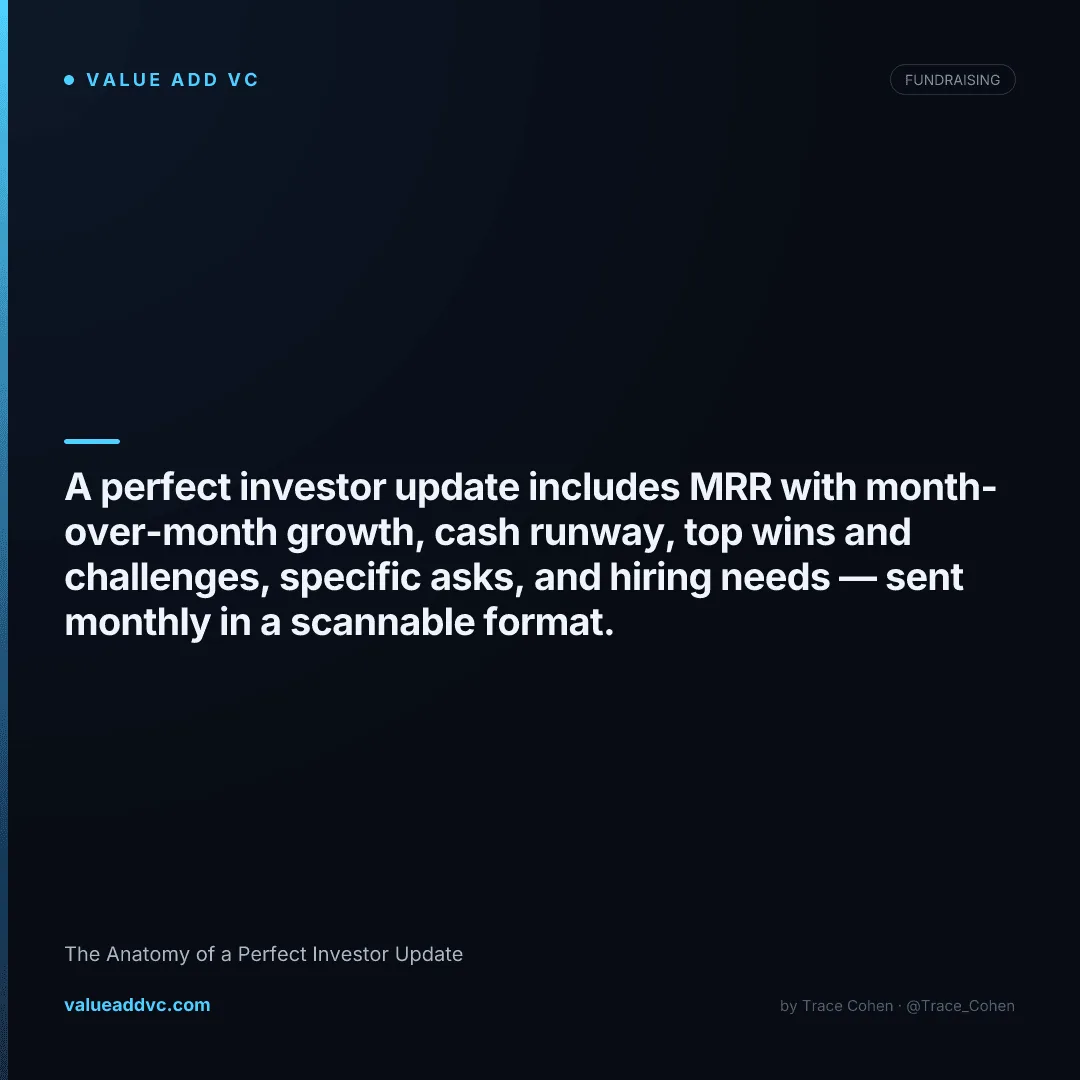
The Six Things Every Investor Update Needs
- •MRR/ARR with month-over-month growth rate — specific dollar figures, not directional language like "revenue is up." If your MRR went from $83K to $91K, say that. Investors are doing mental math anyway; make it easy.
- •Cash position and months of runway — don't make investors calculate this themselves. If you have $1.4M in the bank burning $140K/month, write "10 months runway at current burn." Ambiguity here breeds anxiety.
- •Top 1–2 wins this month — name the customer closed, the product milestone shipped, or the partnership signed. Specificity matters. "Closed a mid-market healthcare customer at $48K ARR" is worth ten times "good sales momentum."
- •Top 1–2 challenges — be direct, not defensive. This is where trust is built or destroyed. Founders who hide problems don't get help solving them. Founders who name problems clearly get intros, advice, and capital faster.
- •Specific asks from your investors — not "let us know if you can help." Instead: "Intro to VP Engineering at fintech companies Series B and above," or "Know anyone who's scaled a sales team from 3 to 15 reps in 18 months?" Vague asks get ignored. Specific asks get forwarded.
- •Hiring status — what roles are open, what stage they're at, and how urgent each is. Your investors have networks. A 50-word paragraph here can surface a hire you'd otherwise spend three months finding.
The Two Things That Destroy Investor Relationships
There are two failure modes that come up repeatedly, and both are avoidable.
The first is the vanity metric update. When you open with "We had a great month — Twitter followers grew 22% and we were featured in TechCrunch," you've signaled that you don't understand what investors actually care about. Press mentions and follower counts don't pay salaries. Revenue does. Retention does. Pipeline coverage does. Lead with the metrics that determine whether your company survives, not the ones that feel good.
The second failure mode is silence under pressure. Most founders stop sending updates exactly when things get hard — which is precisely when investor networks are most valuable. A 15% MoM growth rate needs no explanation. A flat quarter does. When you write clearly about what happened, what you learned, and what you're changing, you demonstrate the self-awareness and operational clarity that investors are betting on. Disappearing at the first sign of difficulty signals the opposite of those qualities — and it's the fastest way to be last on an investor's priority list when your next raise begins.
The format itself should be scannable in under three minutes. Bullet points over paragraphs. Numbers over adjectives. Subject line with the month and one key metric: "April Update — $91K MRR (+9.6% MoM)" tells investors more before they open the email than most updates contain in full.
The founders who maintain investor trust through hard quarters have shorter fundraising cycles, better terms, and stronger board relationships when it matters most. The update is not an obligation — it's leverage.
Stay current with VC and startup trends at Value Add VC. Originally published in the Trace Cohen newsletter.
Latest from the Pulse
Get VC data most people never see
— free to subscribe
Trace's notes on venture, AI and startups, a few times a week. Join 5,000+ subscribers. No spam.
No spam, unsubscribe anytime. Sent via Substack · Privacy · or subscribe on Substack ↗