Most founders dread board meetings. Most investors leave them underwhelmed. That is a structural problem, and the structure is the agenda.
I have sat in hundreds of board meetings — as a founder, as an investor, and as an advisor. The ones that are genuinely useful all share the same design: the board deck travels ahead, the recitation is cut, and the meeting becomes a working session on the two or three things that actually need the board's brain.
The ones that waste everyone's time look the same too: the deck arrives the morning of, the first 45 minutes is a slide-by-slide narration, and then there are 10 minutes left for the hard stuff.
The Startup Board Meeting Agenda That Actually Works
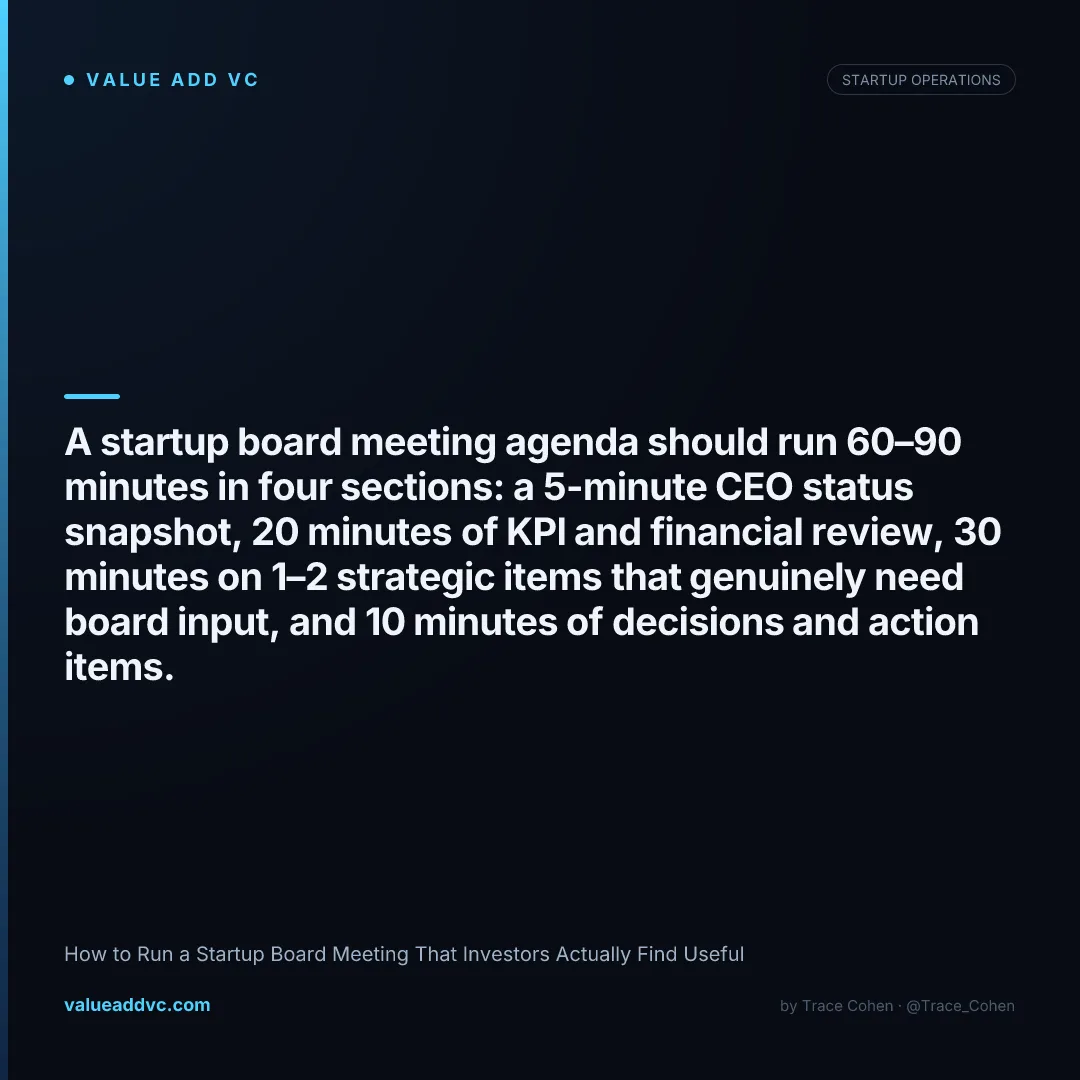
A 60–90 minute board meeting has four sections. The time allocation is deliberate — do not let the first two sections eat the third.
The Pre-Meeting Ritual That Changes Everything
Send the board deck 48 hours before the meeting. Not 24. Not the morning of. Forty-eight hours. This one change will improve your board meetings more than any agenda redesign.
The deck should be your pre-read, not your script. It contains everything informational — financials, headcount, product updates, customer highlights. If it is in the deck and it is purely factual, do not narrate it in the meeting. The board already read it.
Put in the deck
- →Full P&L and balance sheet
- →KPI dashboard vs. plan
- →Headcount and hiring update
- →Product roadmap progress
- →Customer wins and churn
Save for the meeting
- →The strategic question you are wrestling with
- →The decision you need made
- →The uncomfortable truth about a metric
- →The competitive threat that just emerged
- →The key hire you need help closing
What VCs Actually Want From a Board Meeting
I have asked a lot of investors what they actually find valuable in a board meeting. The answers are consistent. They want to think with you, not be briefed by you. They want direct access to the hardest 2–3 problems on your plate. And they want to feel like their pattern recognition — from sitting on 8 other boards — is being put to use.
The things that frustrate them are equally consistent: founders who surface bad news at the meeting rather than between meetings, meetings that run 30 minutes over because the deck was sent the same day, and sessions where no decisions are made and no actions are assigned. Check the VC performance data and you will see that board engagement is one of the few qualitative factors that consistently correlates with better portfolio outcomes.
What VCs Find Valuable
- ✓ Clear asks on specific strategic questions
- ✓ Early surfacing of problems, not at-meeting reveals
- ✓ Data that shows you understand what is actually happening
- ✓ Decisions made and written down before the call ends
- ✓ Honest assessment of what is not working
What Wastes Their Time
- ✕ Slide-by-slide narration of a deck they already read
- ✕ Surfacing a major problem for the first time in the meeting
- ✕ No clear ask — just "wanted to share an update"
- ✕ Running over because the deck arrived same-day
- ✕ Metrics presented without context or variance explanation
Cadence and Format by Stage
The right board meeting cadence changes as you scale. Here is what is standard across most institutional-backed companies, based on patterns I see across the benchmarking data:
| Stage | Formal Meeting Cadence | Written Update Cadence | Typical Duration |
|---|---|---|---|
| Pre-Seed / Seed | Quarterly | Monthly | 60 min |
| Series A | Every 6–8 weeks | Monthly | 90 min |
| Series B+ | Quarterly | Monthly | 2–3 hours |
The 24-Hour Follow-Up
Within 24 hours of every board meeting, send a short follow-up email — not a formal memo, just 5–7 bullet points. Decisions made. Action items with owners and deadlines. Questions that came up that you will answer before the next meeting.
Most founders skip this. It is the single highest-ROI thing you can do to build a board that actually functions as a strategic asset. It signals execution discipline, closes the loop on decisions, and keeps board members accountable for the commitments they made in the room.
The board meeting is not a presentation.
It is the one time each month you have a room full of people who are legally and financially aligned with your success — use it for the hard problems, not the easy ones.
Track fund performance and portfolio benchmarks on the VC Performance Dashboard and Benchmarking Tool at Value Add VC. Originally published in the Trace Cohen newsletter.
Latest from the Pulse
Get VC data most people never see
— 100% free
Weekly benchmarks, valuations, and fund data. Join 5,000+ investors. No spam.