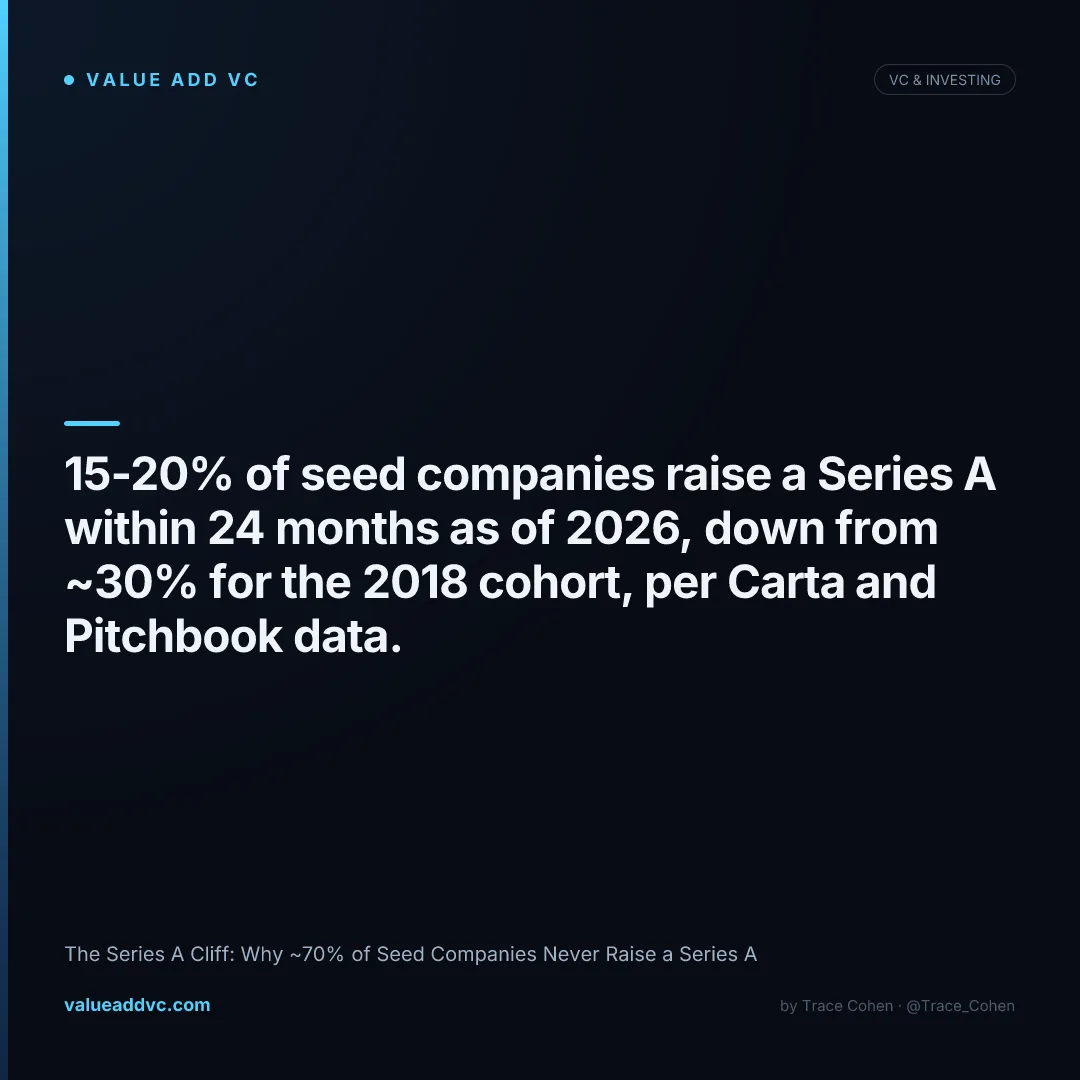
Only 15-20% of recent seed companies raise a Series A within 24 months — down from roughly 30% for the 2018 cohort. That means about 70% never make it across. That's the short answer. The longer answer is more interesting.
I've made 65+ early-stage investments, and the most painful conversations are not with the companies that fail outright — they're with the ones that did everything right at seed, built a real product, found early customers, and still could not clear the Series A bar before the cash ran out. The cliff is real, it's gotten steeper, and most founders are pricing it wrong.
The Series A Conversion Rate for Seed Companies in 2026
The Series A conversion rate — the share of seed-funded companies that raise a priced Series A within 24 months — sits at roughly 15-20% as of 2026, according to Carta and Pitchbook cohort data. A decade ago that number was around 30%. Because seed deal volume exploded while Series A capacity stayed roughly flat, the practical result is that 70-85% of seed companies stall, bridge, or shut down before graduating.
This is not a soft market reading the news as "hard." It's structural. Below is how the graduation rate has moved by cohort. Bigger checks haven't bought better odds either — see how seed round sizes have grown by sector even as the path to Series A has narrowed.
Seed-to-Series-A Graduation Rate by Cohort
| Seed Vintage | US Seed Deals | Graduated to Series A (24mo) | Median Gap |
|---|---|---|---|
| 2016 | ~9,500 | ~31% | 18 mo |
| 2018 | ~11,000 | ~30% | 19 mo |
| 2020 | ~12,500 | ~27% | 21 mo |
| 2021 | ~17,000 | ~22% | 24 mo |
| 2022 | ~15,500 | ~18% | 26 mo |
| 2023 | ~12,000 | ~16% | 27 mo |
| 2024 | ~11,000 | ~15-18% (tracking) | 28 mo |
Estimates synthesized from Carta, Pitchbook, and CB Insights cohort data. The 2021 vintage is the inflection point — record deal volume met a Series A bar that was about to triple.
Why the Series A Conversion Rate Fell So Far
The cliff is the product of two curves crossing. Seed got cheap and abundant; Series A got expensive and scarce.
Seed volume exploded
US seed deals jumped from ~9,500 in 2016 to ~17,000 in 2021 — an 80% increase in funded companies all heading toward the same gate.
Series A capacity stayed flat
The number of true Series A rounds barely grew. More runners, same-width door.
The revenue bar tripled
Series A now wants ~$1M-$2M ARR growing 3x. In 2021 a strong team and a deck could clear it.
Runway ran short
Seed rounds raise 18-24 months of cash, but the median seed-to-A gap is now 26-28 months. The math doesn't close.
The New Series A Bar in 2026
The single biggest reason seed companies miss the Series A is that they're benchmarking against 2021. Here's what the bar actually looks like now versus then.
2021 Series A (gone)
- ✕ $0-$500K ARR acceptable
- ✕ Strong team + big TAM deck
- ✕ ~$60M+ pre-money common
- ✕ Growth narrative over retention
- ✕ 2-3 term sheets in weeks
2026 Series A (real)
- ✓ ~$1M-$2M ARR, 3x YoY growth
- ✓ Net revenue retention above 100%
- ✓ Median ~$45M-$55M pre-money
- ✓ Efficient burn (burn multiple under 2x)
- ✓ Months of process, deep diligence
The median Series A in 2026 is roughly $12M raised on a $45M-$55M pre-money valuation. That's a healthy round — but earning it requires metrics most seed companies simply don't hit on their first 18 months of runway. You can track how these valuations move on our SaaS Valuations dashboard.
The Math Behind the Series A Cliff
Run the arithmetic and the cliff stops being a mystery. Take a typical 2022 seed company: it raised $2.5M at a $12M post, giving it ~20 months of runway at a $125K monthly burn. To raise a Series A it needs to reach ~$1.5M ARR growing 3x. Starting from $150K ARR, tripling annually, that's about 24 months — four months past when the cash runs out.
Multiply that gap across a 17,000-company cohort and you get the cliff. The companies that clear it either (1) raised more seed capital up front, (2) started with higher ARR, or (3) grew faster than 3x. Everyone else needs a bridge — and roughly 40% of 2022 seed companies raised a seed extension or bridge before attempting a Series A, versus under 20% in 2018.
| Outcome (2022 seed cohort) | Approx. Share |
|---|---|
| Raised a priced Series A within 24 months | ~18% |
| Raised a bridge / seed extension, still trying | ~22% |
| Flat / zombie — alive but not raising | ~25% |
| Acqui-hired or small M&A exit | ~8% |
| Shut down | ~27% |
How to Beat the Series A Cliff
As an investor who has watched dozens of companies approach this gate, the ones that clear it share a few habits. The cliff rewards planning that starts at the seed stage, not at month 18.
Raise 24+ months of runway
Budget for the real 26-28 month gap, not the 18-month fantasy. Under-raising at seed is the most common fatal error.
Pick an ARR-friendly model
B2B SaaS and AI-native tools with clear pricing graduate at higher rates than consumer or pre-revenue deep tech.
Default alive by month 12
Get burn multiple under 2x early. Series A investors fund efficient growth, not growth at any cost.
Pre-wire the round
Build relationships with Series A funds 6-9 months before you need the money. Cold Series A processes convert worst.
The bifurcation is worth naming: AI-native companies with real retention are raising Series A rounds faster and richer than the broader market, while the median seed company faces the same cliff everyone else does. You can see how AI valuations diverge from the rest on our AI Valuations dashboard, and how fund returns depend on portfolio construction on the VC Performance dashboard. When you do get in front of investors, your pitch deck needs to be sharp — Gamma is the fastest AI-powered tool to build a polished fundraising deck without a designer. Track your investor pipeline the way you'd track a sales pipeline — Pipedrive is one of the most founder-friendly CRMs for managing investor relationships and follow-up cadence during a raise.
The Series A cliff isn't a market mood. It's arithmetic.
Seed volume up ~80%, Series A capacity flat, and a bar that tripled. Raise for the 28-month gap, not the 18-month one.
Track graduation rates, valuations, and fund performance on the VC Performance Dashboard at Value Add VC. Originally published in the Trace Cohen newsletter.
Latest from the Pulse
Get VC data most people never see
— free to subscribe
Trace's notes on venture, AI and startups, a few times a week. Join 5,000+ subscribers. No spam.