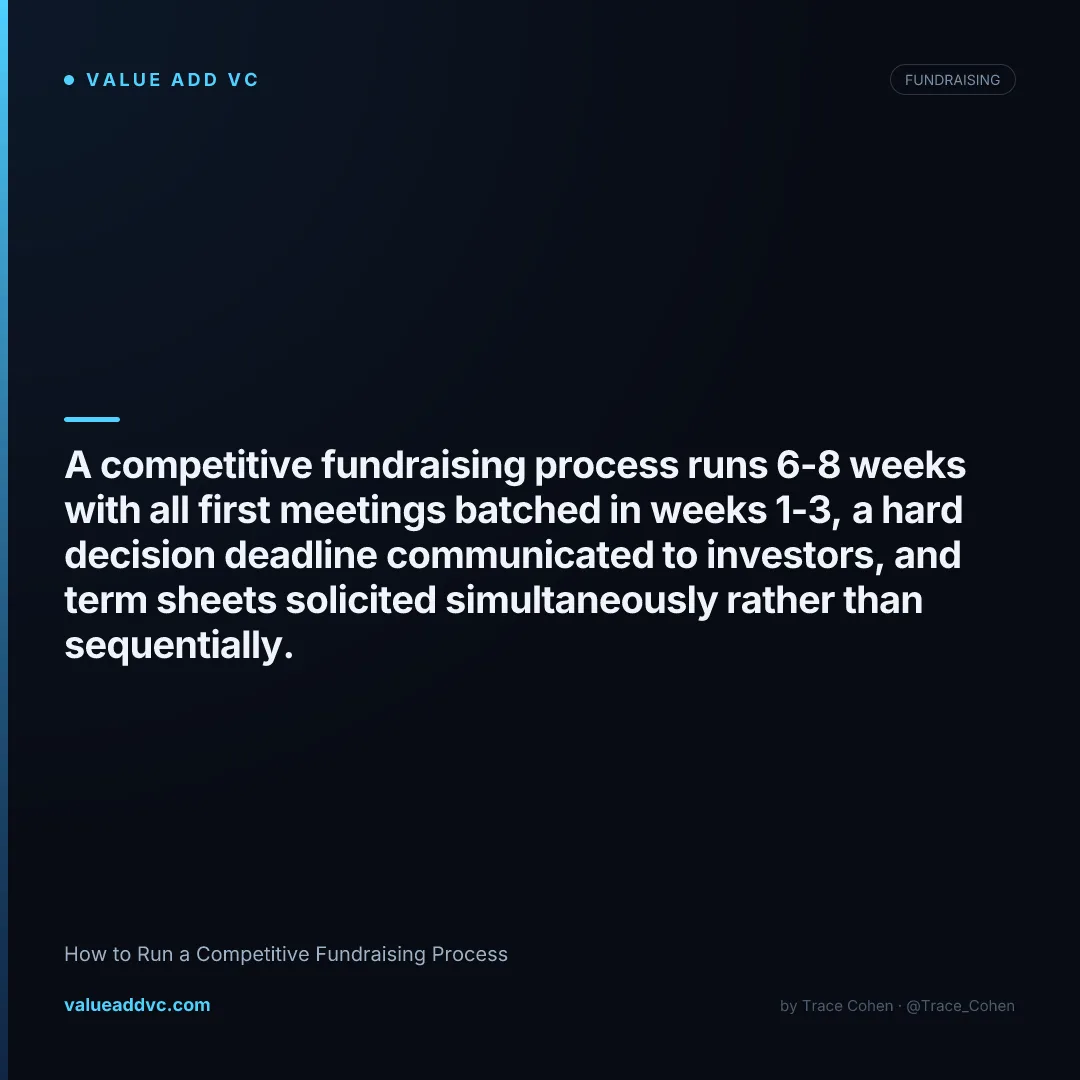
The median seed round takes 4.5 months to close. The top quartile closes in under 8 weeks. The difference is almost never the quality of the company — it's the quality of the process.
I've been on both sides of this as a 3x founder and now with 65+ investments. Founders who run structured competitive processes close faster, at better valuations, and spend dramatically less time distracted from building. Founders who raise ad hoc — taking calls whenever intros come in, meeting investors one at a time — drag rounds out, lose momentum, and often end up with worse terms or no deal at all.
Why Most Founders Raise Wrong
The default fundraising behavior looks like this: a founder gets a warm intro to a VC, takes the meeting, it goes well, they ask for a second meeting, wait two weeks, have that meeting, get asked for more diligence materials, wait another week, have a partner call, wait for IC... and meanwhile they're having first meetings with three other funds who are all at different stages.
This is not a process. This is chaos. It creates no urgency, no competitive dynamic, and gives investors the luxury of unlimited time to find reasons to pass. VCs are professional ditherers when there's no pressure to move. A structured process removes that luxury.
Why Investors Are Wired to Respond to Competitive Pressure
Kahneman and Tversky's research on loss aversion isn't just behavioral economics trivia — it's the operating system of venture capital. The pain of missing a breakout company is psychologically roughly twice as powerful as the satisfaction of making a good investment. The average early-stage VC sees 800-1,200 companies per year and invests in fewer than 15. The deals they move fastest on aren't necessarily the best companies — they're the ones they're afraid to miss. Your process exists to create that fear honestly.
78%
of VCs say competitive dynamics accelerated their decision timeline
DocSend, as of 2024
37%
faster close time for rounds with structured competitive processes
DocSend State of Early Stage, as of 2023
2x
psychological weight of losses vs gains — loss aversion drives faster yes decisions
Kahneman & Tversky
65%
of founders who ran parallel processes got better valuation than initial anchor
First Round Capital survey, as of 2024
Sources: DocSend's State of Early Stage reports; Kahneman & Tversky's work on loss aversion; and First Round Capital's founder survey data.
The Architecture of a Competitive Process
A proper competitive process has five structural elements that work together:
Pre-work (2-3 weeks before launch)
Build and tier your target list (60-80 names). Tier A: your dream leads. Tier B: strong fits, likely movers. Tier C: lower priority but good pitch practice. Collect all intros before you start taking meetings — don't trickle in. Prepare your data room in advance using DocSend or Papermark (which has a free tier with page-level analytics) so you're never waiting on materials.
Week 1-2: Calibration meetings (Tier C)
Take your first 10-15 meetings with Tier C investors. Your pitch will be rough. You will stumble on valuation questions. You will hear objections you haven't thought through. Use these meetings to sharpen everything before you enter conversations that actually matter.
Week 2-4: Core process (Tier A & B simultaneously)
Launch first meetings with your best targets in the same 2-week window. This is the critical move — if Sequoia and Benchmark are both in week-3 diligence at the same time, you have real leverage. If one moves first, you can reference inbound interest. Batch second meetings into week 3-4.
Week 4-6: Term sheets and deadline
Communicate a real decision deadline — typically 3-4 weeks from first meeting. Not a fake deadline. A real one: "We're targeting a decision by [date]." This forces parallel movement and prevents investors from stalling indefinitely while waiting to see who else moves.
Week 6-8: Negotiation and close
Once you have competing term sheets, negotiation is straightforward. Investors know you have options. Pick your lead, use the competing offer to improve terms if needed, and close within a defined window. Don't let this phase drag.
How to Create Real Urgency (Without Lying)
Urgency comes from process architecture, not from manufacturing fake term sheets. Here's what actually works:
- →Set a real deadline and communicate it early. "We're planning to close this round by end of May" said in a first meeting changes investor behavior immediately. It's not pressure — it's process transparency.
- →Reference genuine inbound. If another fund expresses serious interest, you can absolutely say "we're in active conversations with a few funds moving quickly." This is true and creates urgency.
- →Use a sequenced second meeting. When booking follow-ups, say "I have a few slots left on [date] — we're trying to move everyone to second meetings this week." This signals you have a process.
- →Don't chase. Follow up once and move on. Chasing investors who go dark signals desperation. One polite follow-up, then redirect your energy. Scarcity is conveyed by behavior, not words.
- →Soft-circle a credible name before going wide. Even a committed $250K from a respected angel or smaller fund anchors the round. "We have a lead soft-circled" fundamentally changes how every subsequent conversation goes.
- →Use the term sheet call correctly. When you receive your first term sheet, call every firm still in diligence within 24 hours and give them a 7-10 day window to match or opt out. This is standard, appropriate, and it's information — not pressure.
- →Never negotiate with a single term sheet. One offer is a negotiation where the investor holds all leverage. If you only have one, wait or go back out — two term sheets changes the entire power dynamic.
- →Control information timing. Not every investor gets your full data room on day one. Advanced materials go to investors actively in diligence — scarcity of data signals selectivity.
- →Let your calendar do the talking. Offer 3-4 slots over the next 10 days rather than "I'm free whenever." Scarcity of founder time signals demand more effectively than any talking point. And never extend your close date twice — every extension trains investors that the urgency was fake.
The Three Mistakes That Kill Competitive Dynamics
Too many investors
60+ active conversations is unmanageable. Urgency requires scarcity. If 80 funds know you're talking to 80 funds, no one feels competitive pressure.
No hard deadline
Without a stated close date, investors default to their own timeline. "We're interested, keep us posted" is how rounds die. A deadline forces a binary decision.
Sequential not parallel
Meeting investors one at a time destroys leverage. You need Tier A investors in diligence simultaneously so that a term sheet from one creates real pressure on others.
The Numbers Behind Competitive Processes
Based on what I've observed across dozens of rounds:
6-8 weeks
Median close time, structured process
4-5 months
Median close time, ad hoc raise
15-25%
Valuation premium from competitive dynamics
20-40
Optimal first meetings for a seed round
Fundraising is not a relationship — it's a transaction.
Run it like one. Structure creates urgency. Urgency creates decisions. Decisions close rounds.
Explore Related Dashboards
Interactive tools with live data on this topic
Latest from the Pulse
Get VC data most people never see
— 100% free
Weekly benchmarks, valuations, and fund data. Join 5,000+ investors. No spam.