
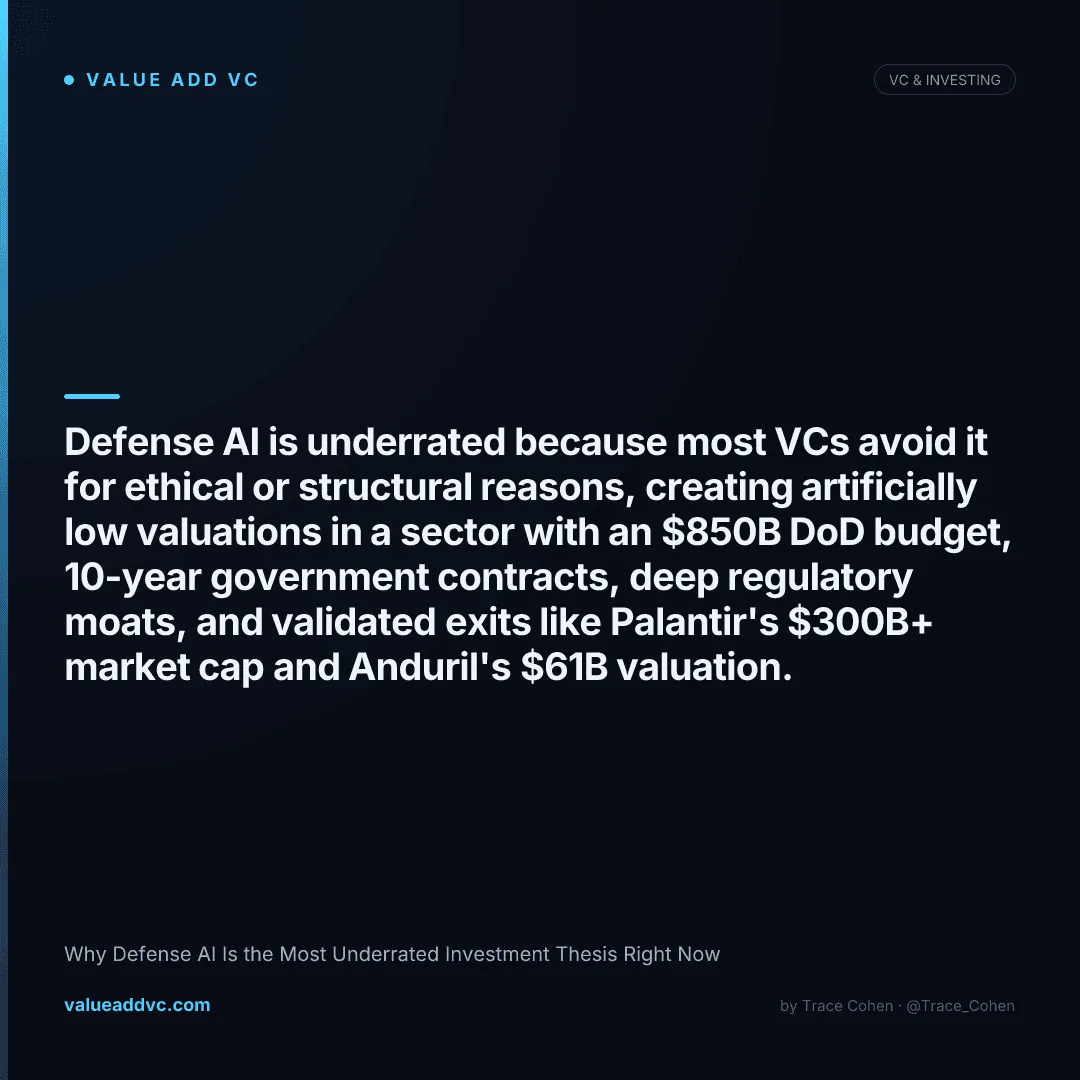
The U.S. Department of Defense budget hit $850B in 2026. Private investment in defense tech has gone from under $1B annually in 2019 to more than $20B in 2024. Palantir trades above a $300B market cap. And most VC firms still won't touch the category.
The Numbers That Should End the Debate
Let's start with what's already happened. Anduril Industries raised $5B at a $61B valuation in May 2026 — double its $30.5B mark from less than a year earlier — after doubling revenue to $2.2B in 2025. Shield AI — autonomous military aviation software — hit a $12.7B valuation in March 2026, up 140% in a year, after a U.S. Air Force deal. Rebellion Defense was acquired by Shield AI. Palantir, which spent a decade being dismissed as "too government-reliant," now trades at revenue multiples that make pure commercial SaaS companies look modest.
The Ukraine war removed any remaining ambiguity. AI-enabled drone warfare, autonomous targeting, and battlefield intelligence systems proved decisive in ways that no think-tank paper could manufacture. The Pentagon's Replicator Initiative — a $1B+ program to field thousands of autonomous systems by 2025 — was a direct policy response to what happened on the ground in Eastern Europe.
Sectors have gotten ignored for cultural reasons before. Clean energy in 2008. Crypto in 2013. Vertical SaaS in 2015. Every single time, the funds that leaned in early generated outsized returns precisely because mainstream capital stayed away and kept valuations rational. Defense AI in 2026 has the same setup — and you can track the companies driving it on our Defense Tech dashboard.
Why VCs Are Asleep at the Wheel
The standard objection is ethical: "We don't invest in things that could be used to harm people." The principle is understandable, but the application is deeply inconsistent. Most of the same funds that refuse defense AI happily back consumer social platforms engineered to maximize engagement in teenagers, surveillance-adjacent adtech, and gig economy models that systematically underpay workers. The ethics line is selectively applied.
The second objection is commercial: "Government contracts are slow, political, and unpredictable." This was true of the legacy defense prime model — Lockheed, Raytheon, Northrop — where you had 10-year procurement cycles and cost-plus contracts that rewarded inefficiency. The new wave of defense tech companies is winning Other Transaction Authority (OTA) contracts, SBIR/STTR grants, and direct DoD program-of-record deals at a pace that looks nothing like the old system. Anduril went from founding to a $250M DoD border security contract in under four years.
The third objection is structural: "The exit path is limited." Palantir's IPO, Anduril's private market trajectory, Shield AI's acquisitions, and the emergence of defense-focused SPACs and strategic acquirers have largely invalidated this. When L3Harris, Northrop Grumman, and General Dynamics are all standing up corporate venture arms specifically to acquire AI-native startups, the liquidity path is more defined than it has been in a decade.
What Makes Defense AI Structurally Different
- •Regulatory moats are real and deep — FedRAMP authorization, security clearances, and ITAR compliance take 18–36 months to achieve and create barriers that no commercial competitor can shortcut with capital alone.
- •Contract duration insulates from churn — DoD program-of-record contracts run 5–10 years with renewal options. There is no enterprise SaaS equivalent to a multi-year, sole-source government contract.
- •The buyer is the most creditworthy entity on Earth — the U.S. federal government has never missed a vendor payment. No accounts receivable risk, no customer bankruptcy risk, no churn from a down macro cycle.
- •Geopolitical tailwinds are structural, not cyclical — China's defense AI investments have exceeded $15B annually since 2022. The U.S. government is not going to reduce AI spending in response to a recession.
- •Talent concentration creates durable advantages — the pool of engineers willing to hold clearances, work in classified environments, and build systems for national security use cases is narrow. Once built, these teams are nearly impossible to replicate.
- •Data generated in operational deployment is proprietary by definition — classified training data, mission-specific telemetry, and combat-proven system logs cannot be replicated by commercial AI labs regardless of funding.
The Founders and Funds Building in This Space
The first generation is already public or late-stage: Palantir, Anduril, Shield AI, Sarcos, Joby (dual-use aviation), and a handful of others. The interesting opportunity is in the second generation — the companies solving specific sub-problems in autonomous systems, electronic warfare, space domain awareness, cyber offense and defense, and AI-enabled logistics.
Dedicated defense tech funds — AEI HorizonX, Lux Capital (increasingly), 8VC, Founders Fund, and a cohort of emerging managers like Dcode Capital and In-Q-Tel's commercial spinoffs — have a structural advantage in deal access that generalist funds will never replicate. The personal relationships, clearance-adjacent networks, and program office visibility required to see the best deals early are not transferable to a GP who has never sat in a SCIF.
From where I sit, the best risk-adjusted opportunity is at the Series A and B stages: companies that have already secured initial DoD contracts (de-risking the customer acquisition question) but haven't yet been priced by the broader market. That window won't stay open much longer. The 2026 defense AI wave is where the 2018 commercial AI wave was — the serious builders are in the room, and the tourists haven't arrived yet.
The best venture opportunities live where capital is uncomfortable. Defense AI is the most discomfort-driven alpha in the market right now — and the window to enter at rational valuations is closing fast.
Stay current with VC and startup trends at Value Add VC. Originally published in the Trace Cohen newsletter.
Latest from the Pulse
Get VC data most people never see
— free to subscribe
Trace's notes on venture, AI and startups, a few times a week. Join 5,000+ subscribers. No spam.
No spam, unsubscribe anytime. Sent via Substack · Privacy · or subscribe on Substack ↗