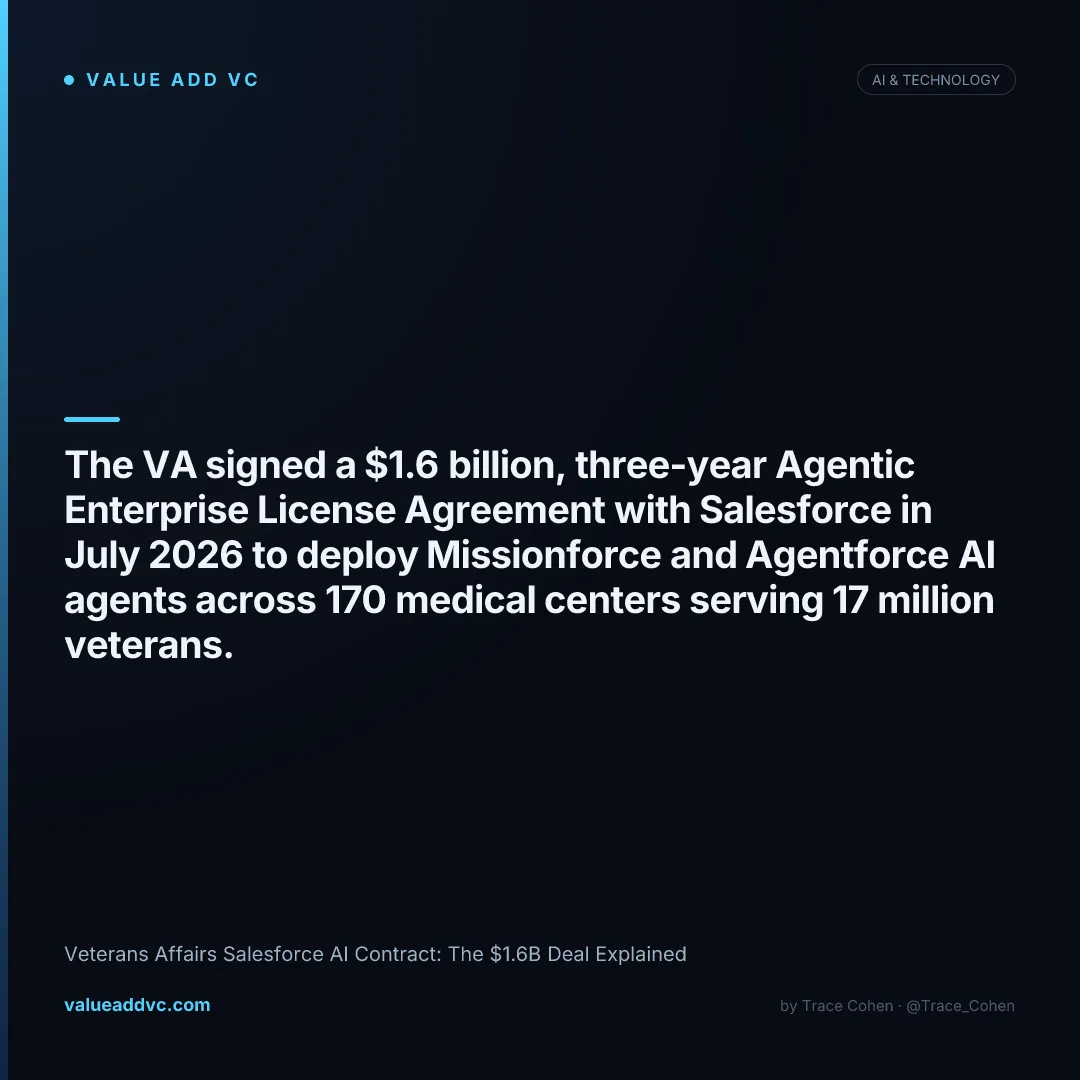
$1.6 billion is the ceiling on the Veterans Affairs Salesforce AI contract signed in July 2026 — a three-year deal to put AI agents in front of 17 million veterans across 170 medical centers.
That's the short answer. The longer answer is more interesting: this is one of the largest agentic-AI-specific government contracts disclosed to date, it landed one day after Oracle signed a separate $7 billion Pentagon software deal, and it's part of a pattern where the federal government is simultaneously locking in legacy vendors and making enormous new bets on AI agents doing real administrative work.
Sources: Salesforce press release (July 24, 2026), Department of Veterans Affairs, Salesforce Q1 FY2027 earnings, checked August 2026.
What Is the Veterans Affairs Salesforce AI Contract Worth?
$1.6 billion is the total contract ceiling for the Veterans Affairs Salesforce AI contract, structured as a three-year Agentic Enterprise License Agreement (AELA) with one base year plus two renewal options. The VA operates 170 medical centers and over 1,100 outpatient clinics serving more than 17 million veterans, and the agreement covers access to Missionforce, Agentforce Public Sector, Agentforce Health, Slack, MuleSoft, Data 360, and Tableau across that entire network. Revenue is recognized only as the VA actually orders services against the ceiling, not upfront — a structure common to large federal enterprise license agreements that lets the department scale spend to actual adoption rather than committing the full sum on day one.
What Does the Veterans Affairs Salesforce AI Contract Actually Include?
Six distinct product lines are bundled into the deal: Missionforce (the VA-specific platform), Agentforce Public Sector, Agentforce Health, Slack, MuleSoft, Data 360, and Tableau. The AI agents are designed to surface information during live calls, instantly route and triage cases, and automate benefits verification — workflows that historically required significant manual staff time. The headline metric the VA is being sold on is scheduling: cutting the average 28-day wait for community care appointments down to minutes. That's a concrete, measurable outcome rather than a vague productivity promise, which is unusual for a government AI contract at this scale.
| Contract | Vendor | Value | Term | Focus |
|---|---|---|---|---|
| VA AELA | Salesforce | $1.6B | 3 yrs (base + 2 options) | AI agents, veteran care & admin |
| Army Missionforce IDIQ | Salesforce | $5.6B | 10 yrs | Enterprise SaaS, largest in DoD history |
| Air Force agreement | Salesforce | $72M | Under $5.6B DoD umbrella | Agentforce for secure gov AI |
| Pentagon software ESI | Oracle | Up to $7.0B | 10 yrs ($3.3B base) | On-prem software consolidation |
| Military software licensing | Dell Federal (Microsoft) | $9.69B | 5 yrs | Consolidated MSFT licenses |
| Pentagon AI data platform | Accenture Federal | $821M | 5 yrs | AI data pipeline to DoD platform |
Figures are 2026 disclosed contract ceilings blended from Salesforce press releases, DefenseScoop, Breaking Defense, and CNBC reporting. Contract ceilings represent maximum spend, not guaranteed revenue.
Why Did the VA Pick Salesforce Over Other AI Vendors?
Salesforce already ran Agentforce Public Sector and Agentforce Health inside the VA before this contract, providing 24/7 virtual contact-center support for patient triage, intake, and care coordination. The $1.6 billion AELA extends that existing relationship into a single, larger procurement vehicle rather than starting fresh with a new vendor — a common pattern in federal IT where switching costs and prior integration work heavily favor the incumbent. Missionforce itself was purpose-built as a government-specific version of Salesforce's platform, which gave the VA a security and compliance posture already tailored to federal requirements instead of a commercial product retrofitted for government use.
How Does the Veterans Affairs Salesforce AI Contract Compare to Other 2026 Government AI Deals?
$32 billion is roughly what the Department of Defense committed in contract ceiling to AI, cloud, cybersecurity, and data analytics programs in just the first half of FY2026. Against that backdrop, the VA's $1.6 billion Salesforce deal is mid-sized — smaller than Dell Federal's $9.69 billion Microsoft licensing consolidation and Oracle's up-to-$7 billion Pentagon software deal, but larger than Accenture Federal's $821 million AI data platform contract. What stands out about the VA deal specifically is that it's aimed at citizen-facing outcomes (appointment wait times, benefits verification) rather than back-office infrastructure, which is a smaller and more specific category of federal AI spend than the broader cloud and licensing consolidations dominating the 2026 numbers.
What Will Salesforce's AI Agents Actually Do for Veterans?
Three specific workflows are named in the contract: surfacing information during live calls, instantly routing and triaging cases, and automating benefits verification. These extend the Agentforce Public Sector and Agentforce Health deployment the VA already had running as a 24/7 virtual contact center. The most concrete deliverable is scheduling — cutting the average 28-day wait for community care appointments down to minutes — which is the kind of measurable, publicly trackable outcome that will make this contract easy to audit for success or failure over its three-year term, unlike vaguer "efficiency" claims common to earlier government IT modernization efforts.
Is the Veterans Affairs Salesforce AI Contract Part of a Bigger Spending Trend?
$7.2 billion is the combined federal contract ceiling Salesforce has now disclosed in 2026 alone, once you add the VA's $1.6 billion AELA to the $5.6 billion Army Missionforce IDIQ and the $72 million Air Force agreement. That stacks on top of Oracle's $7 billion Pentagon deal signed one day before the VA announcement, and Dell Federal's separate $9.69 billion Microsoft licensing consolidation from May 2026. Salesforce and ServiceNow shares both rose the week these deals landed — ServiceNow up 6%, Salesforce up 4% — which the market read as confirmation that enterprise software vendors with credible agentic AI products are winning outsized government budget allocation in 2026, not just commercial enterprise deals.
Track how AI spending is trending more broadly on the AI Spending dashboard and how vendor valuations are responding on the AI Valuations dashboard.
What Are the Risks in the VA's $1.6 Billion AI Bet?
28 days to minutes is a very public promise to fail publicly on. Because the AELA structure only pays Salesforce as the VA actually orders services, a slow rollout or a stalled adoption curve across 170 medical centers means the company may never collect the full $1.6 billion ceiling — this isn't a guaranteed payout, it's a spending cap. There's also concentrated political risk: veteran care is one of the most scrutinized categories of federal service delivery, and any high-profile AI misrouting or triage error would draw outsized media and congressional attention relative to a similar failure in a less sensitive agency. For Salesforce, the VA contract is also a reference case it will use to sell Agentforce Public Sector into other agencies, so the incentive to make this specific deployment succeed is unusually high.
The VA-Salesforce contract is a $1.6 billion bet that AI agents can cut a 28-day wait down to minutes for 17 million veterans.
It's the clearest test yet of whether agentic AI delivers in government, not just enterprise sales decks.
Bottom line: the Veterans Affairs Salesforce AI contract is a $1.6 billion, three-year agreement that extends an existing Agentforce relationship into Missionforce, Slack, MuleSoft, Data 360, and Tableau across 170 medical centers. It lands inside a broader 2026 wave of government AI and software consolidation deals — Army ($5.6B), Oracle Pentagon ($7B), Dell Federal-Microsoft ($9.69B), Accenture Federal ($821M) — that together push Salesforce's disclosed 2026 federal contract ceiling past $7.2 billion. Whether it delivers the promised 28-days-to-minutes scheduling improvement will be one of the most watched government AI case studies of the year.
Track enterprise AI spending on the AI Spending dashboard and vendor valuations on the AI Valuations dashboard at Value Add VC. Originally published in the Trace Cohen newsletter.
Latest from the Pulse
Get VC data most people never see
— 100% free
Weekly benchmarks, valuations, and fund data. Join 5,000+ investors. No spam.