
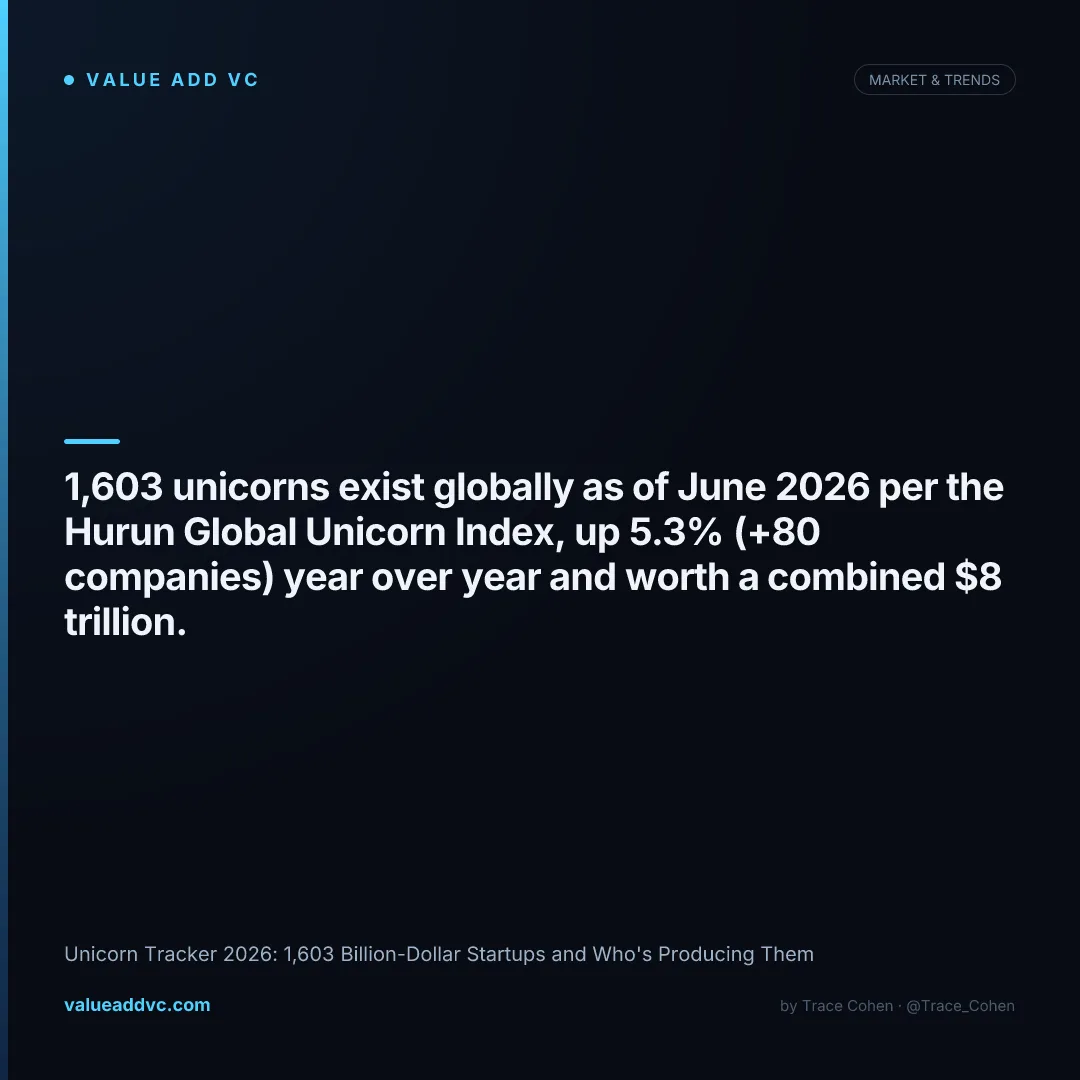
1,603 unicorns exist worldwide as of June 2026, worth a combined $8 trillion. That's the short answer. The longer answer is that where those companies sit on a map has gotten more lopsided, not less — San Francisco alone now has more unicorns than all but a handful of countries.
The Hurun Research Institute released its Global Unicorn Index 2026 on June 25, and it's the cleanest full-population count available this year: 1,603 companies, up 80 from the prior edition, a 5.3% increase. Crunchbase's running tally puts the number closer to 1,660 and CB Insights closer to 1,300, and the gap between all three is entirely about methodology and update cadence — not a real disagreement that the unicorn herd keeps growing even as the definition gets diluted from its original meaning.
What's changed most since last year isn't the headcount — it's the concentration underneath it. A 5.3% increase in the number of unicorns against a 43% jump in combined valuation means the average unicorn isn't getting proportionally richer; a small number of AI companies are getting dramatically more valuable while a much larger tail of the list holds flat or slips backward. That split shows up clearly once you break the numbers down by city and by sector below.

How Many Unicorns Exist in 2026?
There are 1,603 unicorn companies globally as of the Hurun Global Unicorn Index published June 25, 2026, an increase of 80 companies (5.3%) over the previous year's count. Combined, they're worth $8 trillion, up 43% year over year — valuation growth far outpacing the headcount growth, which tells you the increase is concentrated in a small number of companies getting dramatically more valuable rather than a broad-based expansion of the list.
Unicorn Tracker 2026: Which Cities Produce the Most $1B+ Startups
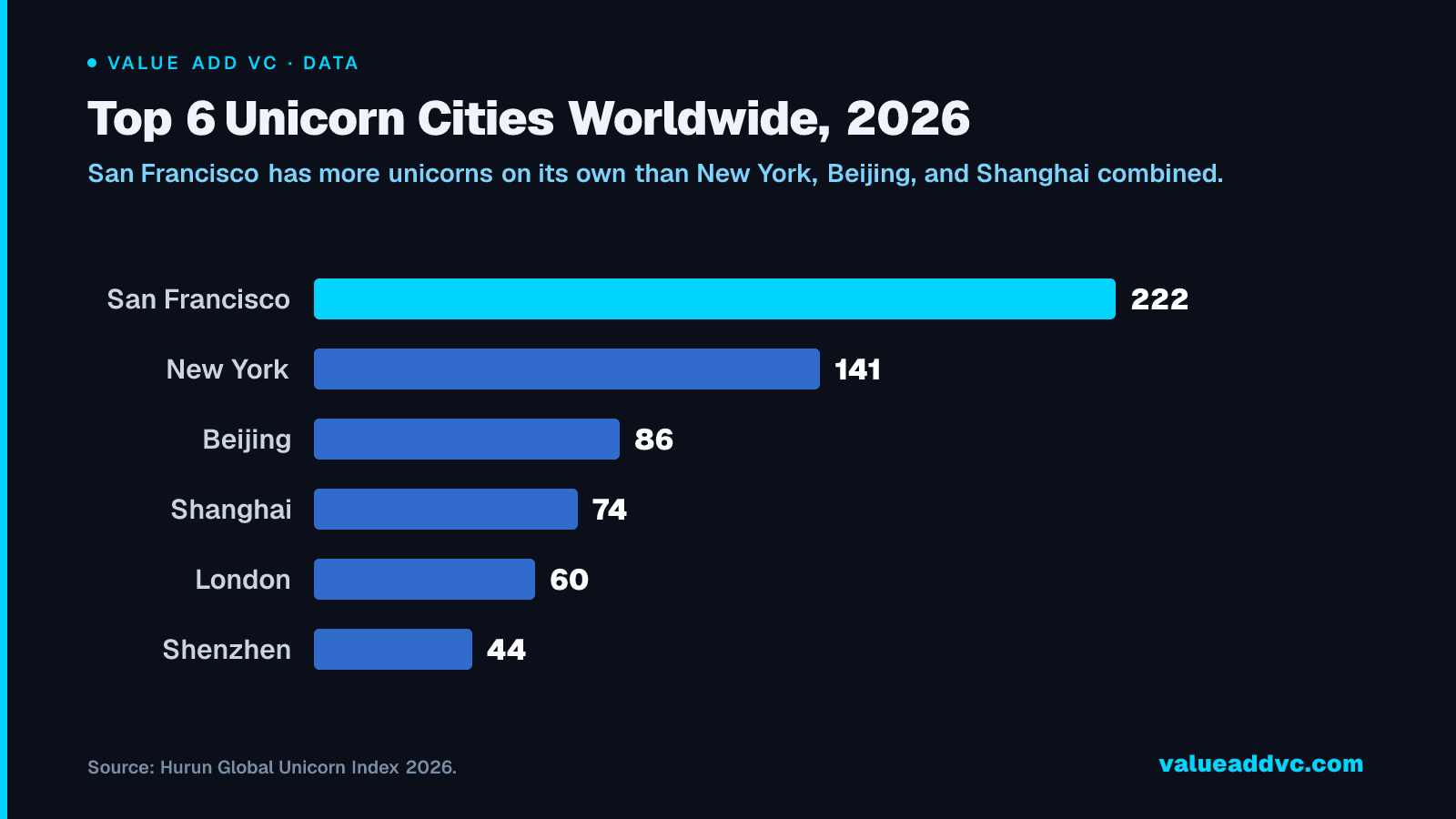
San Francisco is, by a wide margin, the single largest unicorn-producing city on Earth in 2026, with 222 companies — a net gain of 23 over the prior year. New York is a distant second at 141, and Beijing rounds out the top three at 86. The gap between #1 and #2 (81 companies) is itself larger than the entire unicorn count of all but a handful of individual nations, which is the clearest evidence yet that unicorn density remains a metro-level story, not a national one.
| Rank | City | Unicorn count (2026) | YoY change |
|---|---|---|---|
| 1 | San Francisco | 222 | +23 |
| 2 | New York | 141 | — |
| 3 | Beijing | 86 | — |
| 4 | Shanghai | 74 | — |
| 5 | London | 60 | — |
| 6 | Shenzhen | 44 | — |
| 7 | Paris | 27 | — |
| 8 | Hangzhou | 25 | — |
| 9 | Guangzhou | 24 | — |
Figures are from the Hurun Research Institute's Global Unicorn Index 2026, released June 25, 2026 (data compiled through Q2 2026). City counts reflect company headquarters location, not investor location.
Top 6 Unicorn Cities Worldwide, 2026
San Francisco has more unicorns on its own than New York, Beijing, and Shanghai combined.
Hurun Global Unicorn Index 2026.
Data
| Item | Value |
|---|---|
| San Francisco | 222 |
| New York | 141 |
| Beijing | 86 |
| Shanghai | 74 |
| London | 60 |
| Shenzhen | 44 |
Why the Unicorn Count Depends on Who's Counting
Ask three data providers how many unicorns exist right now and you'll get three different answers, and none of them are wrong exactly — they're measuring different things. Crunchbase's live count sat at roughly 1,660 in January 2026 and updates in near real time as new rounds close. CB Insights, which applies stricter valuation-verification criteria and updates on a slower cadence, puts the figure closer to 1,300-1,334. Hurun's 1,603 count, refreshed twice a year, sits in between and is the one most frequently cited by global press because of its detailed city and sector breakdowns.
The practical takeaway: don't treat any single unicorn count as a precise census. Treat the trend — up 5.3% and $8 trillion in combined value, up 43% — as the signal, and treat any specific headline number as accurate to within a couple hundred companies depending on the source's methodology and refresh date. For the full country-level breakdown (the US alone has 650+, China roughly 170, India around 70), see our global unicorn map by country.
The Unicorn Tracker Sector Breakdown: AI Is Rewriting the List
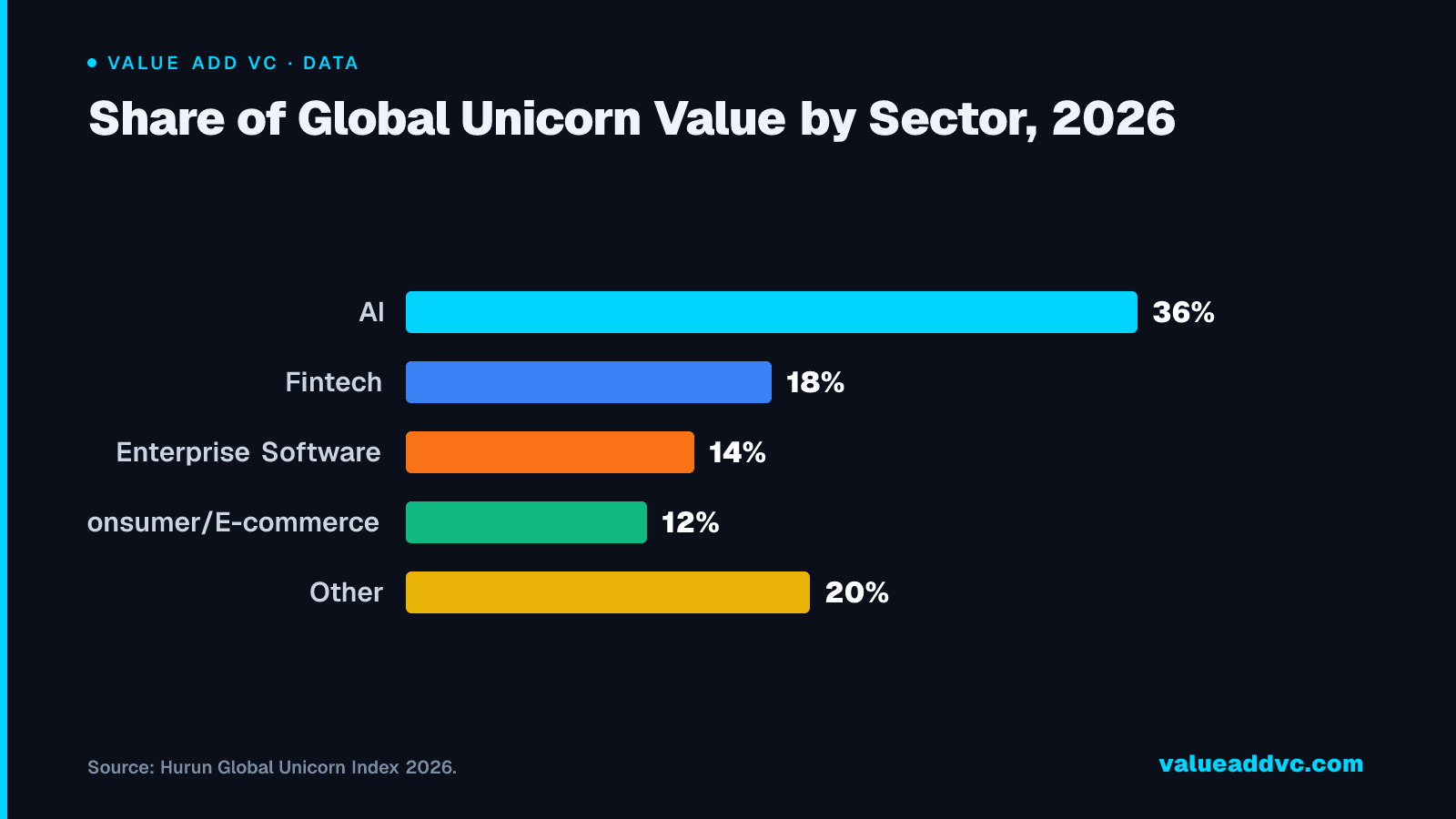
AI companies make up 215 of the 1,603 total unicorns in 2026 — about 13.4% of the count — but a disproportionate 36% of total unicorn value, the highest value share of any sector on the index. The AI unicorn count grew by 87 companies in a single year, more than doubling from where it stood 12 months earlier, and the top three most valuable unicorns in the world are all AI companies: Anthropic at $965 billion, OpenAI at approximately $852 billion, and ByteDance at $480 billion.
Share of Global Unicorn Value by Sector, 2026
Hurun Global Unicorn Index 2026.
Data
| Item | Value |
|---|---|
| AI | 36% |
| Fintech | 18% |
| Enterprise Software | 14% |
| Consumer/E-commerce | 12% |
| Other | 20% |
That value concentration matters for how you should read the headline $8 trillion figure — it isn't 1,603 companies each growing steadily richer, it's a handful of AI labs pulling the average up while a much larger tail of older unicorns sits flat or quietly loses ground. Investors tracking where new billion-dollar valuations are actually forming should check our AI valuations dashboard for company-by-company detail beneath the aggregate numbers here.
New unicorns are still minting fast even outside the mega-cap AI labs — 2026 alone has produced fresh billion-dollar marks like Norm AI (legal AI, $1.2B on a $120M Series C), Runpod ($1B, AI developer cloud GPU infrastructure), and Psibot ($1.48B, China-based embodied AI backed by Chery). Most of these are smaller, faster-moving companies than the household-name AI labs, and they're a better read on where the next wave of unicorn creation is actually concentrated — infrastructure and tooling wrapped around the frontier models, not just the labs building them. For the full running list, see our new unicorns of 2026 tracker.
The Unicorn Graveyard: Who's Losing Billion-Dollar Status
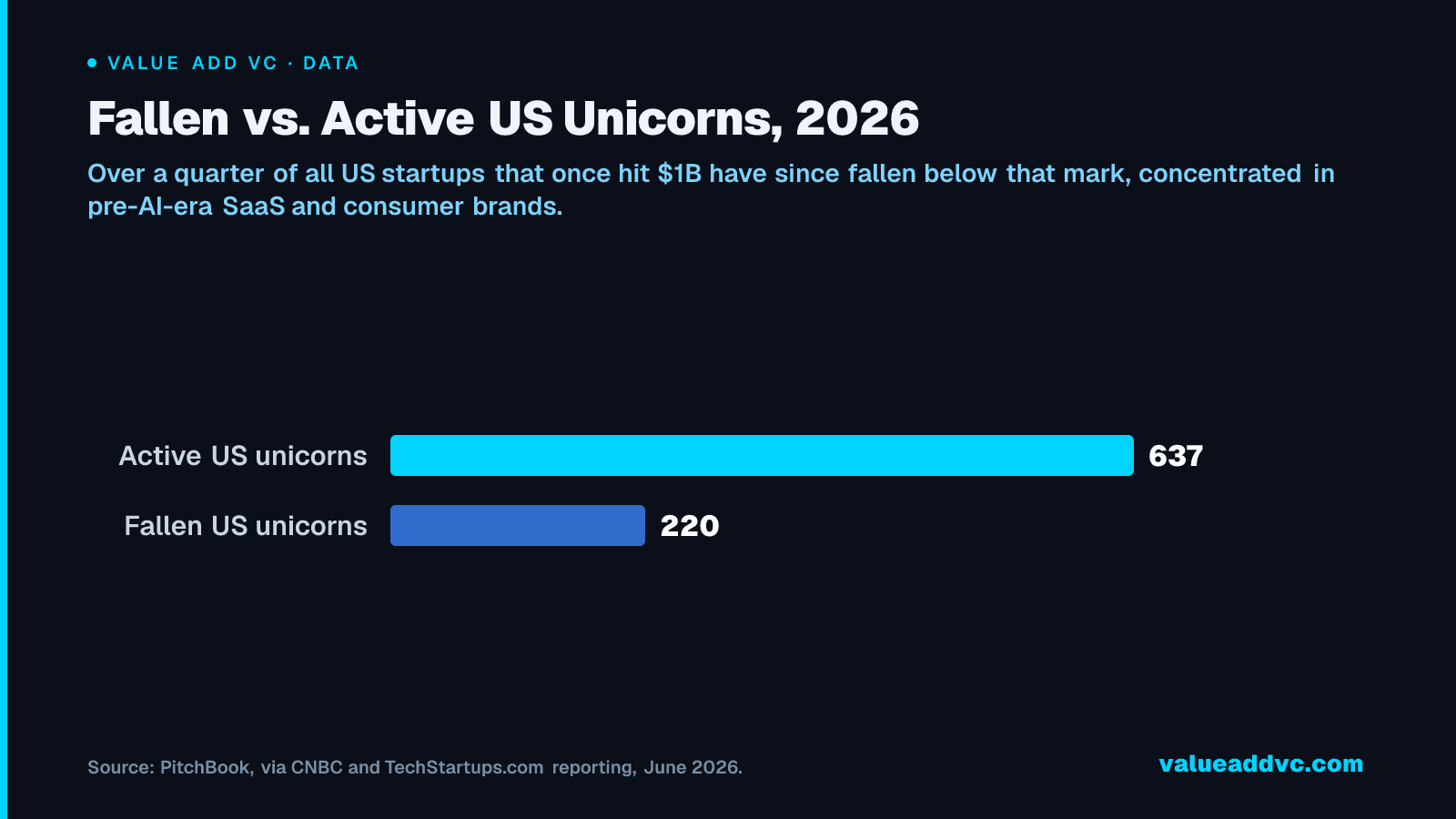
The headline unicorn count only tells half the story, because it's a net figure — new unicorns minted minus unicorns that quietly fall out of the club. PitchBook now tracks more than 220 US startups that once cleared $1 billion and no longer do, out of roughly 857 total US unicorns, meaning over a quarter of the domestic list has already fallen or is at risk. Companies that last raised in 2021 are worth 68% less on average today than their peak mark; those that last raised in 2022 are down 52%. Nearly half of all US unicorns haven't raised a fresh round in three years, which is the leading indicator of a stale, unverified valuation rather than a real one.
The damage isn't evenly spread. Enterprise SaaS accounts for 75 of PitchBook's fallen-unicorn list — roughly double the number from fintech — because AI-native competitors are undercutting legacy per-seat software pricing faster than incumbents can respond. Consumer brands that defined the direct-to-consumer wave of the 2010s, including Glossier, Rothy's, Brooklinen, and Savage X Fenty, are also on the list. The common thread across nearly every fallen unicorn: a business model built before ChatGPT, competing for capital and attention against a market that has redirected more than $250 billion into OpenAI and Anthropic alone.
Fallen vs. Active US Unicorns, 2026
Over a quarter of all US startups that once hit $1B have since fallen below that mark, concentrated in pre-AI-era SaaS and consumer brands.
PitchBook, via CNBC and TechStartups.com reporting, June 2026.
Data
| Item | Value |
|---|---|
| Active US unicorns | 637 |
| Fallen US unicorns | 220 |
That's the context worth holding next to the 1,603 headline figure: the unicorn tracker is a scoreboard with real churn on both ends, not a steadily growing trophy case. A company earning unicorn status in a hot funding cycle is not the same claim as a company holding it three years later without having raised again.
What "Unicorn" Even Means Anymore
Venture capitalist Aileen Lee coined the term "unicorn" in 2013 specifically because $1 billion-plus private valuations were statistically rare — fewer than 40 existed at the time, out of roughly 60,000 US venture-backed startups founded in the prior decade. Rarity was the entire point of the metaphor. Thirteen years later, there are more than 1,600, and the term has drifted from "extraordinary outlier" to "reasonably common late-stage outcome," particularly in AI, where a lab can clear $1 billion in valuation on a seed or Series A round before shipping meaningful revenue.
That drift is why sophisticated LPs increasingly ask fund managers for unicorn-adjusted metrics — realized DPI, not paper TVPI inflated by an unrealized billion-dollar mark — before crediting a "unicorn-maker" reputation as a real signal of returns. A fund with five unicorns and zero exits has a portfolio full of marks, not proof of performance, and the 220+ fallen unicorns tracked above are the clearest evidence that a $1 billion valuation is a moment in time, not a permanent credential.
It also explains why the unicorn label matters less to serious LPs than it used to and why funds are increasingly benchmarked on exit-adjusted return multiples instead. Investors evaluating a fund's actual track record — rather than its logo wall of unicorn portfolio companies — should look at realized VC fund performance data before assuming a high unicorn count translates into strong returns for LPs.
The Bottom Line
1,603 unicorns and $8 trillion in combined value is the 2026 unicorn tracker headline, but the more useful number is the concentration underneath it: one city (San Francisco, 222) with more unicorns than most countries, one sector (AI, 36% of value on 13% of the count) doing the heavy lifting, and three companies (Anthropic, OpenAI, ByteDance) worth a combined $2.3 trillion sitting at the very top. The unicorn count keeps climbing, but where the value actually lives keeps getting narrower — that's the trend worth tracking, not the headline number itself.
Latest from the Pulse
Get VC data most people never see
— free to subscribe
Trace's notes on venture, AI and startups, a few times a week. Join 5,000+ subscribers. No spam.
No spam, unsubscribe anytime. Sent via Substack · Privacy · or subscribe on Substack ↗