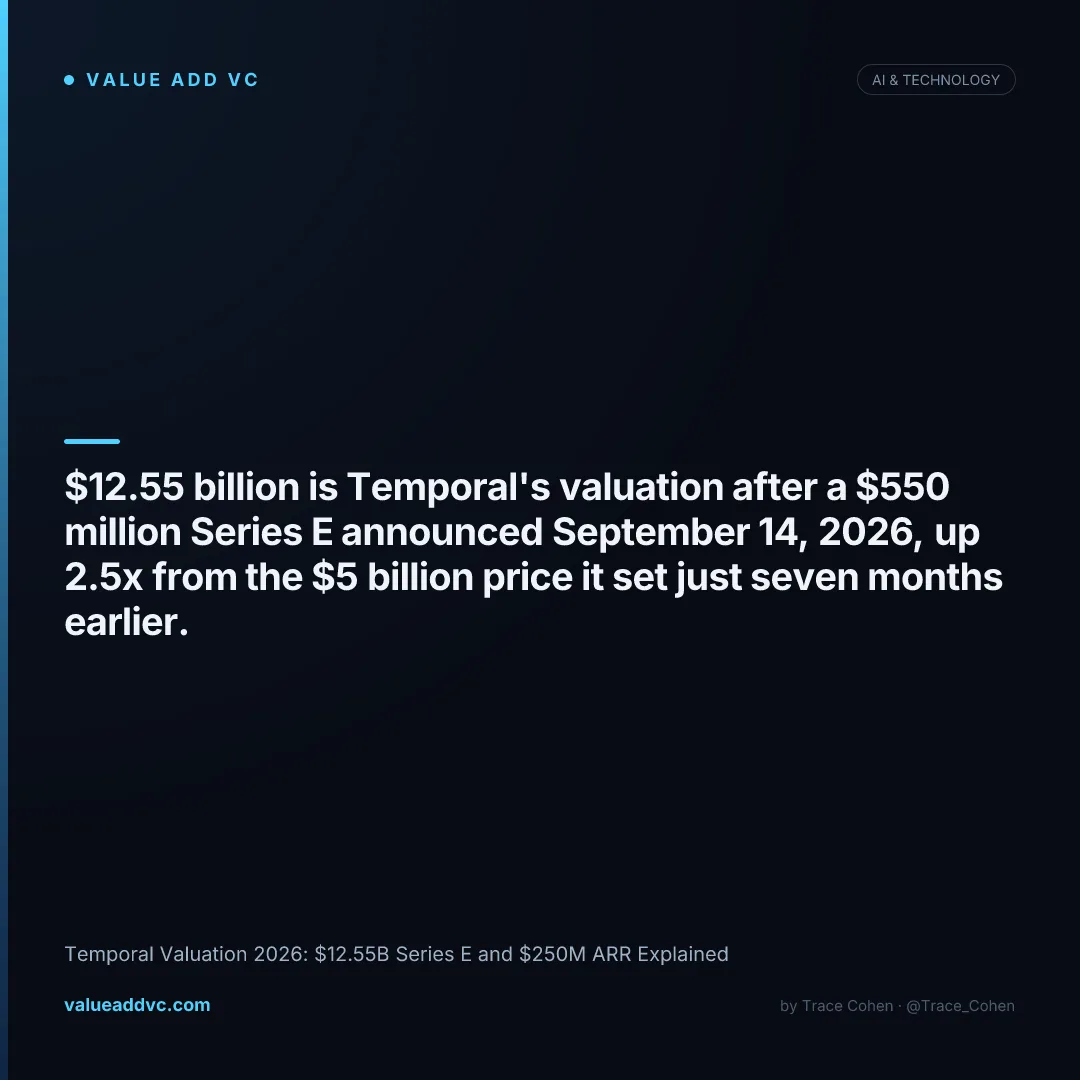
Temporal, the open-source workflow-orchestration company behind "Durable Execution," raised a $550 million Series E at a $12.55 billion valuation on September 14, 2026 — 2.5x the $5 billion price it set just seven months earlier — according to GeekWire's report on the round.
Sources: Temporal's own announcement, GeekWire, and Pulse2, checked September 24, 2026.
Temporal's Valuation: The Full 2025-2026 Trajectory
Temporal's valuation has moved faster over the past 12 months than almost any other infrastructure company outside frontier AI labs. The company was valued at $2.5 billion in an October 2025 secondary transaction, doubled to $5 billion in a $300 million Series D that closed February 17, 2026 — led by Andreessen Horowitz, joined by Lightspeed and Sapphire Ventures — and then jumped another 2.5x to $12.55 billion in its September 2026 Series E, all inside roughly eleven months.
| Date | Round | Amount | Valuation | Lead(s) |
|---|---|---|---|---|
| Oct 2025 | Secondary sale | $105M | $2.5B | Not fully disclosed |
| Feb 17, 2026 | Series D | $300M | $5B | a16z, joined by Lightspeed, Sapphire |
| Sept 14, 2026 | Series E | $550M | $12.55B | Lightspeed, Wellington, Goldman Sachs Alternatives, Tiger Global |
Sources: GeekWire (Series D) and Temporal's own announcement (Series E), checked September 24, 2026.
How Does Temporal Make Money?
Temporal runs an open-core business. The core Temporal engine — the software that implements Durable Execution, a technique for preserving an application's state so a workflow can survive a crash, a timeout, or a failed API call and resume exactly where it left off instead of restarting — is free, open source, and released under the MIT license. Anyone can self-host it.
The company makes money from Temporal Cloud, a managed version of the same engine sold to enterprises that don't want to operate and scale Temporal clusters themselves. Open-source adoption functions as the top of that funnel: self-hosted Temporal installations passed 43 million in August 2026, up 134% since January 2026, per the company's own Series E announcement — and a share of that self-hosted base converts into paying Temporal Cloud customers as their usage scales past what a small internal team wants to operate.
Temporal was founded in 2019 by Maxim Fateev and Samar Abbas, who met building Amazon's Simple Workflow Service and later worked together again on Uber's internal Cadence workflow engine before spinning Temporal out as an open-source successor to both. Fateev, originally CEO, moved to CTO in 2024 when Abbas took over as chief executive.
Why AI Agents Are Driving the Growth
Durable Execution existed years before the current AI-agent wave — Temporal originally sold it for conventional distributed systems like payment processing and order fulfillment — but it maps unusually well onto a newer problem: AI agents that run multi-step, minutes-to-hours-long tasks, where any single step (a model call, a tool invocation, an API timeout) can fail partway through. Without durable execution, a failure forces the whole agent workflow to restart from scratch; with it, the workflow resumes from the exact point of failure.
That's the growth story GeekWire's reporting attributes the Series E to: demand from companies building production AI-agent systems that need workflows to survive failures reliably, not just demos that work once in a controlled test. Temporal's customer list — which per its own announcement includes OpenAI, Snap, Nvidia, Netflix, and JPMorgan Chase — spans both the AI labs building agents directly and large enterprises adopting agentic workflows internally, suggesting the demand isn't confined to one segment of the market.
Where I could be wrong
A $12.55 billion valuation against roughly $250 million in annualized revenue works out to a revenue multiple of about 50x — high even by 2026 AI-infrastructure standards, and a number that assumes Temporal's 200%+ growth rate holds for several more years rather than decelerating the way most infrastructure businesses eventually do as they scale off a larger revenue base. Two markups this steep this close together (2x in four months, then 2.5x in seven) also raise the ordinary risk of any fast-moving private round: the price is set by whichever growth investors are most enthusiastic in a specific quarter, not by multiple years of public-market price discovery.
The open-core model carries its own tension: Temporal needs open-source adoption to keep growing (43 million installations and counting) to feed its Cloud funnel, but every self-hosted deployment that stays self-hosted indefinitely is revenue the company never captures. Competing directly against your own free product is a structural challenge every open-core company faces, and Temporal's ability to keep converting a rising share of that self-hosted base into Cloud customers — rather than just growing the free tier — is the thing to watch in future disclosures.
Competition is real, too: AWS Step Functions, Apache Airflow, and newer entrants like Inngest and Windmill all compete for some portion of the workflow-orchestration and durable-execution market, and a cloud provider bundling a comparable capability into its core platform is a standing risk for any independent infrastructure vendor selling on top of the major clouds.
Is Temporal's $12.55B Number Justified?
The case for the price rests on real, disclosed fundamentals that are unusually strong for a company at this valuation: more than $250 million in annualized revenue, growth above 200% year over year, net dollar retention above 200%, and a customer list that includes some of the largest AI labs and enterprises in the world. The case against it is the multiple itself — 50x revenue is a bet that today's growth rate persists for years, not quarters — and the fact that two back-to-back valuation doublings in under a year reflect current investor appetite for AI-infrastructure names as much as they reflect Temporal's own execution.
For now, Temporal's growth numbers back up the story better than most companies repricing this fast can claim. Whether $12.55 billion holds up will depend on whether Temporal keeps converting open-source adoption into Temporal Cloud revenue at a rate that can plausibly grow into a valuation now pricing in years of continued 200%+ growth.
The bottom line:
Temporal is worth $12.55B after a $550M Series E — up 2.5x in seven months, on $250M ARR growing 200%+ YoY, but priced at roughly 50x revenue on the bet that growth doesn't slow.
Track how AI-infrastructure valuations are moving across the market in our AI agent startups deep dive at Value Add VC. Originally published in the Trace Cohen newsletter.
Latest from the Pulse
Get VC data most people never see
— 100% free
Weekly benchmarks, valuations, and fund data. Join 5,000+ investors. No spam.