
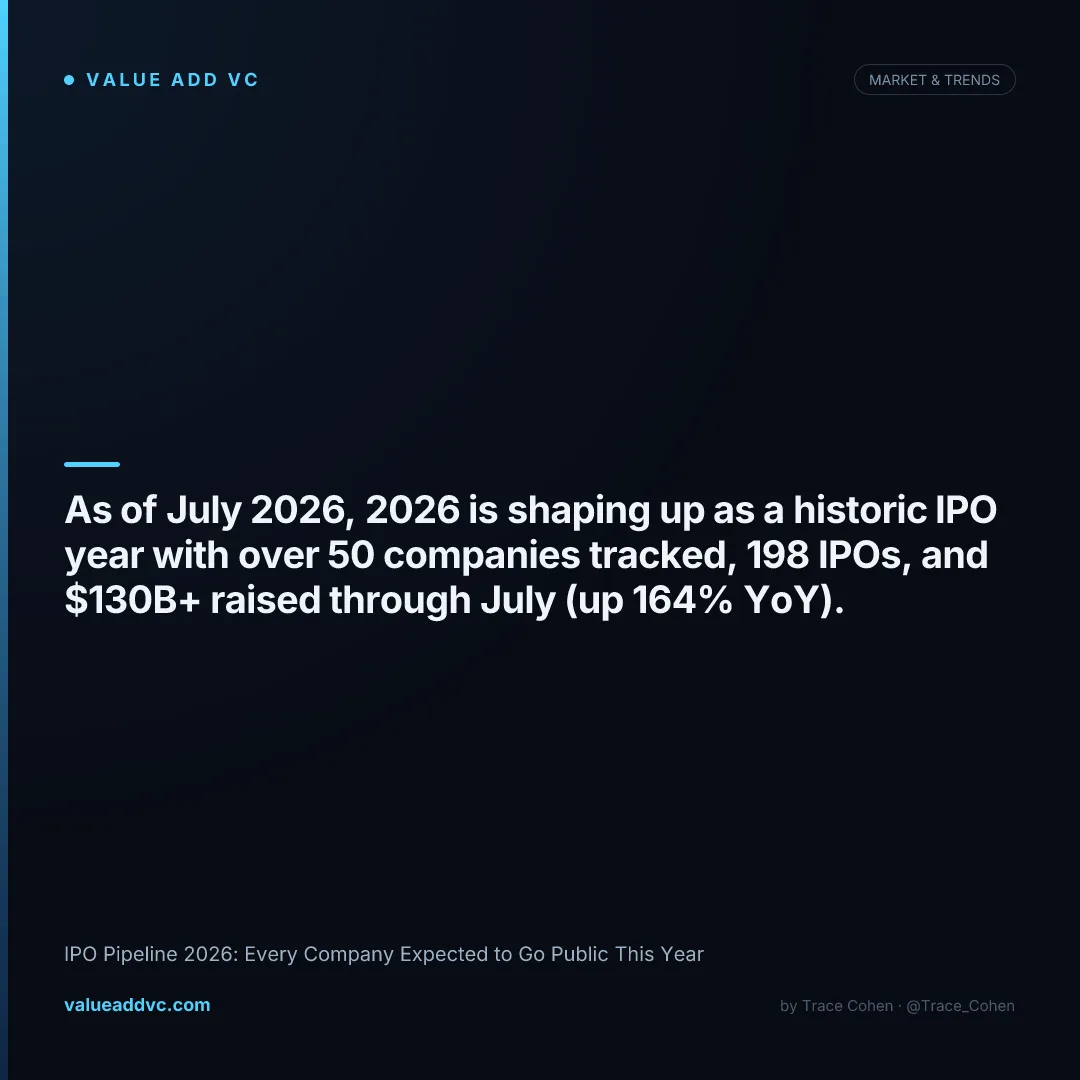
The 2026 IPO pipeline is the most anticipated since 2021 — but anticipation hasn't translated into listings at the pace the market hoped.
As of mid-July 2026, eleven major companies have already listed: SpaceX (Nasdaq: SPCX, Jun 2026, ~$1.77T), SK Hynix (Nasdaq: SKHY, Jul 2026, ~$1T — largest foreign US IPO ever), Cerebras (Nasdaq: CBRS, May 2026, +68% day-one close — the largest tech IPO of 2026 and a direct Nvidia challenger), Firefly Aerospace (Nasdaq: FLY, May 2026, revenue up 572% YoY), Fervo Energy (Nasdaq: FRVO, May 2026, biggest renewable IPO ever), plus consumer and beauty names including Klarna, Chime, Figma, StubHub, and Wella (KKR's beauty platform listing). Four more have filed S-1s: Anthropic (~$965B), OpenAI, Standard Nuclear, and Syntiant. Shein just won Hong Kong listing approval, and Panera Brands has filed confidentially. And the waiting room is still packed — Shield AI, Perplexity AI, Cohere, Revolut, Quantinuum, and Saronic are all rumored or expected to follow. Klarna's bumpy first year as a public company — a $40 debut price that's since roughly halved — is the case study bankers cite most when pricing risk for the rest of this list.
Here's the complete picture — now covering 50+ companies: who's listed, who's filed, who's stalling, and what the real blockers are.
Looking for today's status? This analysis is a mid-July snapshot. For notable 2026 IPOs that have filed, priced, been postponed or been withdrawn, with dates and sources, see the live tracker of notable 2026 IPOs.
The 2026 IPO Window: Market Conditions
Three things define the 2026 IPO environment. First, the Fed held rates in the 4.25–4.5% range through Q1 2026, stabilizing but not aggressively easing. Second, CoreWeave's March 2025 IPO — priced at $40/share (cut from an initial $55 target) for a ~$23B valuation — demonstrated that AI-infrastructure businesses can clear the public markets at reasonable multiples. Third, institutional LPs are demanding DPI. The 2021 vintage cohort is now 5+ years old, and limited partners want cash, not more paper marks.
The window is open — but it's selective. Companies with positive operating cash flow, clear revenue trajectories, and proven unit economics are clearing. Companies that are still pre-profitable and dependent on AI-hype multiples are waiting.
The Full 2026 IPO Pipeline
Status as of July 15, 2026. Listed companies show actual IPO valuation. Remaining pipeline shows targets or last reported secondary market prices. For where each company stands now, see the live tracker.
IPO priced at $135/share on Jun 12, 2026. Raised ~$75B — the largest IPO in history. Includes Starlink satellite internet business.
US ADR listing priced at $149/share on Jul 10, 2026. Raised $26.5B — largest US IPO by a foreign company ever, surpassing Alibaba. World's #1 HBM chip maker. Rose 13% on day one to $168.01.
IPO priced at $185/share on May 14, 2026 (above raised range). Raised $5.55B — the largest tech IPO of 2026. Stock closed up 68% on day one. Order book 20x oversubscribed. 2025 revenue: $510M (+76% YoY). Widely seen as the clearest Nvidia challenger to reach the public markets.
IPO'd May 2026. Revenue up 572% YoY on Blue Ghost lunar lander and Alpha/Eclipse launch vehicle contracts. One of the strongest post-IPO revenue growth stories of the year.
IPO priced at $27/share on May 13, 2026. Raised $1.89B — biggest renewable energy IPO ever. Bill Gates-backed (Breakthrough Energy Ventures). Google deal for up to 3 GW. Rose 30% on debut.
IPO priced at $40/share on Sep 10, 2025. Raised $1.37B. Shares opened at $52 (+30%) on debut. Now trading ~$17.66, well below $46B 2021 peak.
IPO priced at $27/share on Jun 12, 2025. Shares opened at $43 (+59%) on debut. Largest US neobank by customers (~22M accounts).
IPO priced at $33/share on Jul 31, 2025. Adobe deal blocked by EU in Dec 2023 ($1B termination fee). IPO followed within 18 months.
IPO priced at $23.50/share on Sep 16, 2025, below its $16.5B target. Raised ~$800M. Profitable; benefiting from live-events recovery.
IPO priced at $32/share on May 21, 2025. Raised $437M. Musculoskeletal care platform with employer-sponsored health contracts.
Confidentially filed S-1 on June 1, 2026. Targeting October Nasdaq listing. Goldman Sachs, JPMorgan, Morgan Stanley leading. Raised $65B Series H at ~$965B valuation.
Confidentially filed S-1 on June 8, 2026. Originally targeting September but may wait until 2027. 800M+ weekly active users, ~$25B annualized revenue, but $14B in projected 2026 losses.
S-1 filed July 7, 2026. NYSE: STDN. 18.3M shares at $18–21/share, targeting $356M raise. TRISO fuel manufacturer for SMRs. Backed by a16z, Chevron Technology Ventures. Revenue: $3.36M LTM.
S-1 filed July 6, 2026. Nasdaq: SYTN. Targeting ~$300M raise. Edge AI inference chips (NDPs) for earbuds, wearables, drones. $270M LTM revenue. Intel Capital and Microsoft backed.
Filed confidentially Jan 6, 2026. Goldman Sachs and JPMorgan leading. 250M MAUs, $561M 2025 revenue (+29% YoY). Secondary market prices ~$8.5B (down 43% from $15B peak). No listing date confirmed.
Raised $5B Series H in May 2026 at $61B (2x in one year). Palmer Luckey says 'definitely' going public. CEO Schimpf says 'bad to IPO in hype cycle.' Won $20B Army contract. Targeting $4.3B 2026 revenue.
$42B employee share sale (Aug 2025). Redomiciled to US (Delaware). Hired IPO-veteran CFO. COO now citing 2027 target. $3.3B+ ARR. 190M+ monthly users. No S-1 filed.
Confidential S-1 filed Nov 2025, confirmed Apr 2026. Paused in March citing weak crypto markets. Co-CEO says '80% ready.' Now reportedly sliding to 2027. Deutsche Börse invested $200M in secondary.
Bloomberg reported July 1 that Plaid is 'considering' a US IPO with preliminary bank discussions. $8B valuation (Feb 2026). Visa $5.3B acquisition blocked by DOJ in 2021. Revenue +25% in 2025. 150M+ connected consumers.
CEO Ali Ghodsi told Bloomberg 2026 is 'a terrible year to go public.' $5.4B ARR growing 65% YoY. Positive free cash flow. Strategically waiting for less crowded conditions after mega-IPOs clear.
Hong Kong listing approved July 10, 2026, after abandoning earlier UK and US attempts amid scrutiny over sourcing practices and China ties. Targeting ~$3B raise.
Filed confidentially for IPO. Parent of Panera Bread, Einstein Bros. Bagels, and Caribou Coffee. JAB Holding-backed multi-brand restaurant platform.
Maker of the Hivemind autonomous-flight software and V-BAT drones. Projected ~$540M 2026 revenue. Riding the same defense-tech tailwind that's lifted Anduril.
AI-native search engine positioned as a Google challenger. ~$500M ARR. CEO Aravind Srinivas has said the company is targeting a 2027–2028 IPO, not 2026.
Nvidia-backed GPU-leasing neocloud reportedly raising up to $4B at a $14.5B pre-money valuation, led by Blackstone and Coatue. IPO target pushed from 2026 to 2027.
Enterprise-focused foundation model company. ~$150M ARR. Considered one of the more probable 2026 AI-model IPO candidates behind Anthropic and OpenAI.
UK-based neobank with 50M+ customers globally. Secondary-market valuation has climbed to $150–200B. Leadership has pointed to a 2027–2028 listing window.
Honeywell subsidiary and one of the best-funded quantum computing companies. Honeywell has signaled a targeted spinoff or IPO in 2026 or 2027.
Builds autonomous surface vessels for the US Navy. a16z-backed. Part of the same defense-tech wave as Anduril and Shield AI, though no filing timeline confirmed.
Pivoted to SMB and enterprise after exiting retail consumer. Strong growth in spend management platform.
Valued at $159B in a February 2026 employee tender offer, up from $91.5B a year earlier. Leadership has consistently pushed back on IPO timeline. Employee liquidity managed via secondaries.
The Valuation Reset: 2021 vs 2026
Nearly every company in the pipeline is pricing at a meaningful discount to its 2021 peak. This is not weakness — it is how rational markets work after a correction. What matters is whether these companies have improved their underlying businesses enough to justify even the lower number.
| Company | 2021 Peak Valuation | 2026 Expected | Change |
|---|---|---|---|
| Klarna | $46B | $15.1B (listed) | –67% |
| Chime | $25B | ~$25B (listed) | Flat |
| Cerebras | $8B (2024) | $56.4B (listed) | +605% |
| Databricks | $43B (2023 trough) | ~$134B (delayed) | +211% from trough |
| Anduril | $30.5B (2025) | ~$61B | +100% |
| Discord | $15B | ~$8.5B secondary | –43% |
| Canva | $40B | $42B (2027 target) | +5% |
| Kraken | $20B | ~$13.3B | –33% |
| Plaid | $13.4B | ~$8B | –40% |
| Stripe | $95B (2021) | $159B (Feb 2026 tender) | +67% |
| Shield AI | $5.3B (2024) | $12.7B | +140% |
| Cohere | $5.5B (2024) | ~$7B | +27% |
| Revolut | $45B (2024) | $150–200B secondary | +233 to +344% |
| Quantinuum | $5B (2024) | $10B+ | +100% |
Source: last known private round pricing vs. analyst consensus pre-IPO estimates as of mid-2026. Actual IPO pricing will vary.
What's Holding Back the IPO Pipeline
Four structural issues are keeping the pipeline from clearing faster — the same dynamics behind why hundreds of venture-backed unicorns that should have listed years ago are still stuck, a problem we sized up in our count of the 200-company IPO backlog:
The 2021 valuation hangover
Most of these companies last raised at 2021 multiples — 30–100x revenue. Public markets are pricing comparable companies at 8–15x revenue in 2026. Founders and boards are waiting for a window that justifies a higher price, but that window may never fully reopen.
Rate sensitivity and macro uncertainty
The IPO market is deeply correlated with the 10-year Treasury yield. With rates stabilizing (not falling) at 4.25–4.5%, institutional investors are demanding higher earnings yields from equities, compressing what they'll pay for growth.
Secondary market alternatives
The rise of GP-led secondaries and tender offers has reduced the urgency for companies to go public to generate employee liquidity. Stripe's annual secondary program and Databricks' $10B raise show that large private companies can manage liquidity needs without the costs and scrutiny of an IPO.
Regulatory complexity
Cerebras was the clearest example: a well-positioned AI chip company couldn't go public for over a year because of a single foreign investor, until it restructured G42's stake into non-voting shares to clear CFIUS. Shein is now living the same story on the trade-and-sourcing side, having abandoned both a UK and a US listing attempt before landing Hong Kong approval. The CFIUS and cross-border-scrutiny process is slower and less predictable than at any point in the past decade, particularly for companies with exposure to defense, AI infrastructure, or China-linked supply chains. Any fund that invested alongside sovereign wealth funds or Gulf state vehicles in AI infrastructure companies — or backed a China-connected consumer brand — needs to war-game this scrutiny before the S-1 process starts, not during it.
What VCs and LPs Are Watching For
From conversations across the LP community, these are the deals with the most pressure attached:
| Company | Who's Waiting | Est. VC Value at IPO | Vintage Funds Affected |
|---|---|---|---|
| Anthropic | Google, Spark Capital, a16z | $50B+ unrealized | 2021–2025 funds |
| Stripe | Sequoia, a16z, Founders Fund | $15B+ unrealized | 2010–2016 funds |
| Databricks | Andreessen Horowitz, NEA | $10B+ unrealized | 2013–2021 funds |
| Anduril | a16z, Thrive, Founders Fund | $8B+ unrealized | 2017–2024 funds |
| Discord | Greenoaks, Index, Greylock | $2–3B+ gains | 2015–2021 funds |
| Canva | Blackbird, Felicis, Sequoia | $5B+ unrealized | 2013–2021 funds |
| Perplexity AI | IVP, NEA, Nvidia | $3B+ unrealized | 2022–2025 funds |
| Revolut | Index, DST Global, Tiger Global | $10B+ unrealized | 2015–2021 funds |
| Saronic | a16z, General Catalyst | $2B+ unrealized | 2022–2025 funds |
Track public market performance and IPO outcomes on the Tech IPO Dashboard at Value Add VC. Historical IPO volume data is available on our IPO tracker.
My Take: 2026 Is Already a Historic IPO Year
Eleven major listings in 14 months, headlined by SpaceX ($1.77T) and SK Hynix ($26.5B raise) — this is the most active IPO environment since the 2021 peak. And the second half is stacked: Anthropic, OpenAI, Standard Nuclear, and Syntiant have all filed. Discord and Panera Brands have confidential filings in. Shein just cleared Hong Kong approval. The pipeline is actually clearing — and it keeps widening: we're now tracking 50+ companies, up from 40 just a month ago, as Shield AI, Perplexity, Cohere, Revolut, Quantinuum, and Saronic all enter the conversation.
The pattern is clear: companies with real revenue and clear narratives are pricing well. Cerebras (+68% day-one close, the largest tech IPO of 2026 and a legitimate Nvidia challenger), Firefly Aerospace (revenue +572% YoY), Fervo Energy (+30%), and SK Hynix (+13%) all cleared above range or posted standout growth. The AI, space, defense, and energy themes are all working — and Shield AI and Saronic look like the next wave of defense-tech listings following Anduril's lead.
What's slipping is also telling. Databricks' CEO called 2026 "a terrible year to go public" — not because the market is bad, but because the queue is too crowded. Kraken paused on weak crypto markets. Anduril's CEO doesn't want to IPO during a hype cycle. Canva pushed to 2027. Perplexity and Revolut are both explicitly targeting 2027–2028 rather than rushing into a crowded 2026 window.
The lesson: the window is open, but only for the ready. Companies with clean narratives, real revenue, and sector tailwinds (AI, defense, space, energy) are clearing fast. Everyone else is discovering that "waiting for the perfect window" is just another way of saying 2027.
198+ IPOs. $145B+ raised. 50+ companies tracked. And the biggest names are still ahead.
2026 isn't just a recovery — it's the biggest IPO year in a generation. The question isn't if the pipeline clears, but who's next.
Track the 2026 IPO pipeline in real time on the Tech IPO Dashboard at Value Add VC. Originally published in the Trace Cohen newsletter.
Latest from the Pulse
Get VC data most people never see
— free to subscribe
Trace's notes on venture, AI and startups, a few times a week. Join 5,000+ subscribers. No spam.
No spam, unsubscribe anytime. Sent via Substack · Privacy · or subscribe on Substack ↗