

$110 million is what Taktile raised in a Goldman Sachs-led Series C in June 2026. That's the short answer. The longer answer is more interesting.
Taktile builds AI decisioning software that lets banks and insurers automate the calls that used to require a human underwriter or claims adjuster — and it just pulled in growth-equity money from Goldman Sachs Alternatives, not a typical fintech-focused fund. The round takes total funding to $184 million since the company's 2020 founding, but Taktile still won't say what it's worth. Here's what the numbers do tell us, and how the business stacks up against Zest AI and Provenir, the two most obvious comparables in AI-driven financial decisioning.
What Is Taktile's Series C Funding and Valuation?
Taktile's Series C is a $110 million round announced in June 2026, led by Growth Equity at Goldman Sachs Alternatives with participation from existing investors Balderton Capital, Index Ventures, Tiger Global, Y Combinator, and Dig Ventures. Taktile has not disclosed a post-money valuation for the round — CEO Maik Taro Wehmeyer confirmed the funding amount publicly but declined to give a number, which is common when a single growth-equity lead prices a deal privately rather than syndicating a round with a public term sheet.
How Much Money Has Taktile Raised in Total?
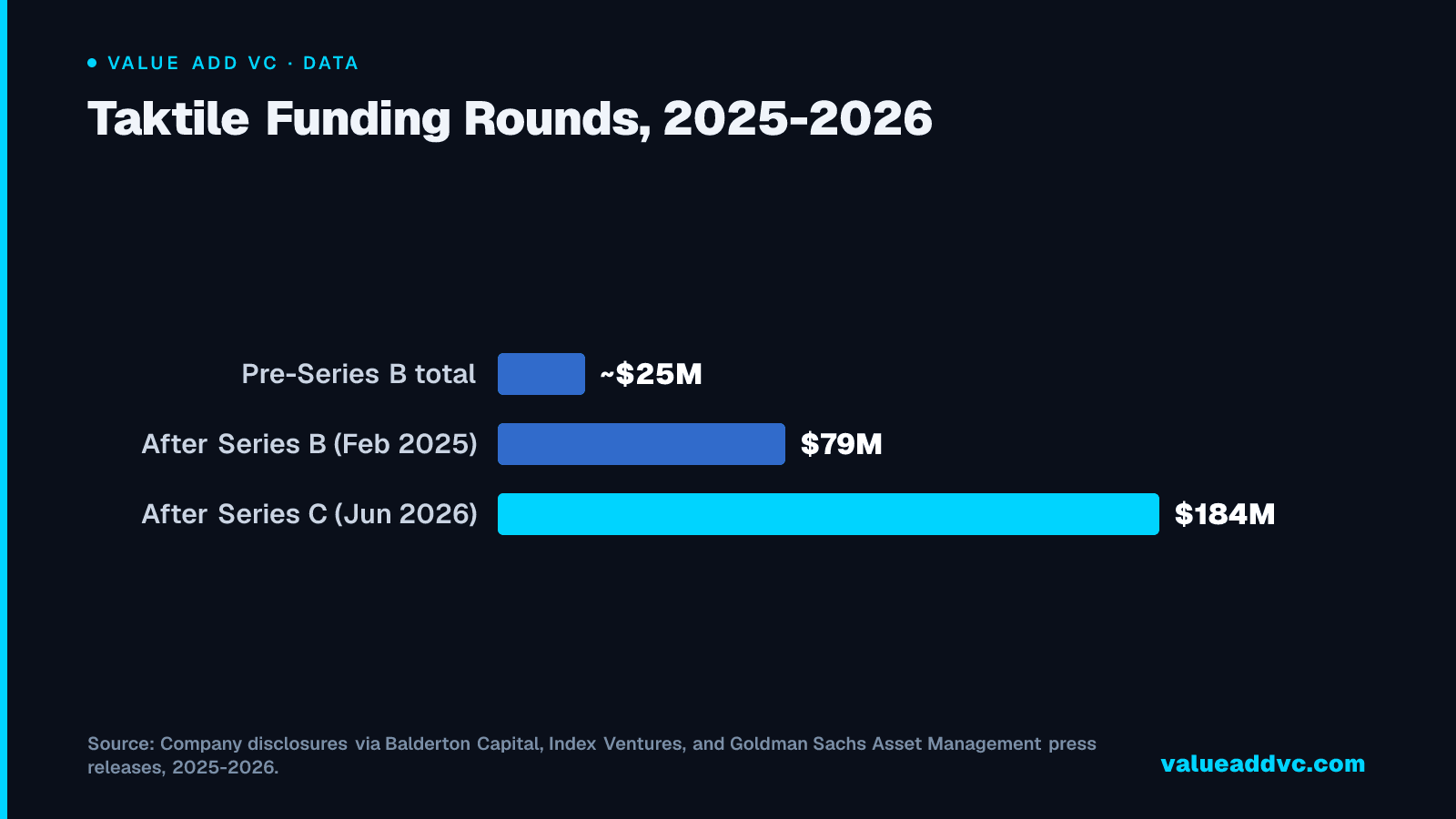
$184 million is Taktile's total funding raised since its 2020 founding, built up over three main rounds. The company raised a $54 million Series B in February 2025, led by Balderton Capital with Index Ventures, Tiger Global, Y Combinator, Prosus Ventures, and Visionaries Club participating — a round that brought cumulative funding to roughly $79 million at the time. Fourteen months later, the $110 million Series C more than doubled that total, a funding pace that tracks the same 3.5x ARR growth and 4x customer growth Taktile reported for 2024.
Taktile Funding Rounds, 2025-2026
Taktile roughly doubled its cumulative funding in 14 months, moving from a $54M Series B to a $110M Series C as customer count and ARR both accelerated
Company disclosures via Balderton Capital, Index Ventures, and Goldman Sachs Asset Management press releases, 2025-2026.
Data
| Item | Value |
|---|---|
| Pre-Series B total | ~$25M |
| After Series B (Feb 2025) | $79M |
| After Series C (Jun 2026) | $184M |
What Does Taktile's AI Decisioning Platform Actually Do?
Taktile sells what it calls an Agentic Decision Platform: a workflow builder that lets a bank or insurer's own risk team combine AI agents, configurable business rules, and human sign-off into a single automated pipeline for underwriting, claims, fraud screening, and anti-money-laundering checks. Unlike vendors that push their own proprietary credit score, Taktile is score-agnostic — it calls a customer's existing risk models and data providers as inputs, then lets risk analysts iterate on decision policy logic directly in a low-code interface rather than filing a change request with a data science team. That positioning is why Taktile's typical implementation runs four to eight weeks, a timeline it markets against slower, more rigid enterprise decisioning suites.
Who Are Taktile's Customers and How Big Is the Platform?
150+ customers across 24 markets now run on Taktile, spanning fast-growing fintechs like Mercury, Kueski, and Zilch alongside larger, more established names such as Allianz and Rakuten Bank. The platform processes over 30 million automated decisions every week as of 2026. Growth accelerated sharply in 2024, when Taktile quadrupled its customer base and grew annual recurring revenue 3.5x — the growth curve that underpinned both the 2025 Series B and this year's Series C.
How Does Taktile Compare to Zest AI and Provenir?
Zest AI and Provenir are the two companies most often named alongside Taktile in AI-driven financial decisioning, but each takes a different approach. Zest AI leads with its own proprietary credit-scoring models and is most often deployed by U.S. banks and credit unions modernizing consumer underwriting, while Provenir is an older, enterprise-paced decisioning suite known for deep integrations and long implementation cycles rather than speed. Taktile's pitch sits between them: score-agnostic like Provenir, but built for the faster, self-serve policy iteration that Zest AI's more rigid scoring layer doesn't offer.
| Company | Founded | Total funding | Latest round | Est. valuation | Implementation |
|---|---|---|---|---|---|
| Taktile | 2020 | $184M | $110M Series C (2026) | Undisclosed | 4-8 weeks |
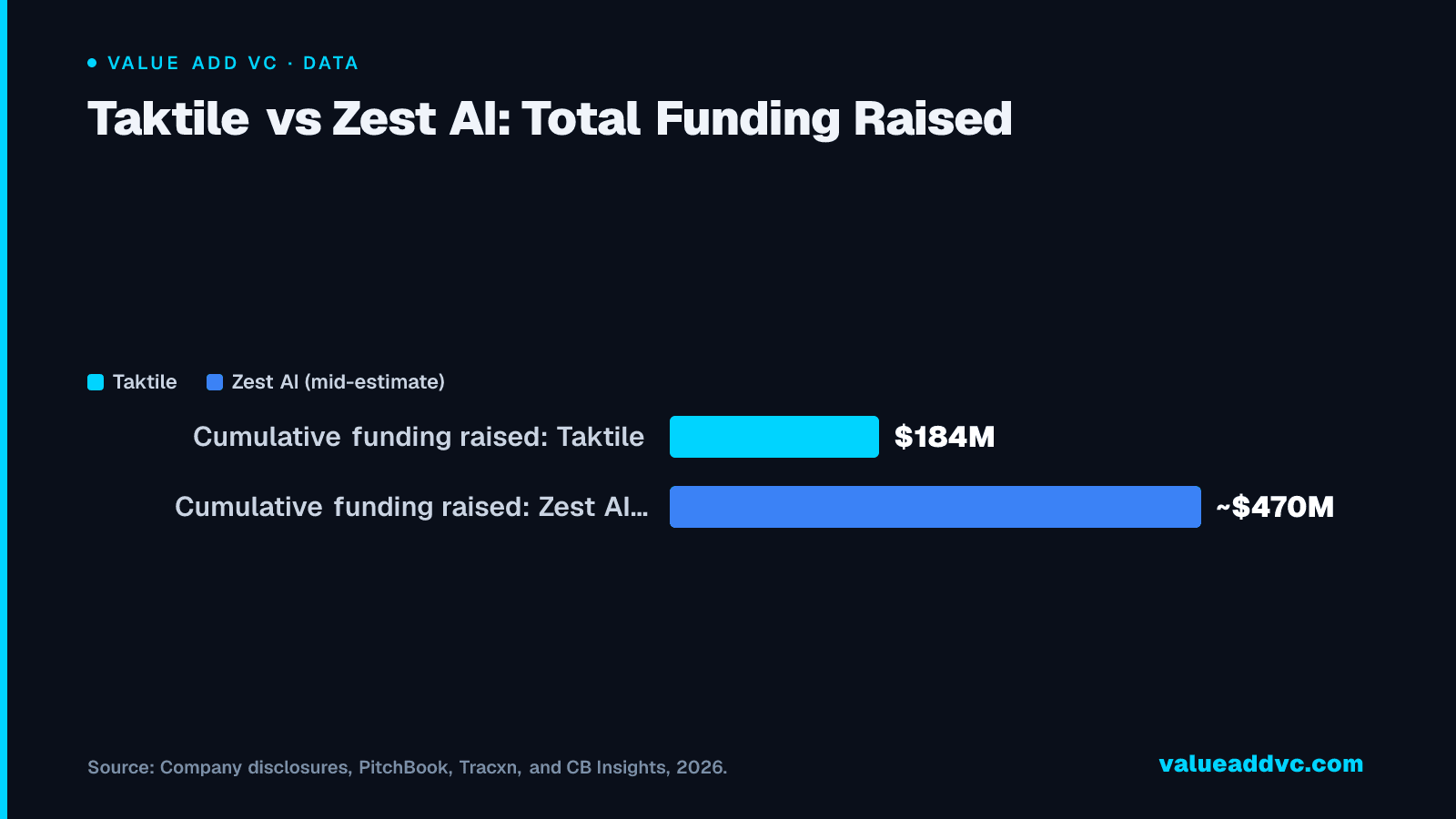
| Zest AI | 2009 | $390M-$554M* | ~$200M growth round (2024-25) | Undisclosed | Weeks to months |
| Provenir | 2002 | Largely self-funded | N/A (bootstrapped growth) | ~$243M (est.) | Months |
Figures are 2026 estimates blended from company press releases (Taktile, Goldman Sachs Asset Management, Balderton Capital), Tracxn, PitchBook, and CB Insights, which report differing totals for Zest AI's cumulative funding ($319M-$553.9M depending on source). Provenir's valuation and revenue are third-party estimates (Prospeo, CB Insights), not company-disclosed figures.
Taktile vs Zest AI: Total Funding Raised
Company disclosures, PitchBook, Tracxn, and CB Insights, 2026.
Data
Why Won't Taktile Disclose Its Series C Valuation?
Growth-equity-led rounds like this one are priced through direct negotiation with a single lead investor rather than a syndicated process with multiple term sheets circulating, which makes the number far easier to keep private than in a traditional multi-VC Series C. Goldman Sachs Alternatives' Growth Equity arm — the same unit behind late-stage bets across fintech and enterprise software — typically structures these deals with valuation terms disclosed only to the company's board and cap table, not the press. For context on how VC and growth-equity funds report these numbers back to their own investors, see our breakdown of VC and PE fund performance reporting standards.
What Does Taktile's Round Say About AI Fintech Investing in 2026?
A bank-focused growth-equity arm — not a fintech-specialist fund — led this $110 million round, which is itself the more interesting signal than the dollar figure. Goldman Sachs Alternatives typically writes growth-equity checks into companies with proven, recurring revenue rather than early product-market-fit bets, so its decision to lead Taktile's Series C reads as a vote that AI decisioning software for regulated financial institutions has moved from experimental pilot budgets into durable, renewable enterprise contracts. That shift matters for the broader AI-in-fintech category: infrastructure vendors selling into banks and insurers face far longer sales cycles and heavier compliance review than a typical B2B SaaS company, so a $110 million check from a bank-adjacent investor is a stronger endorsement of durability than the same amount from a generalist venture fund would be.
It also fits a pattern we've tracked across 2025 and 2026: capital concentrating in AI companies that sell directly into regulated, high-stakes workflows — underwriting, claims, compliance, legal review — rather than generic productivity tools. Taktile's four-to-eight-week implementation window and score-agnostic architecture are the product decisions that make that regulated-workflow sale possible at all; a vendor that requires a bank to rip out its existing credit models before it can go live simply won't close deals at the pace Taktile has, which is likely why its customer count quadrupled in a single year even before this round closed.
The Bottom Line
Taktile's $110 million Series C, on top of $184 million raised since 2020, is a clear signal that Goldman Sachs sees durable demand for AI decisioning software that banks and insurers can configure themselves rather than outsource entirely. The undisclosed valuation makes a direct comparison to Zest AI's roughly $470 million in estimated cumulative funding or Provenir's roughly $243 million estimated value imprecise, but the underlying metrics — 150+ customers, 30 million weekly decisions, and 3.5x ARR growth in 2024 — put Taktile on a trajectory that would justify a meaningfully larger valuation than its last disclosed round implied.
Track fintech and AI infrastructure funding rounds like Taktile's on the AI Valuations dashboard at Value Add VC.
Latest from the Pulse
Get VC data most people never see
— free to subscribe
Trace's notes on venture, AI and startups, a few times a week. Join 5,000+ subscribers. No spam.
No spam, unsubscribe anytime. Sent via Substack · Privacy · or subscribe on Substack ↗