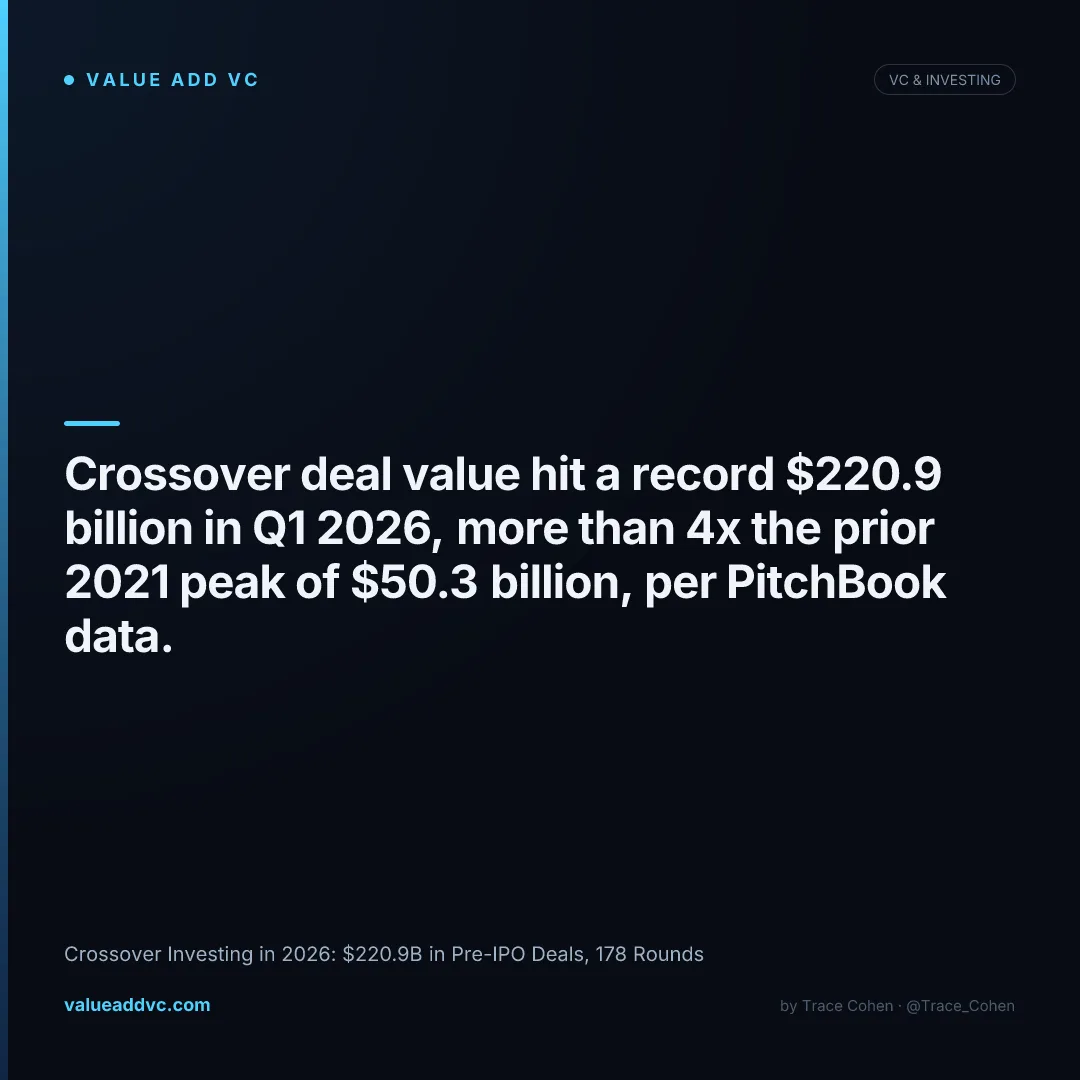
Crossover deal value hit a record $220.9 billion in Q1 2026 — more than 4x the prior 2021 peak of $50.3 billion — but spread across just 178 rounds, down from 425 at the height of 2021. Crossover investing isn't broadly "back"; it's concentrated in a handful of AI mega-rounds, and by Q2 the hedge funds writing those checks had already started pulling back.
Coatue, Tiger Global, Altimeter, D.E. Shaw, Fidelity, and T. Rowe Price all showed up in 2026's biggest private rounds. But the deal count tells a different story than the dollar figure, and that gap between the two numbers is the actual story institutional investors are watching this year.
Figures blended from PitchBook Q1 2026 crossover deal data, PitchBook's 2025 crossover deal-value share report, and Institutional Investor's 2026 Tiger Global coverage.
Is Crossover Investing Back in 2026?
Yes, by dollar volume: US crossover deal value hit a record $220.9 billion in Q1 2026, more than four times the previous quarterly peak of $50.3 billion set at the end of 2021, according to PitchBook. But deal count stayed low — just 178 rounds, versus 425 in Q4 2021 — which means the same capital, or less, is now chasing a far smaller number of companies. The pattern looks less like a broad-based venture recovery and more like a "Mag 7 of private markets" phenomenon, hyper-concentrated in a handful of AI names.
Crossover Investing VC 2026: Dollars Up, Deal Count Down
Over the last 10 quarters, US crossover firms have averaged roughly 170 deals per quarter — about one-third of 2021's pandemic-era pace. Crossover firms' share of total US VC deal value also fell from 42% in 2024 to 38% in 2025, per PitchBook, before the Q1 2026 spike reversed that trend on a dollar basis only. The deal-count chart below makes the concentration clear: Q1 2026's 178 rounds sit below both the 2021 peak and the 10-quarter average, even as the dollars deployed shattered every prior record.
The reason is simple: a small number of enormous rounds now account for most of the dollar total. Altimeter, Coatue, and D.E. Shaw all participated in OpenAI's $110 billion round in February 2026, and Coatue, GIC, and D.E. Shaw led Anthropic's $30.6 billion Series G at a $380 billion valuation the same month. Two companies, roughly $140 billion in combined new capital — that's most of a quarter's crossover total sitting in two checks.
Who's Actually Writing the Checks: Coatue, Tiger Global, and the Rest
Coatue Management closed roughly a dozen VC deals in Q2 2026 alone and co-led both the OpenAI and Anthropic mega-rounds — making it the single most active crossover name in late-stage AI this year. Tiger Global, by contrast, is running a far smaller book than its 2021 self: the firm manages an estimated $50-60 billion in 2026, down from a roughly $95 billion peak, and its newest private vehicle, PIP 16, closed at just $2.2 billion — an 82% drop from the $12.7 billion PIP 15 fund it raised in 2022, even as its overall portfolio has grown to 791 companies.
Fidelity, T. Rowe Price, and D.E. Shaw round out the list of repeat crossover participants, typically entering at Series C or later — crossover investors make their first check at Series C+ more than 60% of the time, according to Dealroom data. The economic logic hasn't changed since the mid-2010s version of this trend: companies backed by crossover investors go public 2.3x more often, 50% faster, and at 148% higher valuations than comparable non-crossover-backed peers, which is exactly the asymmetry that keeps pulling public-market money into private rounds.
Crossover Investing 2026 vs. the 2021 Boom: Side-by-Side
The table below compares the two eras of crossover activity directly. The headline dollar figure looks similar or bigger in 2026, but nearly every underlying structural metric — deal count, fund sizes, sector breadth, diligence pace — points to a much more selective, AI-concentrated version of the same playbook.
| Metric | Q4 2021 peak | Q1 2026 |
|---|---|---|
| Quarterly deal value | $50.3B | $220.9B |
| Quarterly deal count | 425 | 178 |
| Avg. check size (implied) | ~$118M | ~$1.24B |
| Sector concentration | Broad (SaaS, fintech, consumer) | Narrow (frontier AI labs) |
| Tiger Global flagship fund size | $12.7B (2022 vehicle) | $2.2B (PIP 16) |
| Typical entry stage | Series B onward | Series C+ (60%+ of deals) |
| Diligence pace | Days (light diligence) | Weeks (valuation scrutiny) |
Figures are 2026 estimates blended from PitchBook Q1 2026 crossover deal data, Institutional Investor's 2026 Tiger Global reporting, and Dealroom's crossover investor entry-stage analysis. Average check size is implied from total deal value divided by deal count and is not firm-reported.
How the Narrative Swung: From "Crossover Is Back" to "Crossover Is Retreating" in Six Months
Both headlines were written about the same six months of 2026, and both were technically true. In Q1, the story was re-entry: hedge funds piling back into late-stage venture after two quiet years, capped by the OpenAI and Anthropic mega-rounds that pushed quarterly deal value to a record $220.9 billion. By Q2, the story had flipped to retreat — Fidelity and T. Rowe Price cutting new-deal activity sharply (crossover mutual funds got roughly 67% pickier on deal count versus the 2021 pace while concentrating what remained into a handful of trillion-dollar AI names), and hedge funds pausing new commitments as public-market jitters over AI concentration bled into the exact comps they price private rounds against.
The contradiction resolves once you separate dollars from breadth. The re-entry was real but only for frontier AI labs; the retreat was real but only outside them. The scar tissue driving both behaviors is the same: 2022-23 crossover marks averaged roughly -35%, and the mutual funds that carried illiquid unicorn stakes through that drawdown returned in 2026 determined to only hold positions with a visible exit. The June 2026 SpaceX IPO — $85.7 billion in gross proceeds, the largest US listing on record — and Anthropic's confidential S-1 gave this cohort exactly that, which is why the checks kept flowing to those names even as everything else froze.
So the honest one-line summary of crossover investing in 2026 isn't "back" or "retreating" — it's barbelled. Record dollars into two or three IPO-track AI labs, near-total absence everywhere else, and a Q2 pause that arrived the moment public comps wobbled.
Fidelity and T. Rowe Price: The Markdowns Behind the Record Number
Fidelity and T. Rowe Price both show up on the list of repeat crossover participants earlier in this post, but their own 2026 filings tell a split story rather than a simple comeback. Mutual funds — including Fidelity — marked down roughly 50 private software companies by an average of 20% in Q1 2026, implying tens of billions of dollars in aggregate paper losses, according to Bloomberg's July 6, 2026 analysis of mutual fund disclosures. The steepest cuts landed on sales and ML-tooling software: Outreach was marked down 51.4% and DataRobot 50.8%, with Epic Games, Databricks, and Canva also cut by double digits. Fidelity declined to comment on the specific marks when Bloomberg asked. In the same disclosures, AI and semiconductor holdings moved the opposite direction — marked up 40% on average — a split visible from the fund-accounting side, not just the deal-flow side covered above.
One concrete example of what these cuts look like at the company level: Fidelity has marked down its stake in Indian conversational-messaging startup Gupshup four times since its original 2021 secondary purchase at a $1.4 billion valuation — to roughly $697 million in July 2023, about $486 million in December 2024, and $278 million as of January 31, 2026, an 80%-plus cumulative reduction, according to regulatory filings reported by Entrackr and Business Standard. The disclosures cite roughly 300 layoffs and a 5% FY2025 revenue decline at the company. Gupshup isn't an AI mega-round name — it's exactly the kind of late-stage, pre-AI-boom SaaS position that crossover funds bought heavily in 2021 and are now working through, one quarterly NAV update at a time.
What the headline misses
It would be too neat to call this "Fidelity and T. Rowe Price retreating from pre-IPO investing." T. Rowe Price's own disclosures point the other way on the vehicle side: its dedicated T. Rowe Price Managed Late-Stage Venture Fund is on pace to exceed its target size in 2026, with a second fund planned for 2027, and the firm launched a new interval fund with Goldman Sachs' private-markets platform on July 27, 2026, according to KED Global and T. Rowe Price's own press release. This likely means the pullback isn't a wholesale exit from late-stage private markets so much as a rotation within them: both firms appear to be marking down or exiting older, non-AI software bets that never found an exit path, while building or expanding the exact vehicles used to keep buying into AI labs and IPO-track names. Read the deal-count and markdown data together and the 2026 crossover story isn't "back" or "retreating" at the fund level either — it's the same barbell, running through balance sheets instead of headlines.
Why Hedge Funds Hit the Brakes After a Strong Start to 2026
The Q1 2026 spike didn't hold. By Q2, hedge funds hit the brakes on new venture deals as scrutiny over AI valuations increased, according to Institutional Investor's mid-2026 reporting. That's consistent with the broader pattern crossover funds have shown since 2022: front-load capital into a small number of conviction bets when the window looks open, then pull back hard the moment public-market comparables wobble or a mega-round's valuation draws skepticism.
For founders, the practical read is this: crossover capital in 2026 is real but narrow. If you're not a frontier AI lab or a company with a credible near-term IPO story, the crossover check that showed up easily in 2021 is far less likely to show up now — Series C+ companies without that profile are competing for a shrinking pool of crossover attention, even as headline dollar totals suggest the opposite. For the venture-only side of the market, see our deep dive on Tiger Global's 2026 posture, and track live fund benchmarks on our VC performance dashboard.
Three Cycles of Crossover Investing: 2014-15, 2021, and Now
This is the third time in a decade that crossover money has flooded late-stage venture, and each cycle has looked narrower than the last. The 2014-2015 wave was driven by Fidelity and T. Rowe Price marking up unicorns like Uber and Airbnb ahead of an IPO wave that mostly didn't arrive on schedule, forcing multi-year holding periods that dented mutual fund investors' expectations for liquidity. The 2021 wave was the broadest and least disciplined: Tiger Global alone did over 300 venture deals that year, often skipping board seats and formal diligence entirely to win allocation in hot rounds, spreading capital across hundreds of companies at every stage from Series A up.
The 2026 wave inverts that pattern. Instead of spreading thin across many bets, crossover capital is now concentrated in a handful of category-defining AI labs where the underwriting case is closer to a late-stage growth-equity thesis than a traditional venture bet: real revenue, real usage data, and — critically — a plausible IPO or continued mega-round path within 12-24 months. That's a direct answer to the 2014-15 and 2021 lessons, where crossover funds got burned holding illiquid stakes in companies whose public-market comparables never materialized on the timeline the fund's own investors expected.
It also explains why average check size has scaled so dramatically. Dividing Q1 2026's $220.9 billion across 178 deals implies an average check size north of $1.2 billion — more than ten times the roughly $118 million implied average from Q4 2021's $50.3 billion across 425 deals. Crossover funds aren't writing more checks; they're writing dramatically bigger ones into dramatically fewer names, which is a fundamentally different risk profile than the "spray and pray" era five years ago.
What This Means for LPs Inside Crossover Vehicles
The concentration cuts both ways for the institutional investors who fund these crossover vehicles. A mutual fund or endowment allocating to Coatue or Tiger Global's private strategies in 2026 is effectively making a leveraged bet on two or three AI outcomes rather than a diversified venture-style portfolio — closer in risk profile to a concentrated public equity position than the broad, power-law-driven venture allocations LPs are used to underwriting. That's a meaningfully different liquidity and correlation profile than what LPs signed up for in 2021, when the same dollar was spread across hundreds of names in dozens of sectors.
It's also why Tiger Global's PIP 16 vehicle closing at just $2.2 billion, against a $12.7 billion predecessor, reads as a deliberate sizing decision rather than a failed fundraise — part of a broader pullback in 2026 VC fund sizes across the industry. A smaller fund concentrated in fewer, larger AI positions needs less capital to execute the current thesis, and a fund that raised $12.7 billion for a 2021-style spray-and-pray strategy would be badly oversized for a 2026 strategy built around $1 billion-plus checks into a handful of frontier labs. Sizing the vehicle to the strategy, rather than to what the market would bear, is itself a signal of the discipline LPs have been asking crossover managers for since the 2021 mark-downs.
Bottom line: Crossover investing is back in 2026 by every dollar measure — $220.9 billion in Q1 alone, more than 4x the 2021 peak — but it is not the broad-based return the headline number implies. It's Coatue, Altimeter, and D.E. Shaw writing nine- and ten-figure checks into OpenAI and Anthropic, Tiger Global running a fund 82% smaller than its 2022 vehicle, and a Q2 pullback that arrived almost as fast as the Q1 spike did. Watch deal count, not deal value, if you want to know whether this trend has real staying power.
Latest from the Pulse
Get VC data most people never see
— free to subscribe
Trace's notes on venture, AI and startups, a few times a week. Join 5,000+ subscribers. No spam.
No spam, unsubscribe anytime. Sent via Substack · Privacy · or subscribe on Substack ↗