
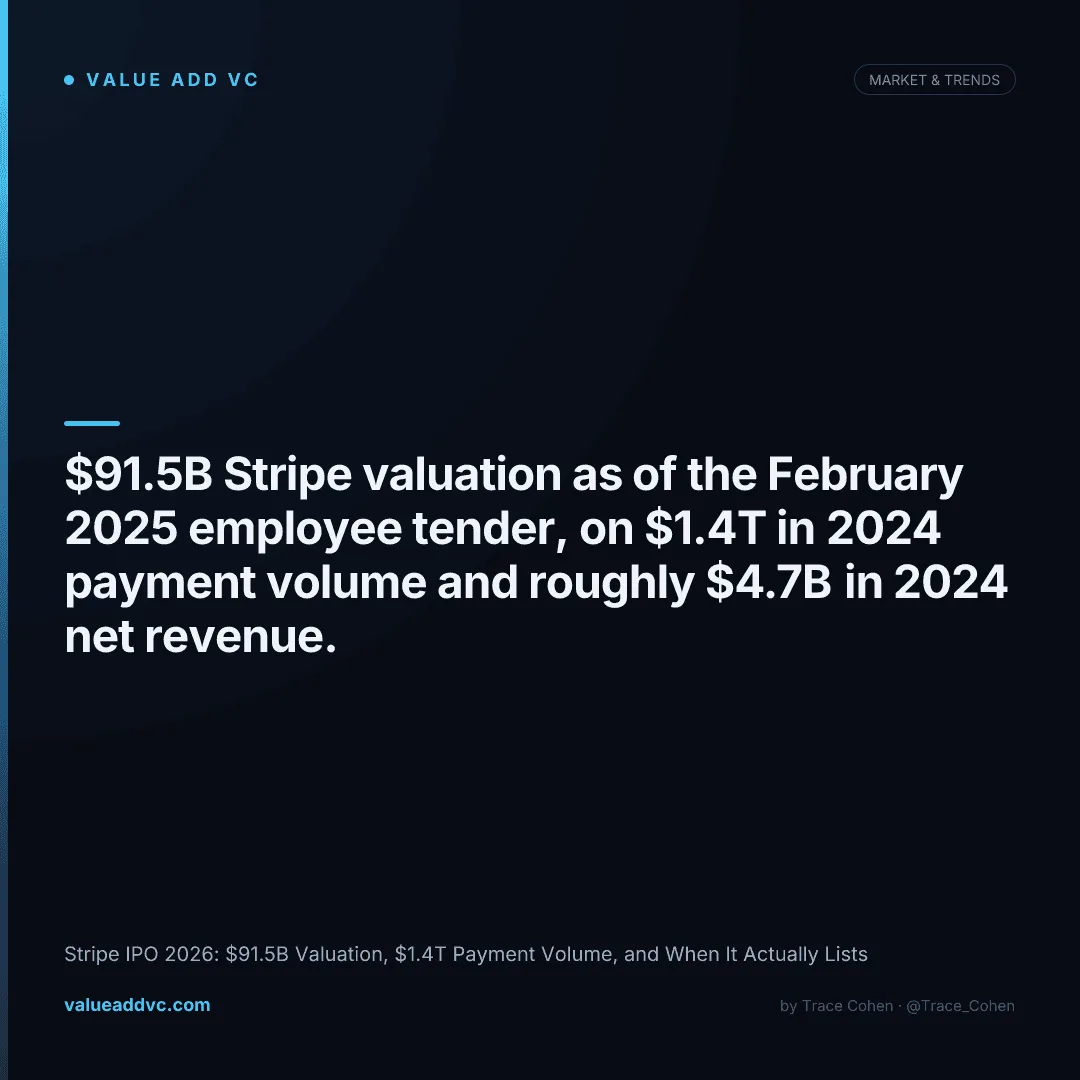
Stripe is valued at $159B on $1.9T of 2025 payment volume and $6.9B in net revenue — and John Collison still says there's no rush to IPO, even as Stripe chases a $53B deal for PayPal.
The fuller picture — why the tender cycle has effectively replaced the IPO, what the $159B valuation actually implies, and the acquisition spree that's reshaping the case for and against a listing — is worth the next 14 minutes.
Stripe IPO 2026: What We Actually Know About Valuation, Timeline, and Strategy
As of August 2026, Stripe still has no S-1 on file and no confirmed IPO timeline. The company's most recent valuation marker is $159B, set in a February 24, 2026 employee tender offer led by Thrive Capital, Coatue, and a16z. Co-founder John Collison said at Davos in January 2026 that going public is not a near-term priority, calling it "the fastest-moving time in our industry since we started Stripe" — a period he'd rather spend building than managing quarterly guidance.
What's actually happened since the February tender isn't another liquidity event — it's two acquisitions. Stripe closed a $7B+ deal for AI model-routing startup OpenRouter in August 2026 and, separately, joined private-equity firm Advent International on a $53B bid for PayPal in July. Both moves point the same direction: Stripe is spending its capital and market position on buying its way into new categories, not on the disclosure and dilution that come with a public listing.
Stripe Valuation History: 2020 to 2026
Seven markers of price discovery over six years. The path from $36B to $95B to $50B and back up to $159B is the cleanest case study in late-stage private valuation re-rating available.
| Date | Event | Valuation | Capital Raised |
|---|---|---|---|
| April 2020 | Series G | $36B | $600M |
| March 2021 | Series H | $95B | $600M |
| March 2023 | Series I (down round) | $50B | $6.5B |
| March 2024 | Tender offer | $70B | $694M secondary |
| February 2025 | Tender offer | $91.5B | ~$1B secondary |
| September 2025 | Internal 409A mark | $106.7B | N/A (option pricing only) |
| February 2026 | Tender offer | $159B | Not disclosed |
| August 2026 | Secondary market (Forge/Hiive) | $172-176B | N/A |
Source: company tender disclosures, Bloomberg, TechCrunch, and Forge/Hiive secondary pricing as of August 19, 2026. The 2023 down round to $50B was a 47% haircut from the 2021 peak; the climb back to $159B took under three years and, per Stripe's 2025 annual letter, required no new growth-capital raise — only updated marks for employee and investor liquidity.
What's Changed Since June 2026: OpenRouter and the PayPal Bid
The single biggest development since this post was last updated is that Stripe stopped waiting for the IPO conversation and started spending. In mid-August 2026, Stripe closed a deal to acquire OpenRouter, the AI model-routing startup that connects developers to 400+ models from 60+ labs, for more than $7B — a 5.4x markup over the $1.3B valuation OpenRouter raised just three months earlier in its May 2026 Series B. The logic: OpenRouter already routes and metering-bills roughly 25 trillion tokens a week, and folding that into Stripe deepens its position as the default billing layer for AI-native companies.
The much bigger story is PayPal. In July 2026, Stripe and private-equity firm Advent International offered PayPal $60.50 a share — roughly $53B — backed by about $50B in committed bank financing, with Stripe and Advent set to hold equal stakes and keep PayPal intact rather than break it apart. PayPal's board rejected the opening bid as inadequate and, according to Reuters reporting picked up by Seeking Alpha, is pushing for a price closer to $70 a share. As of this update, talks are ongoing at a higher, undisclosed price with no signed agreement — this is a live, unresolved story, not a completed acquisition.
This matters for the IPO question directly: one of the six signals flagged back in June as something that would raise the odds of a near-term Stripe IPO was "a Stripe acquisition larger than $10B announced." That signal has now fired. The fact that Stripe is financing it with a PE partner and bank debt rather than a public offering is itself the more interesting data point — it suggests Stripe can fund even a transformative, tens-of-billions-of-dollars acquisition without touching public markets, which if anything reduces near-term IPO pressure rather than increasing it.
The $159B Valuation Math: Is It Justified?
Stripe's 2025 payment volume was $1.9T, up 34% YoY from $1.4T in 2024 — equivalent to roughly 1.6% of global GDP. Net revenue (gross take-rate revenue minus interchange and bank fees passed through) came in at $6.9B for 2025, up 36% YoY from a restated $5.1B in 2024, per Stripe's own 2025 annual letter — a meaningfully higher 2024 figure than the ~$4.7B third-party estimate this post cited in June. EBITDA was $1.2B for the year. At $159B, that puts Stripe at roughly 23x trailing net revenue, up from about 19.5x on the February 2025 mark.
Compare that to public payment peers, several of which have re-rated sharply over the past year. Adyen now trades around 7.1x revenue — roughly half its multiple from a year ago, despite H1 2026 processed volume growing 24% YoY to €803.8B, after a 2026 selloff analysts have called an unprecedented valuation low. PayPal trades around 2x revenue, Block around 1.9x, Visa around 17.6x. Stripe's implied 23x multiple sits above every direct payments peer except the card networks, and it assumes net-revenue growth in the mid-30s% continues through 2027 — a bar Stripe cleared in 2025 but hasn't yet proven it can clear again in 2026.
The defensible part of that math: AI-native companies processing payments through Stripe grew revenue 120% in 2025, and Stripe told Stripe Sessions 2026 attendees that pace has accelerated further this year. OpenAI, Anthropic, and thousands of smaller AI-native companies bill through Stripe's infrastructure, and the OpenRouter acquisition is a direct bet on capturing more of that flow. If you believe AI-native volume keeps compounding at anything close to 2025's pace, 23x starts to look like Stripe pricing itself as the toll booth for AI commerce. If you don't, it's a steep premium to every payments peer except Visa and Mastercard.
Why Stripe Hasn't Filed an IPO
Stripe IPO rumors have circulated every year since 2018, with a fresh wave of "Stripe is going public this year" coverage each time. None of it has been right. The reason isn't market timing. It's structural — and the PayPal bid just added a fourth structural reason.
Robustly profitable through 2025
$1.2B EBITDA on $6.9B net revenue. No need for IPO capital to fund operations.
Tender offers replace IPO liquidity
Three tenders since 2024, most recently $159B in Feb 2026 — employees sell without filing.
Collison brothers retain control
Class B voting structure protects long-term roadmap decisions.
Acquisitions funded outside public markets
$7B OpenRouter deal closed and a $53B PayPal bid, both financed via cash, tender proceeds, and PE partners.
Public-comp environment is worse, not better
Adyen fell to 7.1x revenue in 2026, half its year-ago multiple — a weak comp set for an IPO.
Disclosure burden is asymmetric
Real-time payment-volume and PayPal-negotiation disclosure would help competitors more than investors.
Stripe IPO Timeline: The Realistic 2026, 2027, and 2028 Scenarios
The base-case Stripe IPO timeline right now: 2028 at a $220-300B valuation, conditional on net revenue growing to $12-15B and the PayPal integration (if it closes) going smoothly. That implies roughly a 15-20x exit multiple — modest compression from today's 23x. Anything sooner requires a specific catalyst, and the PayPal bid is the closest thing to one that currently exists.
| Year | Probability | Implied Valuation Range | Trigger Required |
|---|---|---|---|
| 2026 | 8% | $170-200B | PayPal deal closes and needs financing beyond the current bank commitment |
| 2027 | 27% | $190-240B | PayPal integration proves out; secondary market gap widens past 30% either direction |
| 2028 | 33% | $220-300B | Net revenue clears $12B with continued 25%+ growth |
| 2029+ or never | 32% | $300B+ (or indefinite tender/M&A cycle) | Status quo holds — tenders and PE-backed deals cover both liquidity and growth capital |
The single most underappreciated outcome in the table above is still the bottom row, and the PayPal bid actually reinforces it. There is a real, growing probability that Stripe simply never goes public — that tender offers plus PE-partnered acquisitions become a permanent capital structure, the same way SpaceX has shown a company can stay private past $1T as long as the cap table can fund liquidity and growth internally. If that's the world we're heading to, retail investors will need to access Stripe via SPVs and secondary markets indefinitely.
Stripe Cap Table: Who Wins When (and If) Stripe IPOs
The biggest beneficiaries of a Stripe IPO still aren't employees with recently-vested RSUs. They're the funds that wrote checks at $36B or earlier. Here's the breakdown of who owns what, based on disclosed and reasonably inferred positions at the $159B mark — stakes are pre-dilution estimates and the February 2026 round brought in new capital from Thrive Capital that likely diluted legacy holders modestly, so treat the percentages as directional, not exact.
| Investor | Entry Round | Estimated Stake | Implied Value at $159B |
|---|---|---|---|
| Sequoia Capital | Series A (2012) | ~9% | $14.3B |
| Andreessen Horowitz | Series B (2012) | ~6% | $9.5B |
| Founders Fund | Series B (2012) | ~5% | $8.0B |
| General Catalyst | Series A (2012) | ~4% | $6.4B |
| Tiger Global | Series I (2023) | ~2.5% | $4.0B |
| GIC, Goldman Sachs, MSD | Series H/I | ~5% combined | $8.0B |
| Patrick + John Collison | Founders | ~15-20% combined | $23.9-31.8B |
Stakes are estimates based on disclosed primary rounds, dilution math, and public statements. Actual cap table is not disclosed.
How to Invest in Stripe Before the IPO (If You Want To)
If you're an accredited investor and want pre-IPO Stripe exposure in 2026, you have three real paths. None of them are cheap, and the math has gotten more expensive since June — secondary pricing now sits above the tender, not below it.
Forge / Hiive secondaries
Departing-employee shares occasionally come available. Pricing as of August 19, 2026 implies a $172-176B valuation ($72.45/share on Forge, $71.49/share on Hiive) — a premium to the $159B February tender, not the 5-15% discount seen in mid-2026. Minimums $10-25K. Fees 5%+ per side.
Best for: Accredited investors with $25K+ who want direct equity
SPVs through funds with primary access
AngelList, Sydecar, and bespoke SPVs from existing Stripe holders occasionally bundle small allocations. Minimums typically $50-250K. Carry is usually 10-20% with management fees of 1-2%.
Best for: Accredited investors with $50K+ who can stomach SPV economics
Indirect via public-comp funds
Sequoia's Heritage Fund, Founders Fund Growth, and General Catalyst Endurance Fund all hold Stripe. Becoming an LP requires $1M+ minimums plus invitation. The cleanest indirect exposure is owning Visa, Mastercard, or Adyen — directly correlated to Stripe's exit multiple, though Adyen's own 2026 multiple compression is a reminder that correlation cuts both ways.
Best for: Investors at LP-scale or retail buying liquid comps
What the Headline Misses
A $159B valuation and a $53B bid for PayPal make for a clean growth story, but two things cut against it. First, if the PayPal deal closes, combining the two largest online-checkout networks would draw real antitrust scrutiny — the kind of regulatory review that a public S-1 would force Stripe to detail in ways a private tender never requires. That review alone could push any related capital-raising need (and thus IPO pressure) out rather than in. Second, the AI-native revenue Stripe is counting on isn't as stable as the 120% 2025 growth number suggests: OpenRouter's own platform data shows combined US-lab token share falling from roughly 70% in June 2025 to roughly 30% a year later as Chinese open-weight models gained ground, which is exactly the kind of pricing and volume volatility that could compress the AI-billing upside Stripe just paid a 5.4x premium for.
There's also a market-sentiment counterpoint worth naming: the "fintech IPO window opens wide" scenario this post floated in June hasn't clearly played out. Chime and Klarna both listed in the current cycle, and Klarna's stock has traded well below its debut levels for stretches of 2026 — a reminder that a strong private mark doesn't automatically translate into a strong public one, which is itself an argument for Stripe staying private longer, not less.
What to Watch Next to Update the Stripe IPO Timeline
Two of the six signals flagged in June have now moved. Here's the current state of all six, updated as of August 19, 2026.
- →Fired: A Stripe acquisition larger than $10B was announced — the $53B PayPal bid (pending) and the closed $7B+ OpenRouter deal both cleared that bar in 2026.
- →Flipped: The secondary-market gap moved in the opposite direction than expected — Forge and Hiive now price Stripe at a 10%+ premium to the $159B tender, not a discount.
- →Whether the PayPal deal actually signs — PayPal's board wants closer to $70/share versus Stripe and Advent's opening $60.50 offer, with talks ongoing and no agreement as of mid-August 2026
- →Patrick or John Collison hiring a CFO successor (Steffan Tomlinson remains CFO as of August 2026, also now sitting on Cyera's board)
- →An S-1 confidential filing leak — historically reported 6-9 months before a public S-1; none reported yet
- →Whether Klarna's and Chime's public trading stabilizes — a rocky first year for both makes the broader fintech IPO window harder to call open
Stripe at $159B on $1.9T volume, with a $53B bid for PayPal on the table, isn't a delayed IPO.
It's a company using tender offers and PE-backed M&A as a permanent substitute for public markets — and the PayPal deal is the clearest evidence yet that it's working.
Track every IPO filing on the Tech IPO Dashboard and compare payment-company multiples on the SaaS Valuations Dashboard at Value Add VC. Originally published in the Trace Cohen newsletter.
Latest from the Pulse
Get VC data most people never see
— free to subscribe
Trace's notes on venture, AI and startups, a few times a week. Join 5,000+ subscribers. No spam.
No spam, unsubscribe anytime. Sent via Substack · Privacy · or subscribe on Substack ↗