Market & TrendsJune 7, 2026·12 min read·Last updated: June 7, 2026

Stripe vs Adyen vs Braintree: $1.4T+ in Combined Volume, EV/Revenue Multiples, and Which Wins in 2026

Stripe, Adyen, and Braintree process more than $4T in combined annual payment volume — but the valuation gap between them comes down to growth rate, SaaS exposure, and who owns the developer.

TC
Trace Cohen
Co-Founder & GP at Six Point Ventures · 3x founder (BrandYourself, Launch.it, SPOT) · 65+ investments · Based in Boca Raton, FL

Quick Answer

$1.4T in 2025 Stripe payment volume vs €1.29T at Adyen vs $1.5T+ through PayPal's Braintree. Stripe leads on developer reach and SaaS share at a ~$91.5B private valuation; Adyen wins on enterprise unit economics with 47%+ EBITDA margins; Braintree leads on raw volume but trails on growth. Stripe is the overall 2026 winner on growth, share gains, and strategic optionality.

Stripe processed $1.4T in payments in 2024 at a $91.5B private valuation — roughly the same volume as PayPal's Braintree (~$1.5T) and slightly ahead of Adyen (€1.29T / ~$1.4T). That's the headline. The interesting story is what each dollar of volume is actually worth.

Total payment volume (TPV) is the metric everyone leads with because it's the most flattering. Net revenue, take rate, growth rate, and gross margin are the metrics that drive valuation — and on those, Stripe, Adyen, and Braintree look almost nothing alike.

Stripe Valuation vs Adyen vs Braintree in 2026: The Head-to-Head

Stripe is privately valued at ~$91.5B (February 2024 tender) with secondaries clearing in the $85–$110B range. Adyen trades publicly at ~€40B market cap (~$43B USD) in mid-2026. PayPal's Braintree is not separately valued, but PayPal as a whole sits at ~$70B market cap, with Braintree contributing the majority of unbranded volume. Stripe wins on equity value; Adyen wins on profit per dollar of volume; Braintree wins on raw scale inside a slower-growing parent.

Metric (2024–2026)StripeAdyenBraintree (PayPal)
2024 TPV$1.4T€1.29T (~$1.4T)~$1.5T (inside PayPal $1.68T)
TPV growth YoY~38%~22%~5–7%
Net revenue (last reported)~$5B+ (private est.)€1.99B (2024)Not broken out
Take rate (blended)~1.5% effective~14 bps on TPV / ~1% net~2.0–2.5% effective
Gross margin~70–80% on software~55%Bundled w/ PayPal
EBITDA marginMid-teens (estimate)47.5% (FY 2024)~22% (PayPal consol.)
Headcount~8,500~4,400Inside PayPal's ~24,000
CustomersMillions, SMB + SaaSFortune 500 enterprisePayPal-tier enterprise
Last valuation$91.5B (Feb 2024 tender)~€40B market capNot separated
EV / Net revenue~15–18x (private)~20x (public)PayPal ~2.5x revenue
Geography mixUS-led, 50+ countriesEU-led, 30+ countriesUS-led
Notable customersOpenAI, Anthropic, Amazon (some), Shopify (until 2027)Meta, Microsoft, Uber, Spotify, eBayAirbnb, Uber, DoorDash, Yelp

Sources: Stripe annual letters (2024, 2025), Adyen H1/FY 2024 reports, PayPal 10-K 2024, secondary market reports.

Stripe in 2026: $1.4T Volume, $91.5B Valuation, and Why It's Still Growing 40%

Stripe processed $1.4T in 2024, up from $1T in 2023 — a 40% YoY increase that no other player at this scale is matching. The company crossed $5B in run-rate revenue in 2024 and turned operating-profitable that year, after burning capital for nearly a decade on international expansion and product breadth.

The $91.5B tender from February 2024 was a 30% step-down from Stripe's March 2021 peak of $95B, but it functions as a floor — secondary trades through 2025 and into 2026 reportedly cleared in the $85–$110B range. Stripe's premium over Adyen on equity value comes from three things:

  • SaaS share dominance. Stripe processes payments for ~60% of YC companies and the majority of AI startups (OpenAI, Anthropic, Perplexity, Replicate, Together AI, et al.). Every new AI unicorn ships with Stripe Checkout out of the box.
  • Software adjacencies. Stripe Tax, Stripe Atlas, Stripe Billing, Stripe Issuing, and Stripe Connect together produced ~$1B+ of non-payments revenue in 2024 at SaaS gross margins (~75%+), pulling up the blended multiple.
  • Growth rate. 40% TPV growth in 2024 vs Adyen's 22% means Stripe is forecast to pass Adyen on net revenue (if it hasn't already) by year-end 2026.

The risk: Shopify ends its Stripe partnership in 2027 to bring more processing in-house, which could remove $200B+ of TPV. Stripe is reportedly already replacing that with Amazon-tier enterprise wins, but it's the single biggest concentration risk on the platform.

Adyen in 2026: €1.29T Volume, 47.5% EBITDA Margins, and Why Profits Don't Move the Stock

Adyen processed €1.29T in 2024 (up 22% YoY) and produced €1.99B in net revenue with a 47.5% reported EBITDA margin. Net income was roughly €890M for the full year. By every traditional profitability metric, Adyen is the best-run business of the three.

And yet Adyen's stock has been the punching bag of European fintech since August 2023, when the company missed Q1/H1 expectations on the basis that US enterprise merchants were squeezing take rates and Adyen refused to chase volume by undercutting. Shares fell 39% in a single day. By mid-2026 the stock has recovered roughly 60% from that low but is still well below the 2021 peak of €2,773.

Adyen's positioning is the inverse of Stripe's:

  • Single global platform. Adyen built one stack across 30+ countries with direct local acquiring, which gives it the best authorization rates and lowest interchange-plus pricing for Fortune 500 buyers.
  • Enterprise-only. Adyen does not sell to SMBs. Average customer is processing $100M+ annually. Top customers (Meta, Microsoft, Uber, eBay, Spotify) process $1B+ each.
  • Take rate compression. Adyen's effective take rate on TPV is ~14 basis points — a fraction of Stripe's ~150 bps blended rate — because enterprise pricing is interchange-plus single-digit bps.

If you're an LP picking on free cash flow, Adyen wins. If you're picking on growth rate or developer reach, it doesn't.

Braintree in 2026: $1.5T Volume Trapped Inside PayPal's Margin Story

Braintree, acquired by PayPal in 2013 for $800M, is now PayPal's primary unbranded enterprise gateway. PayPal processed $1.68T of total TPV in 2024 across branded (PayPal wallet) and unbranded (Braintree gateway) volume, and Braintree contributes roughly $1.5T of that — making it, by raw volume, the largest of the three.

The problem: Braintree's economics are bundled into PayPal's consolidated P&L. PayPal's total 2024 revenue was $31.8B with operating margin of ~22% and net income of ~$4.1B. Wall Street has spent the last two years arguing that Braintree is a margin drag — the unbranded gateway business is high-volume / low-take-rate (~10–20 bps net) and competes directly with Stripe and Adyen on price.

Under CEO Alex Chriss (in role since September 2023), PayPal has explicitly de-prioritized unprofitable Braintree volume in favor of margin expansion. The result by mid-2026:

  • Braintree growth has slowed from double-digit to ~5–7% YoY as PayPal walks away from money-losing enterprise renewals.
  • Branded PayPal checkout (Pay Later, Venmo, PayPal Complete Payments) is being prioritized — those carry 2%+ take rates vs Braintree's sub-30bps.
  • PayPal's market cap of ~$70B implies ~2.5x revenue, putting it at a deep discount to both Stripe (~15–18x) and Adyen (~20x). The market does not credit Braintree as a separate asset.

If you ranked these companies on growth or strategic positioning, Braintree is last. If you ranked them on installed enterprise volume per acquirer, it's first.

Stripe vs Adyen Take Rates: The 10x Gap That Explains the Valuation Gap

Take rate is the single most-misunderstood metric in payments. Here's what each company actually keeps per $100 processed:

Stripe

~$1.50

Blended across SMB cards (2.9%+$0.30), enterprise interchange-plus, and software upsells.

Adyen

~$0.14

Enterprise-only, direct acquiring, mostly interchange-plus single-digit bps.

Braintree

~$0.10–$0.20

Unbranded gateway pricing, competing with Adyen on enterprise mandates.

Stripe keeps roughly 10x as much revenue per dollar of TPV as Adyen because Stripe's customer base is millions of SMBs and software companies paying the full sticker rate, not a handful of Fortune 500 names negotiating bps off interchange. That's why Stripe's $5B revenue base is bigger than Adyen's €2B even though TPV is similar — and it's why the EV/revenue multiples look the way they do.

Stripe vs Adyen vs Braintree: Who Wins for Which Use Case

Pre-seed / seed startup

Winner: Stripe

5-minute integration, Stripe Atlas + Tax + Billing in one stack.

Series B+ SaaS in 30+ countries

Winner: Stripe

Best developer docs, broadest currency support, Stripe Billing handles subs natively.

Fortune 500 retailer / marketplace

Winner: Adyen

Direct local acquiring beats Stripe's reseller stack on authorization rates and cost.

Global travel / mobility (Uber-tier)

Winner: Adyen

Multi-currency settlement and risk tooling built for cross-border at scale.

US-only enterprise wanting PayPal wallet

Winner: Braintree

Native PayPal wallet acceptance ships with the gateway.

AI startup raising in 2026

Winner: Stripe

Default integration in every YC and AI-native stack; Stripe Connect handles agent payments.

Margin-maximizing CFO

Winner: Adyen

Best vendor for squeezing payments cost from existing scale.

Pure TPV scale

Winner: Braintree

Largest single-gateway book, but capacity is being deliberately shed by PayPal.

EV/Revenue Multiples in 2026: What Stripe, Adyen, and Braintree Actually Trade At

Public payment processors trade in a wide multiple band depending on growth rate and software exposure. Compared against the broader public payments comp set, here's where the three sit in mid-2026:

CompanyEV / Net RevYoY Rev GrowthRule of 40 Score
Stripe (private)~15–18x~30–40%~50+
Adyen~20x~22%~70 (22% + 47.5% EBITDA)
PayPal (incl. Braintree)~2.5x~7%~29
Block (Square)~2x~10%~25
Shift4~3x~25%~50
Fiserv~3.5x~7%~40

Adyen at 20x revenue is the highest-multiple public payments stock in 2026 because of its Rule of 40 score (~70). Stripe's private multiple is lower per dollar of revenue, but the absolute equity value is twice as large because the revenue base is roughly 2.5x bigger. PayPal trades like a slow-growth incumbent because that's how the market scores Braintree's contribution. See the broader SaaS valuations dashboard for how these compare to software comps.

The Stripe vs Adyen IPO Question: Who Goes First, and When

Adyen is already public (Euronext Amsterdam: ADYEN, listed June 2018 at €240, current price ~€1,250 in mid-2026). The question is really Stripe, which has been "could IPO any quarter" since 2021.

The Collison brothers have repeatedly said an IPO is not imminent. The February 2024 tender at $91.5B and a follow-on tender in early 2025 at reportedly higher marks suggest Stripe is intentionally meeting employee liquidity needs through private mechanisms instead of going public. The math is straightforward:

  • Public markets in 2026 are valuing high-growth fintech at 15–20x revenue (Adyen, Shift4) — roughly where Stripe's last private mark sits.
  • Going public means losing the tender mechanism that lets Stripe set its own price every 12–18 months.
  • A 2027 or 2028 IPO at $120–150B is plausible if growth holds at 30%+ and the broader tech IPO window opens further.

Braintree doesn't have an IPO question because it's inside PayPal. The more interesting question is whether activist pressure forces PayPal to spin out or sell Braintree — something analysts have floated since 2024, and which would immediately reset comparable valuations across the space.

The Verdict: Stripe Wins 2026, Adyen Wins on Profit, Braintree Wins on Volume

On a head-to-head 2026 ranking — weighting growth, strategic optionality, AI/software exposure, and developer reach — Stripe is the winner. The 40% TPV growth, the AI-native customer base, the software adjacencies at SaaS margins, and the $91.5B equity value all point the same direction.

Adyen wins on profitability and is the obvious LBO target if PE ever decides to swallow a $40B European fintech. Braintree wins on raw volume but is being managed for margin inside a parent that doesn't want the unbranded business growing at any cost.

For a SaaS founder picking a processor in 2026, the answer is almost always Stripe. For an enterprise CFO with $1B+ TPV, the answer is almost always Adyen. For a merchant who specifically wants PayPal wallet acceptance bundled in, Braintree is the answer. The valuation gap between them — Stripe at 2x Adyen on equity, Adyen at 8x PayPal on multiple — reflects exactly that customer-mix split.

Same $1.4T of volume. Three completely different businesses.

Stripe wins growth and developer share. Adyen wins margins. Braintree wins raw volume — and only Braintree is shrinking by choice.

Track payments and fintech valuations on the SaaS Valuations Dashboard, the Tech IPO Tracker, and the Big Tech Earnings dashboard at Value Add VC. More analysis in the Trace Cohen newsletter.

Frequently Asked Questions

What is Stripe's valuation in 2026 compared to Adyen?

Stripe was last priced at $91.5B in its February 2024 tender, with secondary trades reportedly clearing in the $85–$110B range through mid-2026. Adyen trades publicly at roughly €38–€42B market cap (~$40–$45B USD) in mid-2026, putting Stripe at roughly 2x Adyen on equity value despite Adyen producing more GAAP profit. Stripe's premium reflects higher growth and SaaS exposure, not better unit economics.

How much payment volume does Stripe process vs Adyen vs Braintree?

Stripe processed $1.4T in 2024 (up from $1T in 2023), Adyen processed €1.29T in 2024, and PayPal's Braintree unit processed roughly $1.5T+ as part of PayPal's $1.68T total payment volume. All three are within striking distance on raw TPV, but Stripe is growing faster (~40% YoY) than Adyen (~22%) or Braintree (estimated ~5–7%).

What is the difference between Stripe, Adyen, and Braintree?

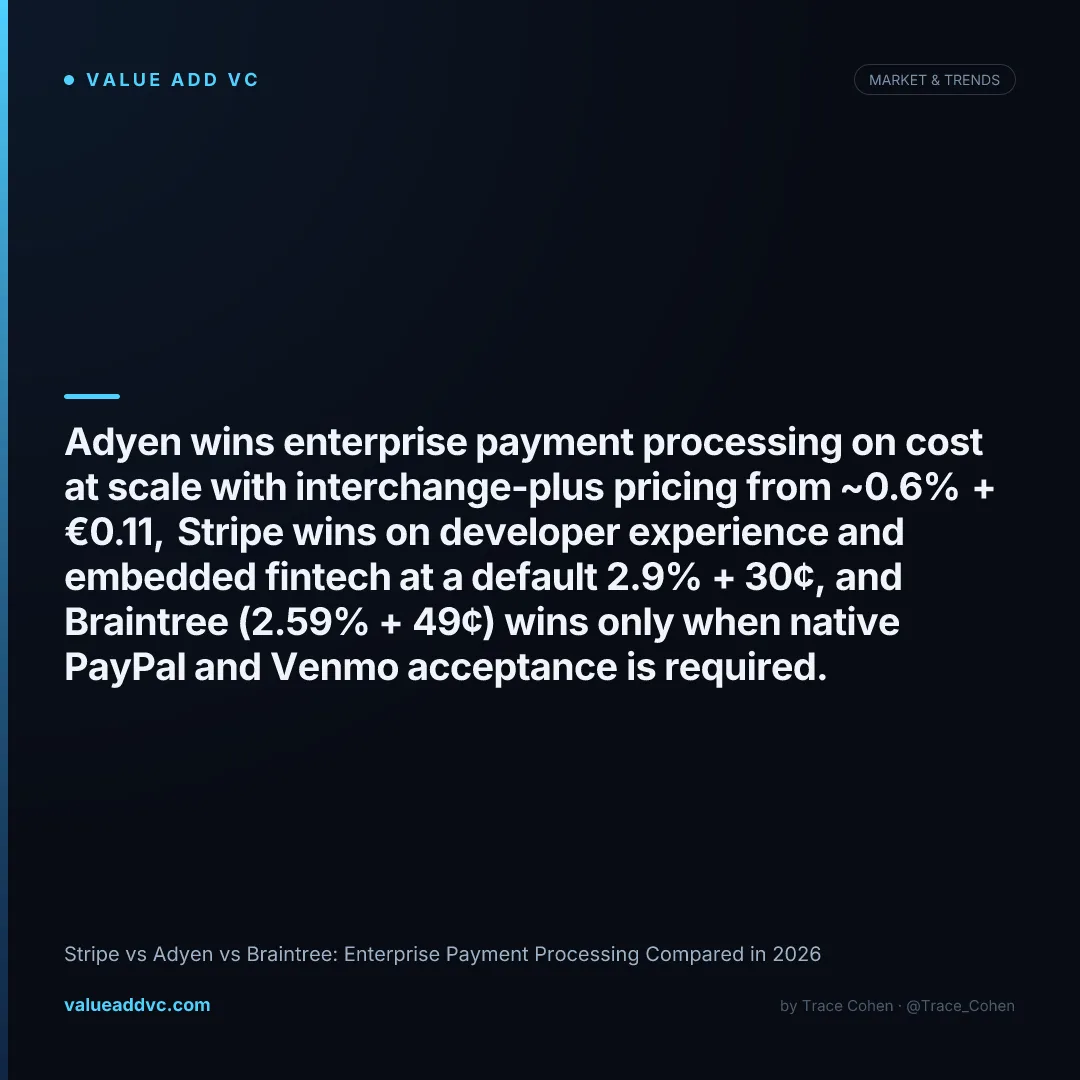
Stripe is a developer-first US payments platform with broad SaaS and startup market share, priced at ~2.9% + $0.30 for standard cards. Adyen is a single-platform enterprise acquirer optimized for global Fortune 500 retailers and marketplaces, with blended take rates closer to 0.5–1%. Braintree is PayPal's enterprise gateway, bundled with PayPal wallet acceptance — often picked by merchants who already want PayPal checkout.

Which payment processor has the best unit economics in 2026?

Adyen has the best unit economics, with reported EBITDA margins above 47% in 2024 and net income margins north of 30%. Stripe is profitable on an operating basis as of 2024 but runs much higher operating spend on R&D and international rollout. Braintree's margins sit inside PayPal's consolidated 22–24% operating margin and are not broken out separately.

Is Stripe worth more than Adyen and Braintree combined in 2026?

On private secondary marks alone, Stripe at ~$91.5B is roughly equal to Adyen (~$42B) plus the implied Braintree slice of PayPal (~$15–$25B). Markets price Stripe at a premium because of its ~40% revenue growth rate, software-like gross margins on its non-payments products, and dominant share among SaaS and AI startups raising in 2024–2026.

Explore 45+ free VC tools, dashboards, and recommended startup software.