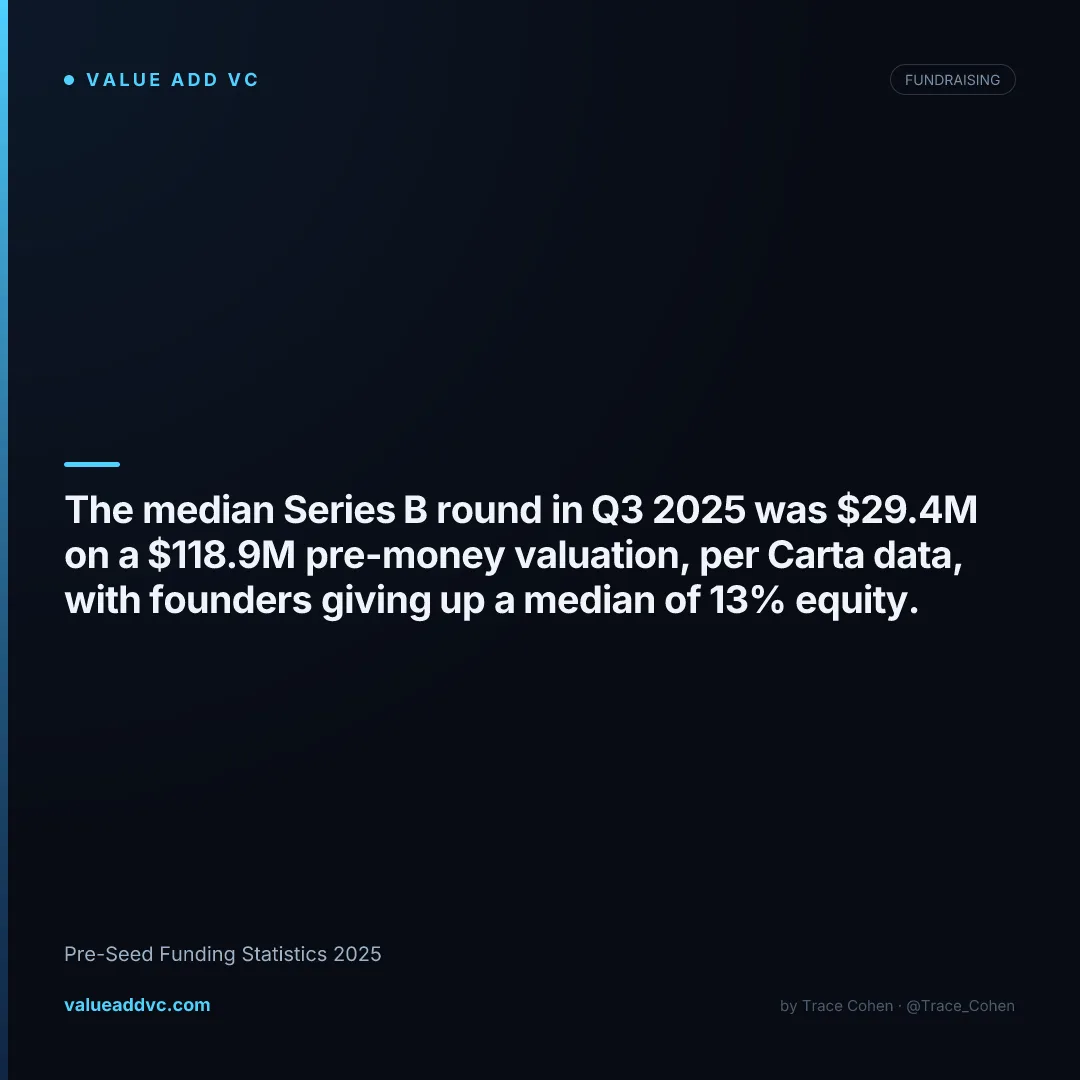
U.S. startups raised $5.2B across Series B deals in Q3 2025 alone, at a median round of $29.4M on a $118.9M pre-money valuation. Fewer companies are getting there, but the ones who do are raising bigger, pricier rounds than a year ago.
Series B in 2025 is the clearest example of capital concentration in the entire funding stack. Dollar volume at the stage fell 26% year-over-year while median valuations climbed 16% over the same period — meaning the bar to reach Series B got higher even as the total pool of capital shrank. If you're benchmarking your own raise, the averages hide a real split: AI companies clearing $40M+ checks at premium valuations, and everyone else fighting for a shrinking share of traditional growth-stage capital.
What do Series B funding statistics show for round sizes in 2025?
Series B funding statistics for 2025 show a median round of $29.4M, sitting within the broader $20M-$50M range typical for the stage, according to Carta's Q3 2025 platform data. That figure masks a wide split by sector: AI-labeled companies are raising Series B rounds averaging $40M or more, while traditional SaaS startups at the same stage are clustering closer to $20M-$30M — roughly the same range the stage occupied in 2023 and 2024.
That gap matters when you benchmark your own term sheet against headlines. A $60M AI Series B covered in TechCrunch and a $22M B2B SaaS Series B closing quietly the same week are both technically "Series B," but they're pricing off different comp sets entirely. Our VC performance dashboard tracks fund-level deployment pace if you want to see how quickly growth-stage capital is actually moving right now.
Series B Round Size and Valuation by Sector (2025)
| Sector | Median Round Size | Median Pre-Money Valuation | Median Dilution | YoY Change |
|---|---|---|---|---|
| AI / ML | $42M | $180M | 11.5% | +38% |
| SaaS / Enterprise Software | $26M | $105M | 13.2% | +9% |
| Fintech | $28M | $112M | 14.1% | -4% |
| Healthcare / Biotech | $32M | $128M | 15.8% | +6% |
| Consumer | $20M | $85M | 14.9% | -18% |
| All sectors (blended) | $29.4M | $118.9M | 13% | -26% (dollars) |
Figures are Q3 2025 estimates blended from Carta's State of Private Markets Q3 2025 report, Carta's SaaS industry spotlight, and sector-level syndicate data. Sector splits are directional estimates derived from Carta's platform aggregates, not per-company disclosures.
How Series B dilution has shifted since 2024
Series B dilution statistics show the biggest year-over-year drop of any stage in 2025: median dilution fell from roughly 15% in Q3 2024 to 13% in Q3 2025, a swing of nearly two full percentage points. Combined with 19.5% at seed and 18% at Series A, a founder who raises all three rounds without a down round now typically retains close to 55% of the company entering growth stage, up from roughly 50% in prior cycles.
The 2021 peak of roughly $155M pre-money collapsed to a $90M trough by 2023 as rate hikes repriced every growth-stage round. The 2025 rebound to $118.9M reflects AI-driven demand pulling the blended median up even as non-AI Series B valuations stayed closer to the 2023-2024 range — see our full funding stage breakdown for how that flows through from pre-seed to Series B.
Series B time to close and investor composition in 2025
Beyond round size and valuation, two operational stats are worth tracking for founders planning a Series B timeline. First, time to close: the median Series B in 2025 took roughly 3-4 months from first partner meeting to wire, up from 2-3 months in 2021, largely because diligence now runs deeper on retention cohorts and unit economics rather than just top-line growth. Second, lead investor composition: multi-stage generalist firms led roughly 55% of 2025 Series B rounds by dollar volume, with dedicated growth-stage funds and crossover hedge funds splitting most of the remainder — a meaningful shift from 2021, when a broader mix of seed funds extending into growth stage participated in Series B leads.
That composition shift matters for founders choosing a lead: a multi-stage firm that can anchor both your Series B and a future Series C internal round is increasingly valuable when the overall pool of growth-stage capital is shrinking, since it reduces the risk of a stalled fundraise two years from now. Boards in 2025 also report spending materially more diligence time on cohort-level retention data before signing a term sheet than they did even twelve months earlier, which is part of why the average time to close stretched out.
Why Series B dollar volume fell even as valuations rose
The single biggest driver of the 2025 Series B statistics is selectivity, not scarcity of capital. VCs invested more capital in Series B deals (18.9% of total dollars deployed in Q3 2025) than almost any other stage, alongside Series C at 20% and Series A at 24.9% — so money is still flowing to growth-stage companies. What changed is how concentrated it got: fewer companies cleared the bar to raise a Series B at all, so the $5.2B in Q3 2025 total volume represents a smaller number of larger, more selectively priced rounds rather than a broad-based slowdown in check size.
Growth-stage investors told us the same story throughout 2025: Series B due diligence now requires demonstrable net revenue retention above 110%, a clear payback period under 18 months, and in most cases a credible AI product angle — even for companies outside AI as a core category. That bar is materially higher than the growth-at-all-costs diligence standard common in 2021, which is a big part of why deal count fell faster than dollars.
Software remains the dominant category by dollars: SaaS companies on Carta's platform brought in $9.3B in new capital across all stages in Q3 2025, up 13% year-over-year and 82% compared to two years earlier, even as Series B-specific SaaS rounds stayed smaller than the AI-driven blended average.
Series B funding statistics 2025 vs. 2024: what changed
Series B funding statistics for 2025 show capital concentration at the top of the market. Total Series B dollars raised fell 26% year-over-year to $5.2B in Q3 2025, while median pre-money valuation rose 16% over the same period, from $102.8M to $118.9M. That combination — fewer dollars overall, but a higher price for the companies that do raise — is the clearest signal in the 2025 data: the bar to reach Series B rose even as the total capital pool available at the stage shrank.
For founders approaching Series B in 2026, the practical takeaway is that the stage has gotten more competitive and more binary. A company with strong retention metrics and a credible AI angle can now command a premium valuation and dilution below the historical median; a company without those signals faces a materially harder fundraising environment than the same company would have in 2021 or even 2023.
What Series B funding statistics mean for your next raise
If you're pricing a 2026 Series B round, anchor to the sector median, not the blended headline. A $26M-$32M raise on a $105M-$128M pre-money valuation is the realistic center of the market for non-AI SaaS, fintech, and healthcare companies — not the $40M-plus AI rounds that dominate press coverage, and not the sub-$15M "Series B" rounds that are really oversized Series A extensions in disguise. Pair pre-money against the median post-money figures founders are actually closing at to sanity-check where your term sheet should land.
Retention and payback metrics matter more than growth rate alone at this stage. A founder who can show net revenue retention above 110% and payback under 18 months is negotiating from a position that supports the lower end of the 2025 dilution range (11-13%), while a founder without those numbers should expect to give up closer to 15-16% to get the round done at all.
Timing your raise around sector-level valuation trends is also worth the effort: AI companies are getting materially better terms right now, so if your product has a genuine AI angle, lead with it in your deck rather than burying it as a feature. Plan for a longer process than you might expect, too — with median time to close stretching to 3-4 months in 2025, founders who start fundraising conversations only after cash runway drops below six months are giving themselves very little margin for error if diligence takes longer than planned. For a broader view of how these dynamics play out from pre-seed through Series C, see our startup funding rounds breakdown, and track live fund deployment trends on our VC performance dashboard.
Bottom line
The 2025 Series B market is smaller in dollars but pricier per deal: $5.2B moved through Series B rounds in Q3 2025 alone at a median $29.4M round on a $118.9M pre-money valuation, with founders giving up a median of 13%. If your round doesn't fit those numbers — either a much smaller check with heavier dilution, or an AI-tier valuation without AI-tier retention metrics — you're not wrong, but you should know exactly which side of the 2025 Series B split you're pitching into before you set your terms.
Latest from the Pulse
Get VC data most people never see
— free to subscribe
Trace's notes on venture, AI and startups, a few times a week. Join 5,000+ subscribers. No spam.