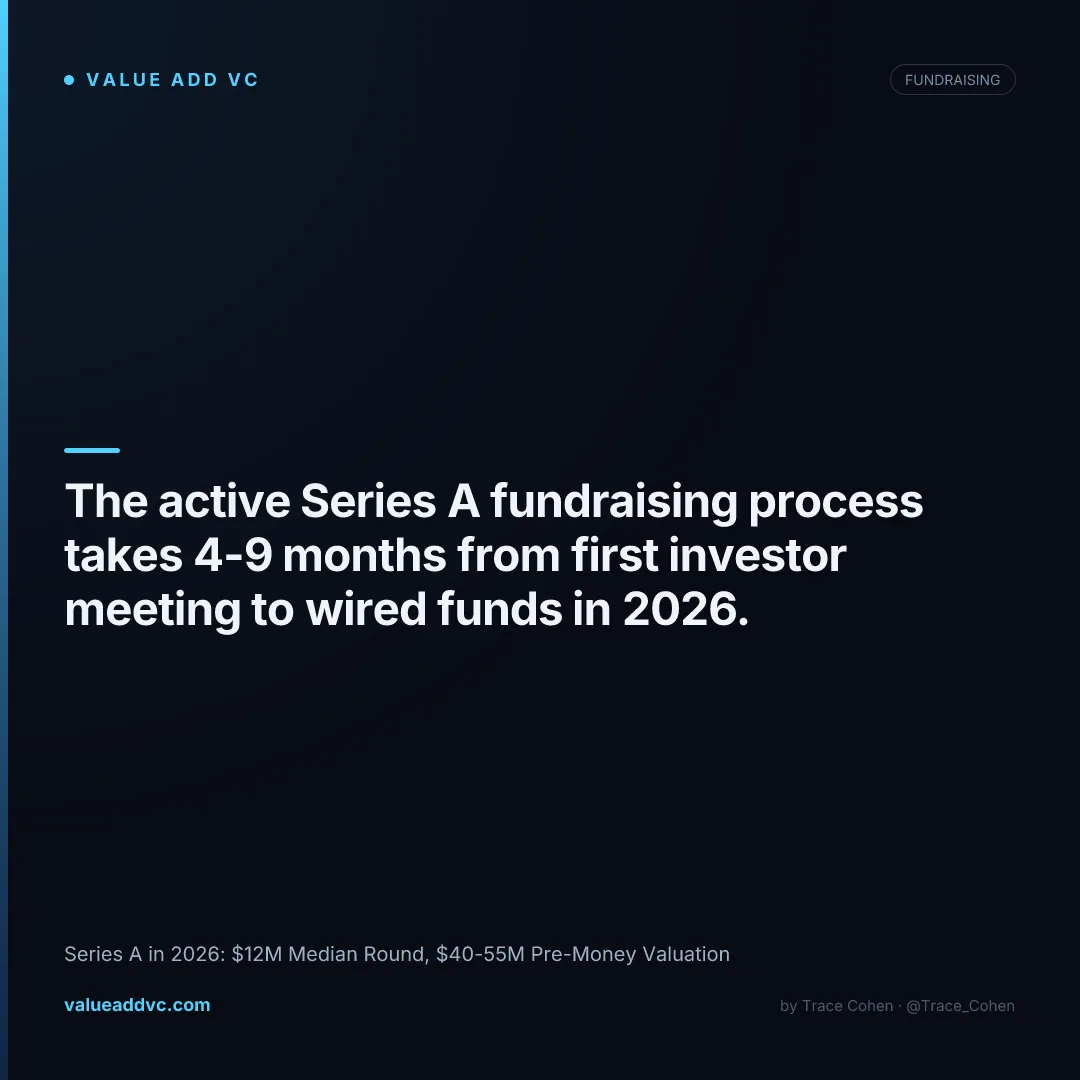
The active Series A process takes 4-9 months from first pitch to wired funds in 2026, but the median wait between closing a seed round and closing a Series A has stretched to 616 days — about 20 months, per Carta's Q2 2025 data.
The recurring mistake is that founders keep asking the wrong version of this question. "How long does a Series A take" has two completely different answers depending on whether you mean the sprint (pitching to close) or the marathon (seed close to Series A close), and conflating the two is why so many founders budget 6 months of runway for a process that actually takes 20.
Series A timeline 2026: how long does it actually take to close?
The series A timeline in 2026 has two distinct phases with very different lengths: an active fundraising process of 4-9 months from first partner meeting to wired funds, and a much longer waiting period of roughly 20 months between closing your seed and closing your Series A. Founders who only plan for the first phase routinely run out of runway during the second.
Fast closes of 4-5 months are achievable for companies with strong metrics and warm investor relationships already in place. Most founders should budget 6-8 months for the process itself, plus another 6-8 weeks of pre-launch preparation — building the deck, the financial model, and the data room before the first pitch even happens.
The confusion between these two timelines is the single biggest planning mistake I see founders make. A founder who read that "Series A takes 6 months" and sized their seed round's runway around that number is going to run out of cash somewhere around month 14, well before the median company even starts pitching for its Series A. The 6-9 month number describes the sprint once you've decided to run the process; it says nothing about how long you'll spend building toward the metrics that make investors want to take the meeting in the first place.
Series A timeline benchmarks: active process vs. seed-to-A gap
| Metric | 2021 | 2026 |
|---|---|---|
| Median seed-to-Series A gap | ~420 days | 616 days |
| Companies closing within 12 months | ~25-30% | 15% |
| Companies taking 3+ years | ~20-25% | 39% (Q3 2025) |
| Median Series A round size | $10M | $12-18M |
| Median post-money valuation | ~$58M | $78.7M |
| Active process length (pitch-to-close) | 3-6 months | 4-9 months |
| Seed-to-A gap, $30M+ Series A cohort | n/a | 14-15 months |
Figures are 2026 estimates blended from Carta's Q2 2025 State of Private Markets report, Carta's Q4 2024 fundraising data as cited by SaaStr, and PitchBook Series A benchmarking. 2021 comparison figures use Carta's historical seed-to-Series-A dataset; methodology and cohort definitions vary slightly across releases.
Why the Series A timeline keeps stretching longer
Investors have raised the bar on what a company needs to show before they'll underwrite a Series A — more revenue, better retention, cleaner unit economics — so companies need more runway to hit those numbers before they even start pitching. That's the core driver behind the gap growing from about 420 days in Q4 2021 to 616 days by Q2 2025, an 84% increase over four years according to Carta's data as reported by SaaStr.
The timeline also bifurcates sharply by outcome. Companies that raised $30 million-plus Series A rounds between Q1 2025 and Q1 2026 closed in roughly 14-15 months from their seed, while those raising $0-10 million took roughly 22 months. That's not a random spread — it's investors rewarding companies that hit strong metrics quickly with both a faster close and a bigger check, while slower-growing companies wait longer and often raise less when they do get there. Track how these patterns compare across benchmarks on our benchmarking dashboard.
There's a regional dimension too. The average time from seed to Series A in Israel has stretched to roughly 35 months — nearly three years — reflecting both a smaller domestic investor base and a higher bar for the metrics US-based growth investors expect before writing a Series A check into an Israeli company. US companies aren't immune to the same dynamic; they're simply starting from a shorter baseline because there are more Series A investors physically closer to them.
It's also worth separating cause from symptom. A company that takes 30 months to reach Series A because it deliberately chose capital efficiency and reached $2 million ARR on a single seed round is in a very different position than one that takes 30 months because two prior fundraising attempts failed. The calendar time is identical; the underlying story investors will hear in the room is not, and diligence conversations increasingly probe for which version happened.
What the Series A timeline means for how much runway to raise
The practical implication is straightforward but underappreciated: if the median seed-to-Series-A gap is 616 days, your seed round needs to fund at least 20 months of burn, not the 12-15 months most seed decks still model. Raising a seed round sized for a 12-month runway when the market median to reach Series A is closer to 20 months is a self-inflicted bridge round waiting to happen.
For fund managers, the Series A timeline also matters for reserve planning — a portfolio company that takes 24-36 months to reach Series A ties up follow-on capital longer than models built around the old 12-18 month assumption. See how top funds are adjusting reserve ratios on our VC performance dashboard.
There's also a bridge-round dimension to the runway math. When a company sized its seed for 15 months of runway but the Series A timeline runs closer to 20-24 months, the gap gets filled one of two ways: an extension or bridge round from existing investors, or a down round negotiated under pressure. Bridge rounds have become common enough in 2025-2026 that some investors now treat them as the de facto "new Series A" for companies not yet ready for a priced round — a structural response to the timeline stretching well past what seed rounds were originally sized to cover.
How to compress the active Series A fundraising timeline
Within the 4-9 month active process, the levers that shrink the timeline are the same ones that have always mattered, just with higher stakes now that the surrounding wait is longer. Building the data room and financial model before the first meeting saves 4-6 weeks of back-and-forth. Running a tight, parallel process — getting 15-20 first meetings booked within a 2-3 week window rather than trickling them out — compresses the natural decision-timeline pressure investors feel from competing term sheets.
Warm introductions from existing seed investors also measurably shorten the process versus cold outreach, since diligence moves faster when a trusted co-investor has already vetted the metrics. Companies with exceptional metrics and warm relationships are the ones hitting the 4-5 month fast-close end of the range; cold, metrics-light processes are what stretch toward 9 months or longer.
Term sheet timing matters more than most founders account for as well. The 4-9 month range assumes a process that runs to a natural close; it doesn't account for a term sheet falling through in diligence, which happens often enough that experienced founders keep a second and third lead in active conversation right up until signing, rather than going exclusive with the first term sheet offered. Losing a lead investor at the diligence stage can add 6-8 weeks back onto an otherwise on-track timeline, which is the single most common cause of a "6 month" process turning into a 9-month one.
Series A timeline by round size: does raising more take longer?
Counterintuitively, no — bigger Series A rounds are closing faster from seed, not slower. The $30 million-plus cohort's 14-15 month seed-to-close timeline versus the $0-10 million cohort's 22 months reflects momentum: companies growing fast enough to justify a larger check are also growing fast enough to hit Series A metrics sooner. The median Series A round size overall sits at $12-18 million with a $10-12 million median check size, per Carta and PitchBook data, on a post-money valuation of $78.7 million, up 37% year-over-year.
That valuation growth isn't evenly distributed either — AI companies carry roughly a 38% valuation premium over the cross-industry median at Series A, meaning the fastest, largest, and most highly-priced rounds are increasingly concentrated in one sector. See how these multiples compare across categories on our AI valuations dashboard.
None of that means non-AI companies should expect a 616-day seed-to-Series-A wait as a fixed rule. It's a median across a highly bifurcated dataset, and the bifurcation itself is the more useful signal than the median number in isolation. A capital- efficient SaaS company hitting $1.5-2 million ARR with strong net revenue retention can still close a Series A in 12-14 months; the 20-month median is dragged upward by the much larger group of companies still working toward those metrics, plus a growing cohort deliberately choosing to stay on seed-stage capital longer to avoid diluting into a soft Series A market.
Bottom line
Budget 4-9 months for the active Series A process once you start pitching, but plan your seed round's runway around the real bottleneck: a 616-day median gap between seed close and Series A close, up 84% since 2021. Only 15% of companies close within 12 months, 39% take three-plus years, and the companies closing fastest — 14-15 months — are also raising the largest rounds at $30 million-plus, meaning speed and size are moving together, not in opposite directions.
Latest from the Pulse
Get VC data most people never see
— free to subscribe
Trace's notes on venture, AI and startups, a few times a week. Join 5,000+ subscribers. No spam.