OpenAI's annualized recurring revenue is reportedly nearing $70 billion, per Axios and a source who spoke to Reuters on September 29, 2026 — up more than 70% since July. That follows $40 billion in August, its last disclosed figure, and a five-month plateau near $25B through spring. But booked revenue tells a slower story: $6.7B in Q2 2026, up 18% from Q1, against a $12.3B operating loss, after a $20.9B operating loss on $13.07B of booked 2025 revenue.
Growing revenue ~7x in two years was impressive — but growing ARR 60% from $25B to $40B in five months is a different gear entirely. Enterprise customers drove the breakout: business revenue had overtaken consumer by August, with customer count growing 32% in a single month. The problem is that Anthropic is projected to top $100B in annualized revenue by year-end, per the New York Times, so even at a reported ~$70B, OpenAI is still behind. Meanwhile OpenAI has ruled out a 2026 IPO and is targeting a valuation of around $1.4 trillion, excluding new capital, in a raise of at least $30 billion, Bloomberg reported on September 29.
Sources: Bloomberg (Aug 13, 2026), Wall Street Journal via Investing.com (Aug 18, 2026), CNBC (Aug 10 & 19, 2026), Axios/NYT (Sep 18, 2026), First For Money via Yahoo Finance (citing Axios) and Reuters via CNBC-TV18 (Sep 29, 2026; reported, not confirmed by OpenAI).
OpenAI Revenue 2026: The $40B ARR Breakdown by Product
Updated September 30, 2026: OpenAI's annualized recurring revenue is reportedly nearing $70 billion. Axios reported it on September 29 (summarized by First For Money via Yahoo Finance), and a source familiar with the matter told Reuters the same day that the run rate has risen by more than 70% since the start of the third quarter in July, driven by a more than twofold increase in enterprise sales. OpenAI hasn't confirmed the figure, so the $40B August figure below remains its last disclosed run rate. Separately, Bloomberg reported that OpenAI plans to raise at least $30 billion at a valuation of around $1.4 trillion, excluding the new capital.
Updated September 29, 2026: OpenAI hasn't disclosed a run-rate figure since the $40B reported in August, but a lot has changed around it. CNBC reported on August 19, 2026 that CFO Sarah Friar told employees OpenAI "will be a public company in 2027," and showed slides with the revenue run rate up 35% quarter to date and enterprise run rate up 50%. On September 12, Sam Altman said an IPO is off the table for 2026 ("I would say not 2026"), and on September 15 PYMNTS reported, citing the Financial Times, early talks on a private round at about $1.2 trillion — a figure investors proposed, but which GVWire reported a day later OpenAI itself is considering seeking at least $1.5 trillion, citing Codex and GPT-6 traction. Days later, an FT-reported investor deck put 2026 revenue at $36B and negative free cash flow at $278B through 2030. On the same day, the New York Times reported (via Gulf News) that Anthropic's annualized revenue is projected to top $100B by year-end, up from $65B in July. The rough $40B breakdown: ~$22B from ChatGPT subscriptions, ~$12B from API consumption (boosted by GPT-5.6 adoption), and ~$6B from Sora, ads, and licensing.
| Revenue Line | 2024 | EOY 2025 | Feb–Jun 2026 | % of Total |
|---|---|---|---|---|
| ChatGPT Plus ($20/mo) | $1.9B | $6.0B | $8.5B | 34% |
| ChatGPT Team / Edu / Pro | $0.3B | $3.0B | $4.5B | 18% |
| ChatGPT Enterprise | $0.6B | $3.4B | $4.0B | 16% |
| API (GPT-5 class models) | $0.8B | $8.0B | $6.5B | 26% |
| Sora + Ads + Licensing | $0.1B | $1.0B | $1.5B | 6% |
| Total (annualized run rate) | $3.7B* | $21.4B | $25.0B | 100% |
Sources: OpenAI investor disclosures, The Information, FT, Bloomberg, Sacra, reported leaks Q1–Q2 2026. 2025 and 2026 figures are annualized run rates, not GAAP recognized revenue; the 2026 column reflects the ~$25B February–June plateau, before the July breakout to the ~$40B split described above; *2024 is full-year booked revenue. Booked 2025 revenue was $13.07B per leaked audited financials.
From $1B to $25B, a Five-Month Plateau, Then a Breakout to $40B
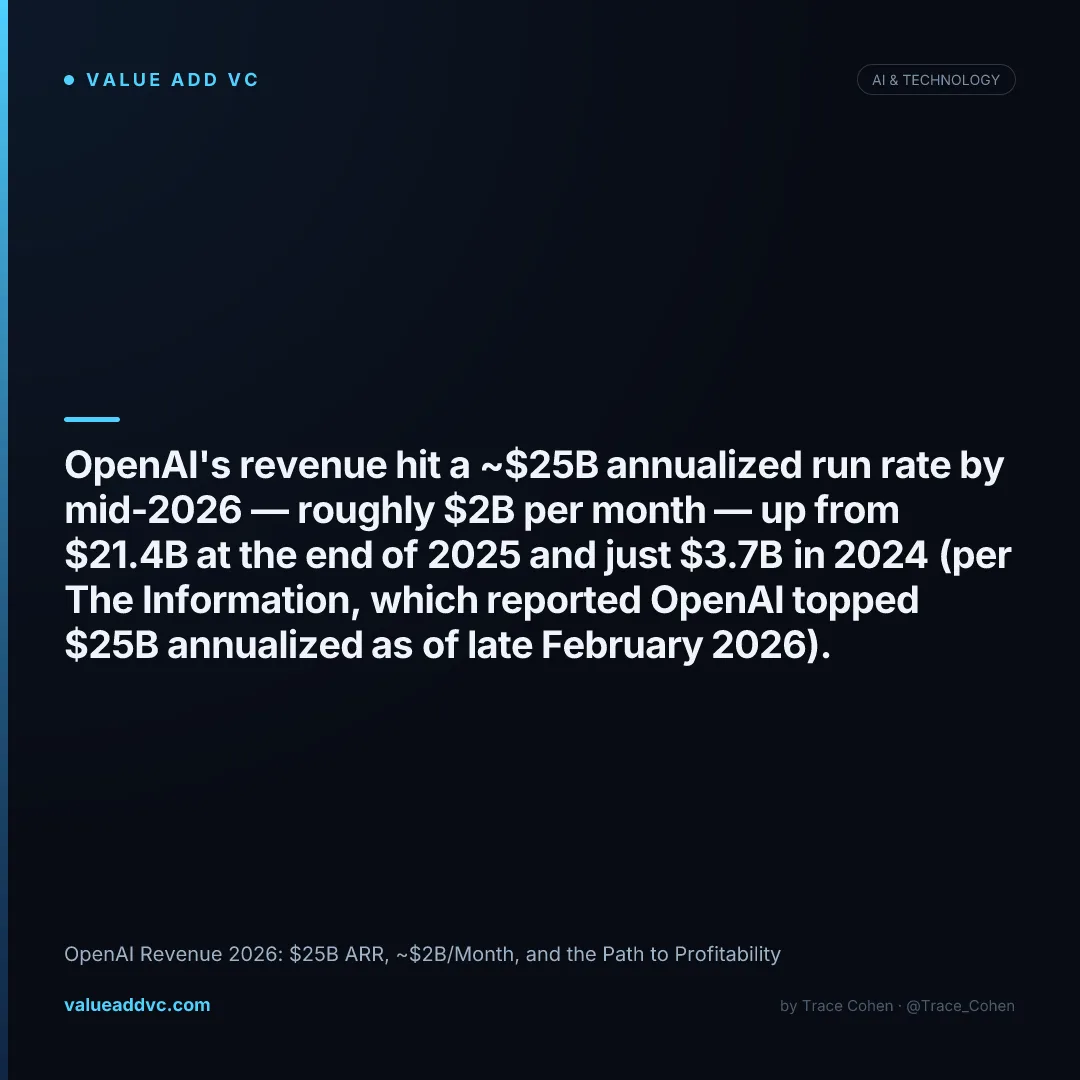
The clearest way to see what happened: OpenAI passed $1B annualized revenue in mid-2023, booked $3.7B in 2024 and $13.07B in 2025, exited 2025 at a $21.4B run rate, and hit ~$25B by February 2026 — where it then stalled for five months. The plateau broke in July: president Greg Brockman said internally that the annualized run rate grew more than 20% month-over-month, and by mid-August Bloomberg reported the figure had topped $40B, roughly doubling the pace from the end of 2025. For context on how growth rates translate to AI vs SaaS valuation multiples, see the full breakdown.
Jun 2023
$1.0B
100M weekly
Dec 2024
$5.5B
300M weekly
Dec 2025
$21.4B
800M+ weekly (Oct)
Feb–Jun 2026
~$25B (flat)
~900M weekly
Aug 2026
$40B (+60%)
~1B weekly
Sep 2026 (reported)
~$70B
per Axios, Reuters
What broke the stall? Enterprise. ChatGPT's consumer base was largely saturated — 1 billion monthly actives as of June 2026 — so the net-new growth had to come from business contracts, and it did: enterprise customer count grew 32% in July alone, and enterprise revenue had passed consumer by August. The $200/month Pro tier (500K+ subscribers, a $1.2B+ ARR line on its own) still compounds steadily, but it's enterprise procurement, not consumer conversion, now driving the acceleration. A closer look at what's actually inside those enterprise contracts and seat counts explains why that line is now doing more of the growth work than consumer subscriptions. Track broader adoption trends on the Enterprise AI Adoption dashboard.
The Leaked Financials: $13.07B of Revenue, a $20.9B Operating Loss
In June 2026, OpenAI's audited financial statements leaked — first reported by Ed Zitron and verified by the Financial Times and Fortune. The headline: a $20.92B operating loss on $13.07B of booked 2025 revenue — a loss larger than the revenue that produced it. Total costs came to roughly $34B, split between $19.18B of R&D and $5.73B of sales and marketing, with $17.2B flowing to Microsoft for Azure compute — more than OpenAI's entire annual revenue, to a single vendor.
The net loss was larger still: $38.5B, once a one-time, non-cash charge of roughly $41.55B tied to OpenAI's 2025 nonprofit-to-for-profit conversion is layered in. Strip out that structural noise and the $20.9B operating loss is the number that matters for anyone modeling the business. It also reframes the run-rate language OpenAI prefers: a $40B annualized pace is a projection off the latest month; $13.07B is what was actually booked and audited in 2025.
The 2026 quarterlies, shared with investors rather than leaked, show the same pattern. OpenAI told investors revenue reached $6.7B in Q2 2026, up 18% from $5.7B in Q1, while its operating loss including stock-based compensation widened to $12.3B from $9.3B, per the Wall Street Journal. That makes first-half 2026 booked revenue about $12.4B against roughly $21.6B of operating losses. The July breakout came after that quarter closed — Friar told staff that July's annualized recurring revenue exceeded the entire second quarter — so Q3 is the first quarter where the $40B run rate can show up in booked numbers. OpenAI has not reported Q3 results.
OpenAI Burn Rate and the Path to Profitability
The older forecasts this post used to cite — roughly $14B of 2026 losses, made when run-rate revenue was ~$25B — have been overtaken. OpenAI burned $3.7B of cash in Q1 2026 against $5.7B of quarterly revenue, and its operating loss including stock-based compensation reached $9.3B in Q1 and $12.3B in Q2, per the Wall Street Journal. The newest plan is far bigger in both directions: an investor deck reported by the FT in September 2026 projects revenue rising from $36B in 2026 to $350B in 2030 ($840B cumulative), but $278B of negative free cash flow over 2026–2030 and about $856B of compute and infrastructure spending — with the $122B raised in March on track to run out by 2028. That replaces the 2025-era plan of ~$115B of cumulative burn through 2029. For context, Amazon burned roughly $3B cumulative in its first decade; Uber burned about $25B before GAAP profitability. OpenAI is in a different category entirely, and HSBC had already projected it still won't be profitable by 2030.
| Year | Revenue | Loss | Note |
|---|---|---|---|
| 2024 (actual) | $3.7B | -$5B | booked revenue |
| 2025 (actual) | $13.07B booked / $21.4B exit ARR | -$20.9B operating | leaked, FT-verified |
| H1 2026 (actual) | $12.4B booked ($5.7B Q1 + $6.7B Q2) | -$21.6B operating (-$9.3B Q1, -$12.3B Q2) | told to investors, per WSJ |
| 2026 (plan) | $36B | part of -$278B FCF, 2026–2030 | FT-reported deck, Sep 2026 |
| 2026–2030 (plan) | ~$840B cumulative | -$278B free cash flow | March raise exhausted by 2028 |
| 2030 (plan) | $350B | HSBC: still not profitable by 2030 | 10x 2026 revenue |
Three numbers explain the bulk of the burn. OpenAI's 2026 compute spend with Microsoft Azure is roughly $13B (after $17.2B in 2025). The Stargate JV with SoftBank, Oracle, and MGX is in the early stages of a $500B multi-year buildout. Talent costs run roughly $4B annually across ~4,500 employees — about $900K fully loaded per head. Track this against the broader AI infrastructure spend on our AI Spending Dashboard.
OpenAI vs Anthropic, Google, and xAI: Who's Winning Revenue in 2026?
OpenAI is no longer the revenue leader on either run rate or quarterly revenue. Anthropic passed OpenAI in April 2026 at roughly $30B versus $25B, crossed $47B in May, and hit $65B by the end of July, with preliminary Q2 revenue of $11.5B — well above OpenAI's $6.7B — and its first-ever quarter of positive adjusted operating income. By September 18, Axios, citing the New York Times, reported that Anthropic is "now pacing to generate more than $100 billion in annual revenue, up 50% from just two months ago." OpenAI's own breakout was real, to $40B disclosed in August and a reported ~$70B by late September, but it is still behind Anthropic's projected $100B+ year-end pace. Full breakdown in our piece on how Anthropic hit a $47B run rate.
| Company | Latest ARR (Sep 2026) | Revenue Mix | Valuation | Rev Multiple |
|---|---|---|---|---|
| Anthropic | >$100B pace (Sep 18) | ~80-85% enterprise/API | $965B (Series H) | <10x |
| OpenAI | ~$70B reported (Sep 29); $40B disclosed (Aug) | enterprise now >consumer | $852B (flat, Aug tender); reportedly targeting ~$1.4T | ~12x reported; ~21x disclosed |
| Google Gemini* | not broken out | bundled in Cloud/Workspace | n/a | n/a |
| xAI (Grok, part of SpaceX since Feb 2026) | single-digit $B | consumer + API | ~$250B at Feb 2026 SpaceX merger | n/a |
*Google reports AI revenue inside Cloud and Workspace and doesn't break out Gemini-specific ARR. Anthropic valuation per its Series H announcement ($965B post-money, May 28, 2026); its run-rate pace per the New York Times via Axios (Sep 18, 2026). Multiples are valuation divided by latest run rate. OpenAI figures per The Information, Bloomberg, Sacra, and Epoch AI tracking. xAI's value is its share of the combined $1.25 trillion SpaceX–xAI merger, per The Motley Fool. Both companies' ARR figures are annualized run rates, not booked revenue — on booked 2025 revenue, OpenAI ($13.07B) was still larger than Anthropic (nearly $4.6B, per Reuters), but Anthropic's booked quarterly revenue passed OpenAI's in Q2 2026.
The $1B Ads Bet: OpenAI's Third Revenue Leg
The most interesting new line in OpenAI's 2026 mix isn't enterprise — it's ads. The ChatGPT ads pilot, which launched in the free and Go tiers with 600+ advertisers, crossed $1 billion in annualized run rate in under 200 days, OpenAI said on August 31, 2026, alongside a self-serve rollout to Europe. That's a 10x jump from the $100M pace reported just weeks after launch. It's still a rounding error next to OpenAI's $40B of total ARR as of August, and eMarketer estimates OpenAI will fall short of its own $2.5B 2026 ads target — but it's the fastest-scaling new revenue line OpenAI has launched since ChatGPT Plus, and with hundreds of millions of free users generating near-zero direct revenue today, it's the clearest lever left if subscription growth stalls again.
OpenAI Revenue Per User and Unit Economics
With roughly 1 billion weekly active users and $40B annualized revenue as of August, OpenAI's blended revenue per weekly active user is about $40/year — up from roughly $28/year when the run rate was still at $25B — but the distribution is wildly bimodal. The vast majority of users are free and generate almost nothing directly (the ad pilot is just starting to change that). The 50M+ paid subscribers average well over $500/year — heavily skewed by Enterprise contracts and the $200/month Pro tier.
- Plus tier ARPU: $240/year ($20/mo × 12) — the volume base of the paid mix
- Pro tier ARPU: $2,400/year ($200/mo × 12) — 500K+ subscribers — a $1.2B+ run-rate line on its own
- Enterprise: 7M+ workplace seats deployed; enterprise revenue had overtaken consumer by August, and enterprise sales reportedly more than doubled since July (Reuters)
- API: highly variable; top customers spend tens of millions per year each
Gross margin improved to roughly 39% in Q1 2026, up from 33% a year earlier, because the inference cost per query has dropped roughly 95% since GPT-4's launch in early 2023. The problem is that the improvement is being swamped by compute and talent spending growing as fast as revenue — which is why the operating loss keeps widening even as unit economics get better.
What OpenAI's Revenue Numbers Mean for Investors
At an $852B valuation, OpenAI is priced around 21x its last disclosed $40B run rate, or about 12x the reported ~$70B — down from roughly 34x in the spring as revenue caught up. Anthropic's $965B mark is now under 10x its $100B+ pace, so on disclosed figures OpenAI trades at about twice Anthropic's multiple; on the reported ~$70B the gap is much narrower. The ~$1.4 trillion valuation Bloomberg reported on September 29 would be about 20x the reported ~$70B run rate, or 35x the last disclosed $40B. The telling signal is still the August tender: OpenAI let employees sell $7B of stock at the same $852B price set in March, even though ARR grew about 60% in between. The bull case: OpenAI reaccelerates further, OpenAI's September revenue confirms the reported ~$70B pace, the private round prices near the ~$1.4 trillion Bloomberg reported, and the confidential S-1 filed June 8, 2026 converts into the 2027 listing Friar described. The bear case: compute costs keep scaling with revenue, as the FT-reported $278B cash-burn plan implies; Anthropic's IPO, with shares trading by November, sets the market's reference price first; and the July breakout proves to be a one-quarter enterprise catch-up rather than a new trend line. Compare the broader private AI revenue rankings.
For LPs in venture funds with OpenAI exposure (Sequoia, Thrive, Founders Fund, a16z, Khosla), the $852B mark is a meaningful chunk of net TVPI on 2018–2021 vintage funds — real but unrealized, with the path to DPI running through either the 2027 IPO window (Altman has ruled out 2026) or continued secondary tenders at or above current marks. Track the frontier AI valuation race on our AI Valuations dashboard.
The single most important OpenAI number isn't a reported ~$70B run rate or a billion users.
It's that investors let employees sell stock in August at the same price set in March — even after ARR grew 60%.
Growth used to be the cover story for the losses. OpenAI just proved it can reaccelerate — the five-month plateau broke, and the run rate jumped from $25B to $40B by August, and reportedly to nearly $70B by late September. But the flat $852B tender price showed the market wasn't rewarding that growth with a higher mark, Anthropic is projected to top $100B by year-end, and OpenAI's own plan calls for $278B of negative free cash flow through 2030. The question is no longer just how fast OpenAI grows. It's whether a private round near the reported ~$1.4 trillion valuation can happen before Anthropic's IPO sets the market's reference price.
Explore Related Dashboards
Interactive tools with live data on this topic
Track frontier AI revenue, valuations, and capex across OpenAI, Anthropic, Google, Meta, and xAI on the AI Valuations Dashboard and the AI Spending Dashboard at Value Add VC. Originally published in the Trace Cohen newsletter.
Latest from the Pulse
Get VC data most people never see
— free to subscribe
Trace's notes on venture, AI and startups, a few times a week. Join 5,000+ subscribers. No spam.