
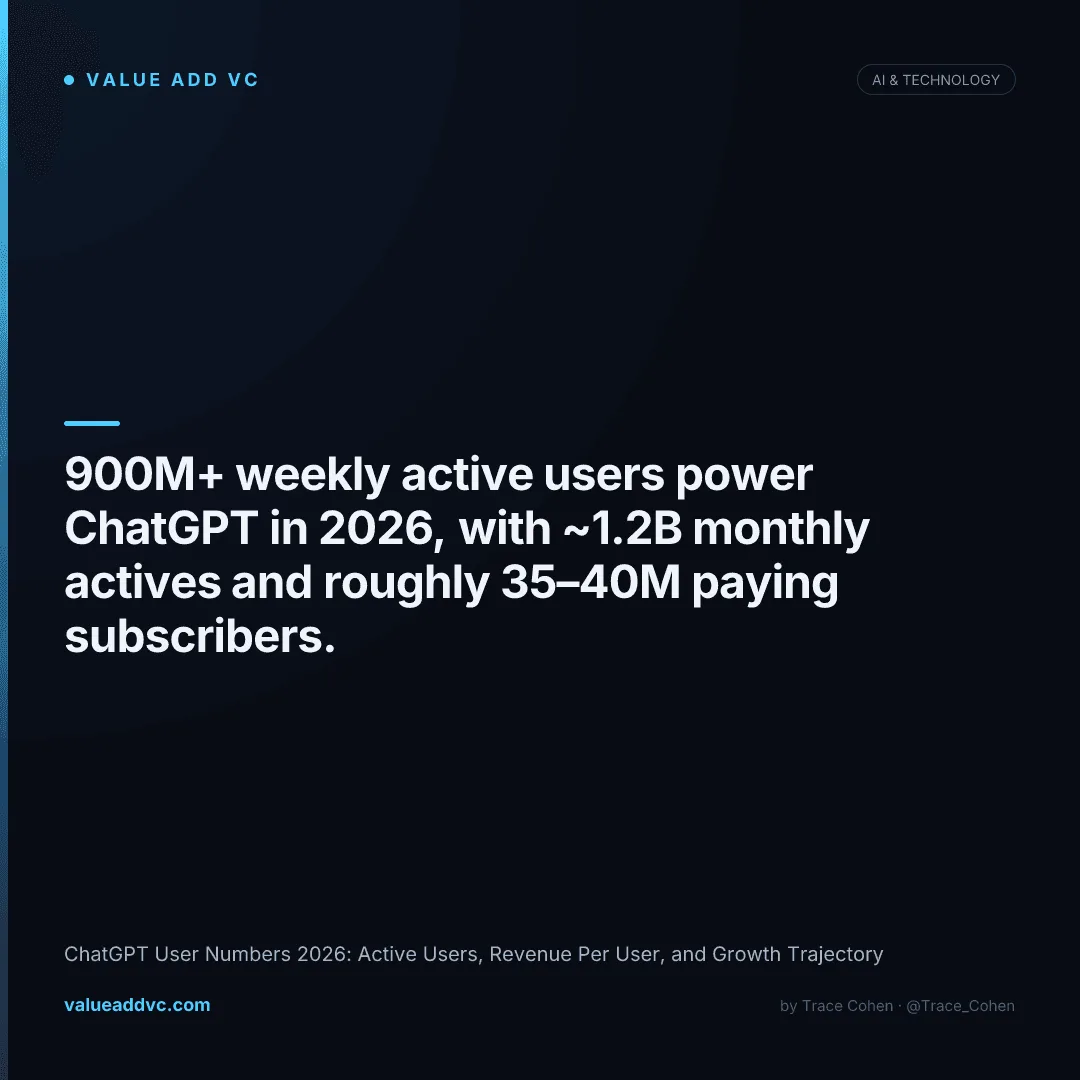
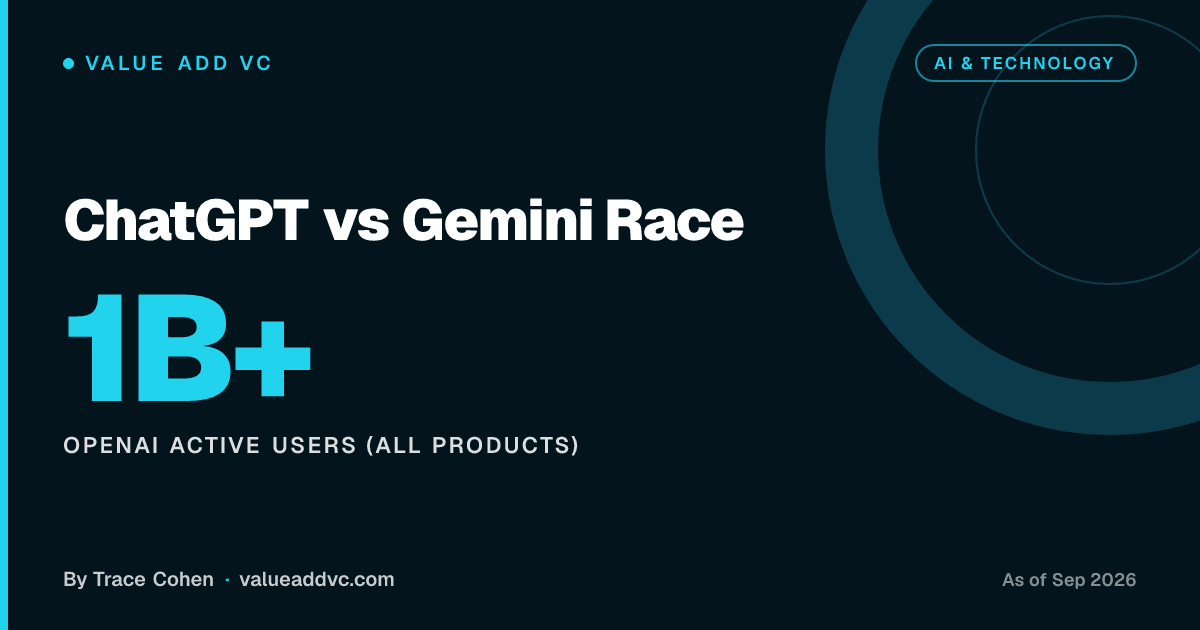
OpenAI confirmed on July 31, 2026 that its products — primarily ChatGPT, plus Codex and ChatGPT Work — now reach more than 1 billion active users and over 2 million businesses, arriving roughly seven months after OpenAI's own internal target date for that milestone. The question is what "late" means for a company whose entire pitch has been growth beating every projection.
Three numbers matter here and they tell different stories: 900 million weekly ChatGPT users OpenAI confirmed back in February, a 1-billion-plus active-user figure it confirmed in July, and just over 50 million people who actually pay. The gap between reach and revenue — and the fact that OpenAI missed its own internal roadmap even while growing faster than almost anything in software history, and while enterprise revenue overtook consumer revenue for the first time in August — is the real story behind the headline number.
Sources: OpenAI, The Information (July 29, 2026), BNN Bloomberg (Jul 31, 2026), Bloomberg (Aug 13-17, 2026), CNBC, Sensor Tower.
Is ChatGPT actually nearing 1 billion users?
It has now crossed that threshold, though the exact wording matters: The Information reported on July 29, 2026, citing internal OpenAI data, that ChatGPT's weekly actives specifically were closing in on 1 billion, up from roughly 900 million confirmed in February. Two days later, on July 31, 2026, OpenAI itself confirmed that its products overall — primarily ChatGPT, plus Codex and ChatGPT Work — reach more than 1 billion active users and over 2 million businesses, without breaking out a ChatGPT-only weekly figure. Separately, ChatGPT crossed 1 billion monthly app users in June 2026 per Sensor Tower, becoming the fastest app in history to do so.
The detail that got buried under the round number is the word "late." OpenAI reportedly set an internal target date for crossing 1 billion weekly users, and July 29 was roughly seven months past it. For a company whose public identity has been built on outrunning its own projections since ChatGPT's 2022 launch, missing an internal number — even one it never disclosed publicly — is a meaningfully different signal than hitting it early.
ChatGPT weekly users vs Gemini and Claude, 2026
ChatGPT and Google's Gemini are now essentially tied on raw reach after Gemini closed a gap of more than 500 million users in a year, and Anthropic's Claude is growing the fastest of the three off a smaller base. The table below lines up the most recent figures for each.
| Metric | ChatGPT (OpenAI) | Gemini (Google) | Claude (Anthropic) |
|---|---|---|---|
| Latest confirmed actives | 1B+ active users, all products (Jul 31, 2026) | 1B+ monthly (Aug 11, 2026) | ~245M monthly (mid-2026) |
| Last weekly-cadence figure | 900M weekly (Feb 27, 2026) | n/a — Google reports monthly | Not separately disclosed |
| One year prior | ~400M weekly (early 2025) | ~400M monthly (mid-2025) | ~59M monthly (mid-2025) |
| YoY growth (approx.) | ~125%+ | ~150%+ | ~300%+ |
| Paying users / customers | 50M+ subscribers | Bundled in Google One/Workspace | 300K+ business customers |
| Distribution edge | Default consumer app + API | Android, Workspace, Search AI | Enterprise coding & API-heavy |
| 2026 annualized revenue | $40B+ total, enterprise > consumer (Aug 2026) | Bundled into Alphabet totals | ~$65B gross (Jul 2026) |
Figures are 2026 estimates blended from OpenAI disclosures, The Information, BNN Bloomberg, Sensor Tower, Google's August 11, 2026 announcement, and Anthropic's disclosures reported by Bloomberg and CNBC (Aug 17, 2026). None of the three companies publishes fully audited, directly comparable user metrics.
Monthly Active Users: ChatGPT vs Gemini, 2026
Sensor Tower, Google (Aug 11, 2026), reported June-August 2026.
Data
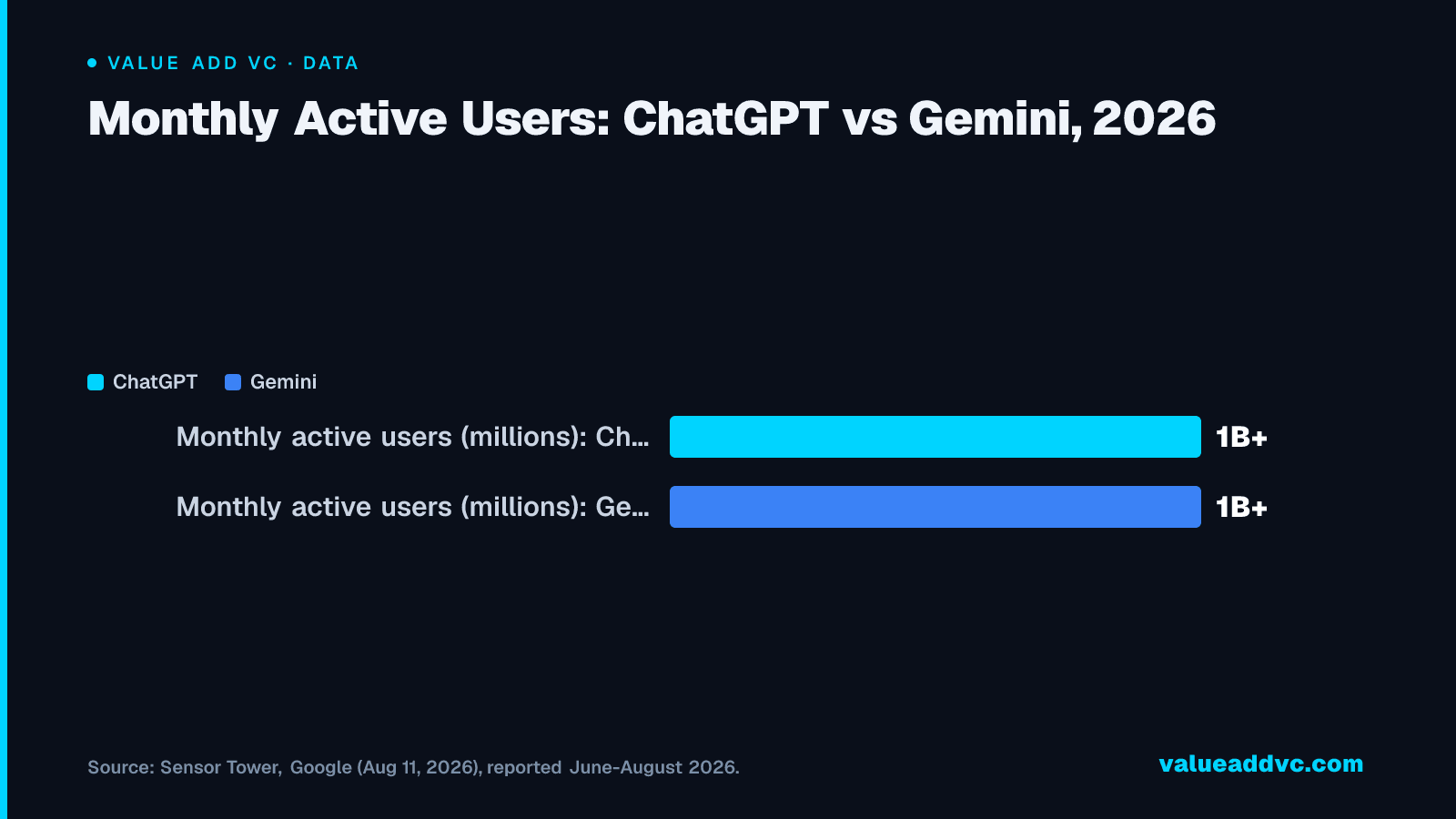
Both products confirmed crossing 1 billion monthly users within about eight weeks of each other — ChatGPT in June, Gemini on August 11 — a gap that has essentially closed since a year earlier, when Gemini trailed by more than 500 million users.
The 50 million paying subscribers behind ChatGPT's 1 billion users
OpenAI confirmed more than 50 million paying ChatGPT subscribers in an April 2026 company update, spanning the $20/month Plus tier, the $200/month Pro tier, and seat-based Team and Enterprise plans, including more than 9 million paying business users. Against a user base that has since crossed 1 billion, that puts paid conversion in the mid-single digits — a share OpenAI is trying to grow toward a stated target of 122 million paying subscribers by the end of 2026, partly through a new $8/month plan aimed at price-sensitive markets in Asia, Latin America, and Africa.
The bigger shift by revenue mix happened on the business side, not the consumer side. OpenAI CFO Sarah Friar told investors on August 14, 2026 that enterprise revenue — Team, Enterprise, and API contracts — had overtaken consumer ChatGPT subscription revenue for the first time, reaching parity months ahead of the company's own end-of-2026 forecast, as its total annualized run rate topped $40 billion in mid-August 2026, roughly double where it started the year. Business customer counts grew 32% in July alone.
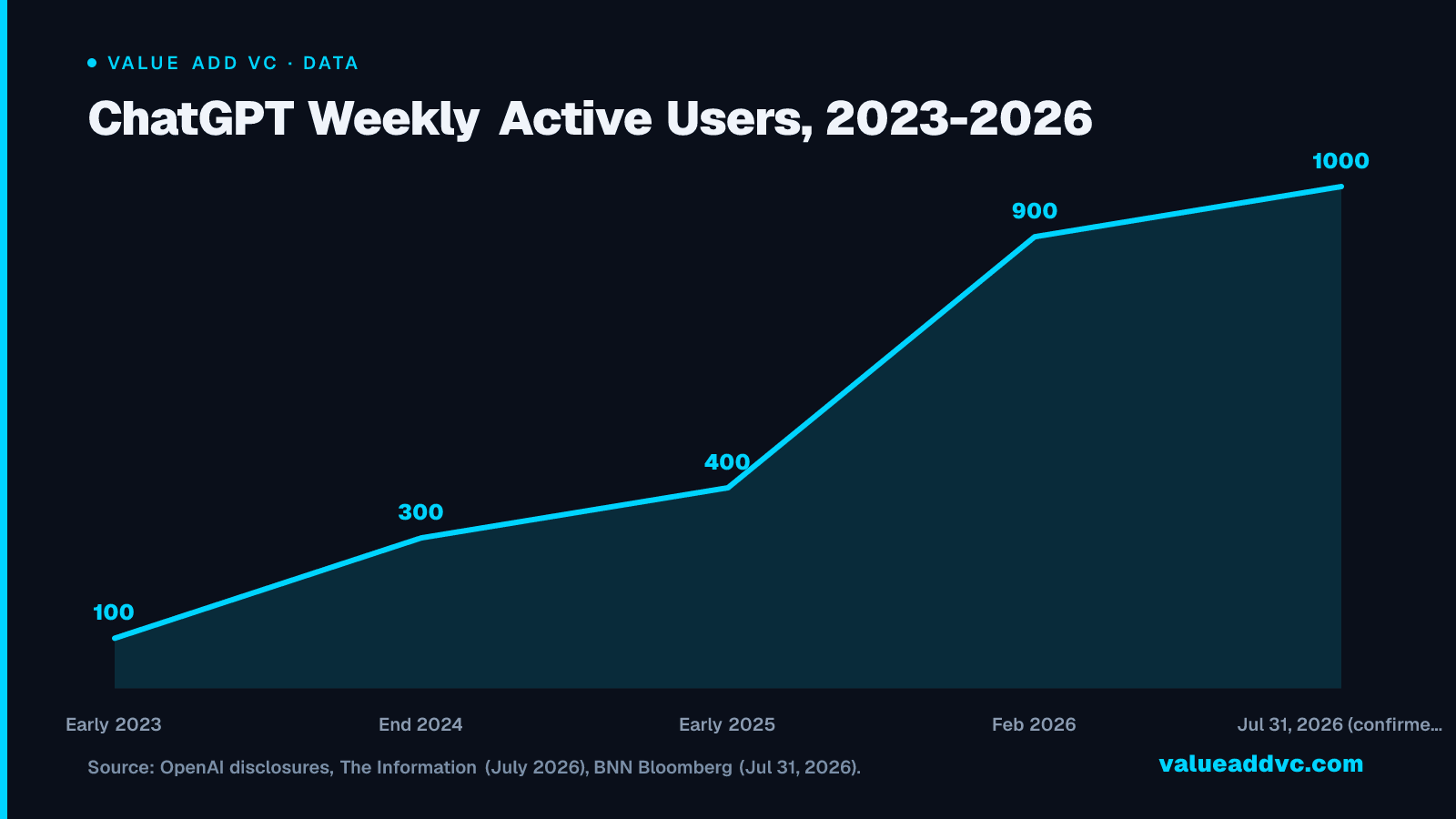
ChatGPT Weekly Active Users, 2023-2026
ChatGPT went from ~100M to ~900M confirmed weekly users in about three years, and OpenAI confirmed its products crossed 1B active users on July 31, 2026
OpenAI disclosures, The Information (July 2026), BNN Bloomberg (Jul 31, 2026).
Data
| Item | Active users (millions) |
|---|---|
| Early 2023 | 100 |
| End 2024 | 300 |
| Early 2025 | 400 |
| Feb 2026 | 900 |
| Jul 31, 2026 (confirmed) | 1000 |
What's changed since our last update
Three things moved between our August 20 update and September 1: OpenAI made its 1-billion-active-user milestone official on July 31, closing the gap between the earlier "nearing 1 billion" reporting and a confirmed number. Then, on August 14, CFO Sarah Friar told investors enterprise revenue had overtaken consumer revenue for the first time — a crossover the company hadn't expected until the end of 2026 — as the total run rate topped $40 billion. And a brand-new ChatGPT Ads product reached a $1 billion annualized run rate in under 200 days, a monetization channel that didn't exist in earlier versions of this analysis. Separately, Anthropic disclosed its own annualized revenue climbed to $65 billion in July, a figure we've updated in the comparison table above.
What the headline misses
A billion-user product that missed its own internal target by seven months is not obviously a growth story or a slowdown story — it's both, depending on which number you anchor to. The absolute growth is still enormous: ChatGPT added roughly 600 million weekly-scale users in about 18 months, from 400 million in early 2025 to over 1 billion confirmed by July 2026. But percentage growth has cooled from its earlier pace, and OpenAI missing an internal roadmap date it never disclosed publicly is exactly the kind of soft signal — visible in what didn't happen rather than what did — that tends to matter more to investors than to headlines. It's also worth remembering that neither the 900 million confirmed February figure nor the July 31 milestone has been independently audited; both come from OpenAI's own data, disclosed on OpenAI's own timeline.
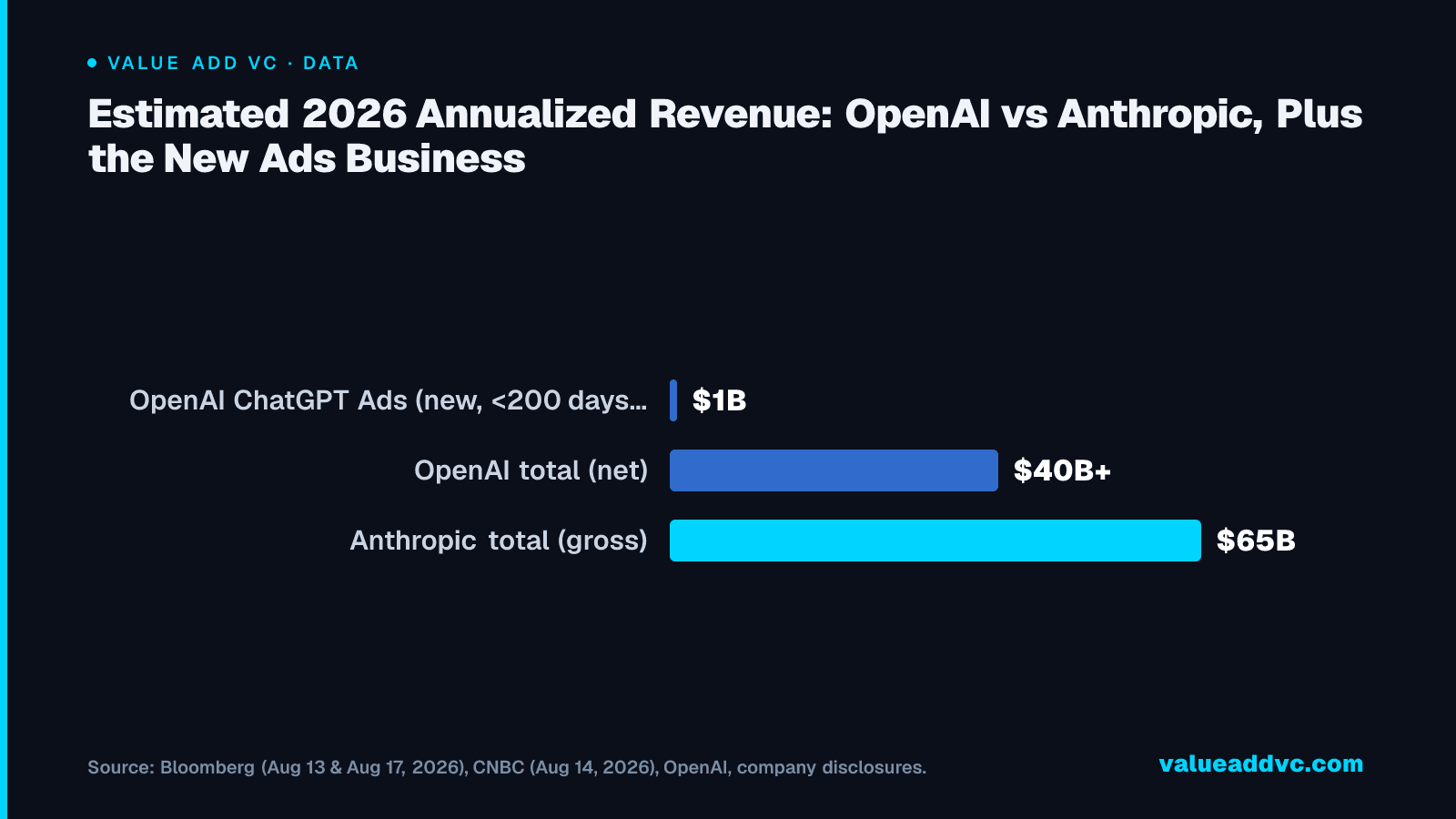
Estimated 2026 Annualized Revenue: OpenAI vs Anthropic, Plus the New Ads Business
OpenAI's total run rate more than doubled since January, but Anthropic's gross ARR figure is still larger on a headline basis — and OpenAI's brand-new ads product is already at $1B run rate
Bloomberg (Aug 13 & Aug 17, 2026), CNBC (Aug 14, 2026), OpenAI, company disclosures.
Data
| Item | Value |
|---|---|
| OpenAI ChatGPT Ads (new, <200 days old) | $1B |
| OpenAI total (net) | $40B+ |
| Anthropic total (gross) | $65B |
What ChatGPT's user growth means for OpenAI's economics
OpenAI's most recent large private raise valued the company at $852 billion in March 2026 on the back of a $122 billion round, a mark it reaffirmed with a $7 billion employee tender offer in August 2026. Against a $40 billion-plus total annualized run rate, that implies a valuation multiple of roughly 21x revenue — a multiple that only holds up if user growth keeps converting into paid seats and business contracts, and inference costs keep falling faster than usage grows. The billion-plus user base is the asset underwriting that multiple; the enterprise crossover is the first hard evidence the monetization side is catching up.
The bear case is straightforward: paid conversion on the free consumer base is still in the mid-single digits, Google's Gemini has fully closed the reach gap after trailing by more than 500 million users a year earlier, and Anthropic's Claude — even with a much smaller consumer app footprint — reported $65 billion in gross annualized revenue in July off enterprise and API demand that doesn't show up in a consumer active-user count at all. A billion-user product that never lifts consumer paid conversion much past the high single digits is a very different business than one that gets there through enterprise contracts instead. You can track how these valuations and revenue multiples move across the sector on our AI Valuations dashboard, and see how OpenAI and Anthropic's competing ARR figures compare in our full accounting breakdown.
The bottom line:
1 billion-plus confirmed active users, a $40 billion-plus revenue run rate that's now majority-enterprise for the first time, and still only about 50 million paying subscribers — the gap between reach and monetization, not the round number, is the story.
Track AI company valuations and revenue on our AI Valuations dashboard, compare these figures against public mega-cap tech earnings on our Big Tech Earnings dashboard, and see the full OpenAI-Anthropic revenue picture on our VC Performance dashboard at Value Add VC. Originally published in the Trace Cohen newsletter.
Latest from the Pulse
Get VC data most people never see
— free to subscribe
Trace's notes on venture, AI and startups, a few times a week. Join 5,000+ subscribers. No spam.
No spam, unsubscribe anytime. Sent via Substack · Privacy · or subscribe on Substack ↗