

Multiverse Computing raised a Series C round targeting up to $570 million at a $1.7 billion pre-money valuation, co-led by Forgepoint Capital International, BNPP Solar Impulse Venture Fund, and Bullhound Capital.
This isn't a foundation model company or a chip company raising a mega-round — it's a compression company, and the reason investors just marked it up roughly 5x in thirteen months is that it claims to solve the one problem every AI buyer is quietly panicking about in 2026: inference cost. Multiverse's CompactifAI product uses tensor networks, a mathematical toolkit built for simulating quantum systems, to shrink large language models by 80 to 95% in size while keeping most of their capability intact — and it runs on the GPUs enterprises already own, no quantum hardware required.

Multiverse Computing $570M Series C: Round Terms and Lead Investors
Multiverse Computing, a San Sebastián, Spain-founded startup, announced on July 27, 2026 that it is raising a Series C round targeting up to $570 million (€500 million) at a $1.7 billion pre-money valuation. The round is co-led by Forgepoint Capital International, BNPP Solar Impulse Venture Fund, and Bullhound Capital, with a long list of additional backers including Santander Alternative Investments, Tikehau Capital, HP Inc., Orange Ventures, Scania Invest, NAventures, Qatar Development Bank, Zouk Capital, SETT, the EIC Fund, the Basque Government's Hazten Scale-Up Fund, and Kutxa Fundazioa. The company says the round may still stay open to a small number of additional strategic investors before it closes.
A 5x step-up in 13 months, and what's driving it
Multiverse closed its Series B in June 2025. Thirteen months later, its pre-money valuation has jumped roughly 5x to $1.7 billion, and total funding — inclusive of this round — is expected to reach $800 million. Step-ups of that size in that timeframe are rare even in the current AI market, and they're almost never justified by narrative alone; the company is pointing directly at revenue. Multiverse says its annualized revenue has grown more than tenfold since the Series B closed, and that first-quarter 2026 sales specifically were up 96x year-over-year.
Triple-digit revenue multiples off a small base are common in early-stage AI; 96x off what was already a meaningfully sized business is not. It signals that CompactifAI moved from pilot deployments to production spend inside the same year enterprises started treating inference cost as a board-level line item rather than an engineering afterthought.
What CompactifAI actually does: tensor networks, not quantum hardware
Multiverse was founded on quantum computing software, but its flagship commercial product, CompactifAI, doesn't require a quantum computer to run. It applies tensor networks — a mathematical framework developed by physicists (including Multiverse co-founder and Chief Scientific Officer Dr. Román Orús) to simulate quantum many-body systems on classical computers — to the weight matrices inside a large language model. The technique identifies and strips out low-information redundancy in those matrices, producing a model that is 80 to 95% smaller while retaining most of the original's accuracy, and that runs on the same GPUs and CPUs the model would have used anyway.
The practical pitch to an enterprise buyer is blunt: same model behavior, a fraction of the memory footprint, lower latency, and a meaningfully smaller inference bill — with no need to wait for fault-tolerant quantum computers to become commercially useful, which for most quantum computing startups is still a multi-year-to-decade bet. Multiverse effectively found a way to monetize quantum-physics math today, on hardware that already exists, which is a large part of why this round priced the way it did.
Why AI compression is suddenly a venture-scale category
Selected AI Infrastructure Raises, 2026 (Valuation, $B)
Source: Company announcements, GlobeNewswire, Crunchbase News, as of July 28, 2026.
Data
| Item | Value |
|---|---|
| Multiverse Computing (Series C) | $1.7B |
| Norm AI (Series C) | $1.2B |
| Chai Discovery (Series C) | $3.8B |
| Multiverse Series B (2025) | ~$0.34B |
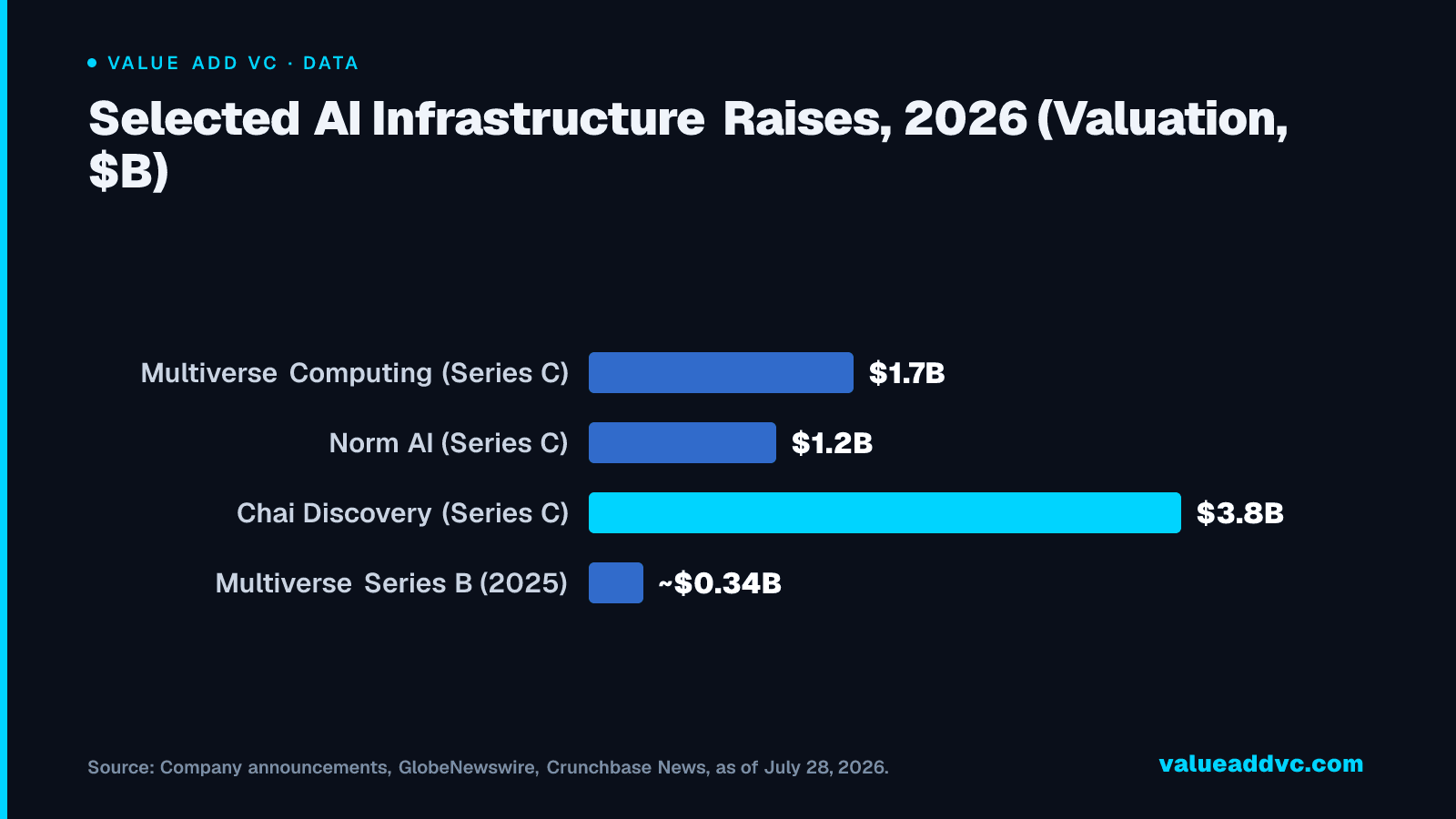
The macro backdrop makes this round easier to read. Hyperscaler AI capex is running into hundreds of billions of dollars a year, and a growing share of enterprise AI budgets is going toward the recurring cost of serving models rather than training them. Every additional token of inference has a real, metered cost, and it compounds at scale in a way training costs — a one-time expense — don't. That's the wedge for a compression company: if CompactifAI genuinely cuts serving costs by up to 90% with acceptable accuracy loss, it's not a nice-to-have optimization, it's a direct line to gross margin for any company running LLMs at volume, and it explains why strategics like HP, Orange, and a Spanish bank-backed fund all wrote checks into an infrastructure-layer round rather than another model company.
The tradeoffs investors are underwriting
What a $1.7B Pre-Money Valuation Is Betting On
Source: Company statements, GlobeNewswire announcement, July 27, 2026.
Data
| Item | Value |
|---|---|
| Revenue growth continuing (96x Q1 base) | 35% |
| Compression accuracy holding at enterprise scale | 30% |
| No dominant open-source compression standard emerging | 20% |
| Strategic investor deployments converting to renewals | 15% |
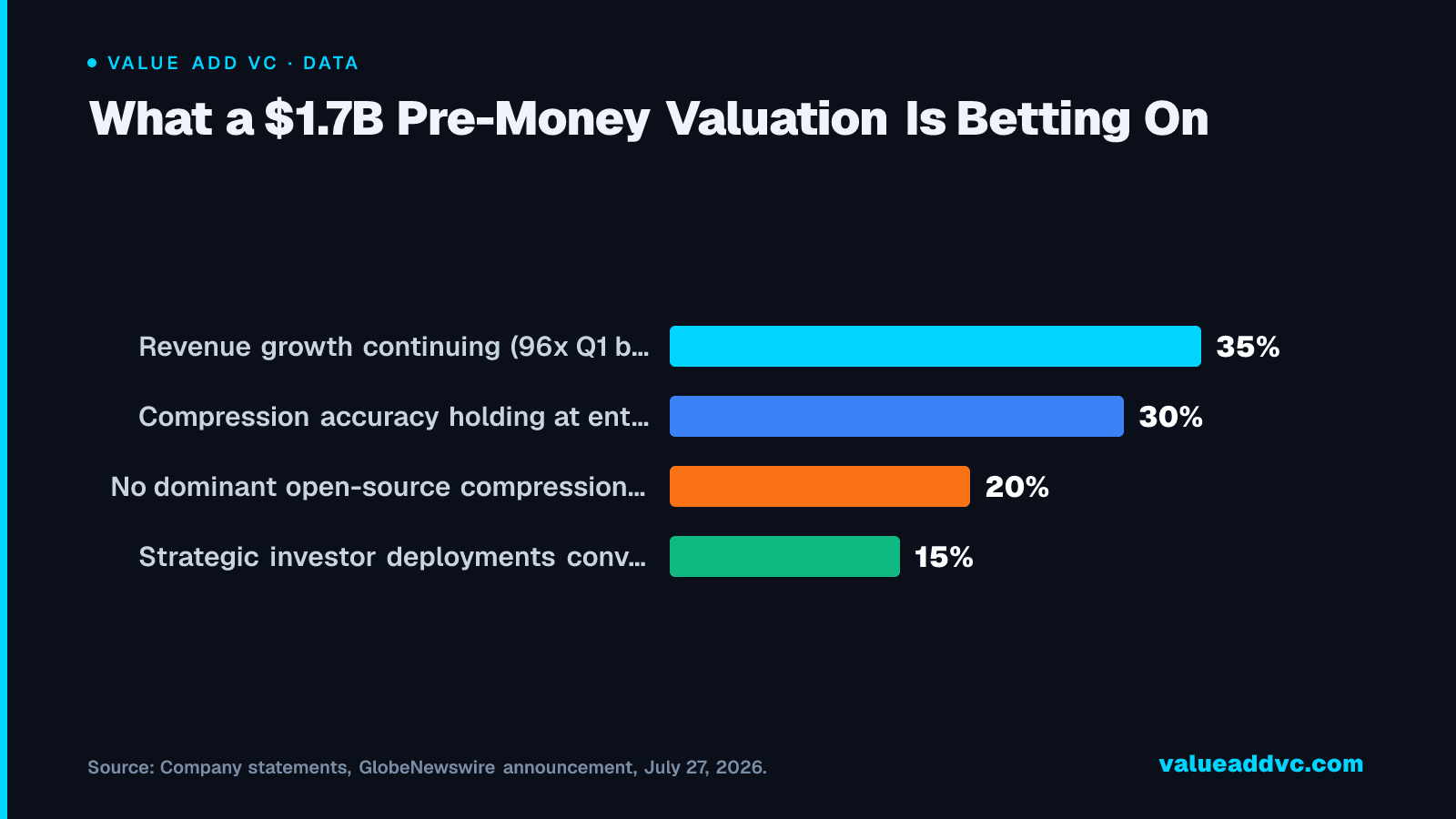
None of this is riskless. A 96x quarterly growth rate off any base decelerates by definition — the question is how much, and whether the deceleration curve still supports a $2.3 billion post-money mark twelve months from now. Model compression is also not a moat by itself: quantization, distillation, and pruning techniques are active research areas at every major lab and cloud provider, and a "good enough" open-source compression standard bundled free into a hyperscaler's serving stack is the scenario every specialist compression vendor has to out-run. Multiverse's bet is that tensor-network compression is meaningfully better on the accuracy-retention curve than those alternatives — the size of this round says its investors currently believe that bet is working.
How I read this round as an investor
I've made 65+ investments and I track AI infrastructure spend closely because it's one of the clearest leading indicators of where enterprise AI budgets actually go once pilots turn into production. The pattern with Multiverse mirrors what I saw with Norm AI's Series C and Chai Discovery's rapid step-up: 2026's biggest AI rounds aren't going to the flashiest model demos anymore, they're going to companies that can point to a specific, measurable cost or capability problem enterprises are already paying to solve, backed by revenue that proves it. A quantum-inspired compression story would have been a research curiosity in 2023. In 2026, with inference spend a board-level concern and export-control-driven chip scarcity still reshaping who can even access frontier compute — see our coverage of Nvidia's China market share collapse — a technology that makes existing GPUs do 5-10x more useful work is exactly the kind of infrastructure bet large strategics and sovereign-adjacent funds want exposure to.
The number to watch next isn't the valuation, it's whether Multiverse's revenue growth rate holds anywhere close to its current trajectory through the next two quarters. A 5x valuation step-up built on a 96x quarterly growth print is a bet that the growth is durable, not a one-quarter spike from a handful of large strategic pilots converting at once. We track how infrastructure cost curves like this flow through to broader company pricing on the SaaS Valuations dashboard and how funds are positioning around AI infrastructure on the VC Performance Dashboard.
The Bottom Line:
Multiverse Computing raised up to $570 million at a $1.7 billion pre-money valuation — a 5x step-up in 13 months — on the strength of a 96x year-over-year revenue print and a product that shrinks LLMs by up to 95% using quantum-physics math running on ordinary GPUs. It's a bet that AI's next bottleneck isn't training compute, it's the recurring cost of serving models at scale, and that tensor-network compression can beat the open-source alternatives every major lab is also racing to ship.
Track how AI infrastructure spend flows through to company valuations on the SaaS Valuations dashboard and how funds are positioning around AI infrastructure on the VC Performance Dashboard at Value Add VC. Originally published in the Trace Cohen newsletter.
Latest from the Pulse
Get VC data most people never see
— free to subscribe
Trace's notes on venture, AI and startups, a few times a week. Join 5,000+ subscribers. No spam.
No spam, unsubscribe anytime. Sent via Substack · Privacy · or subscribe on Substack ↗