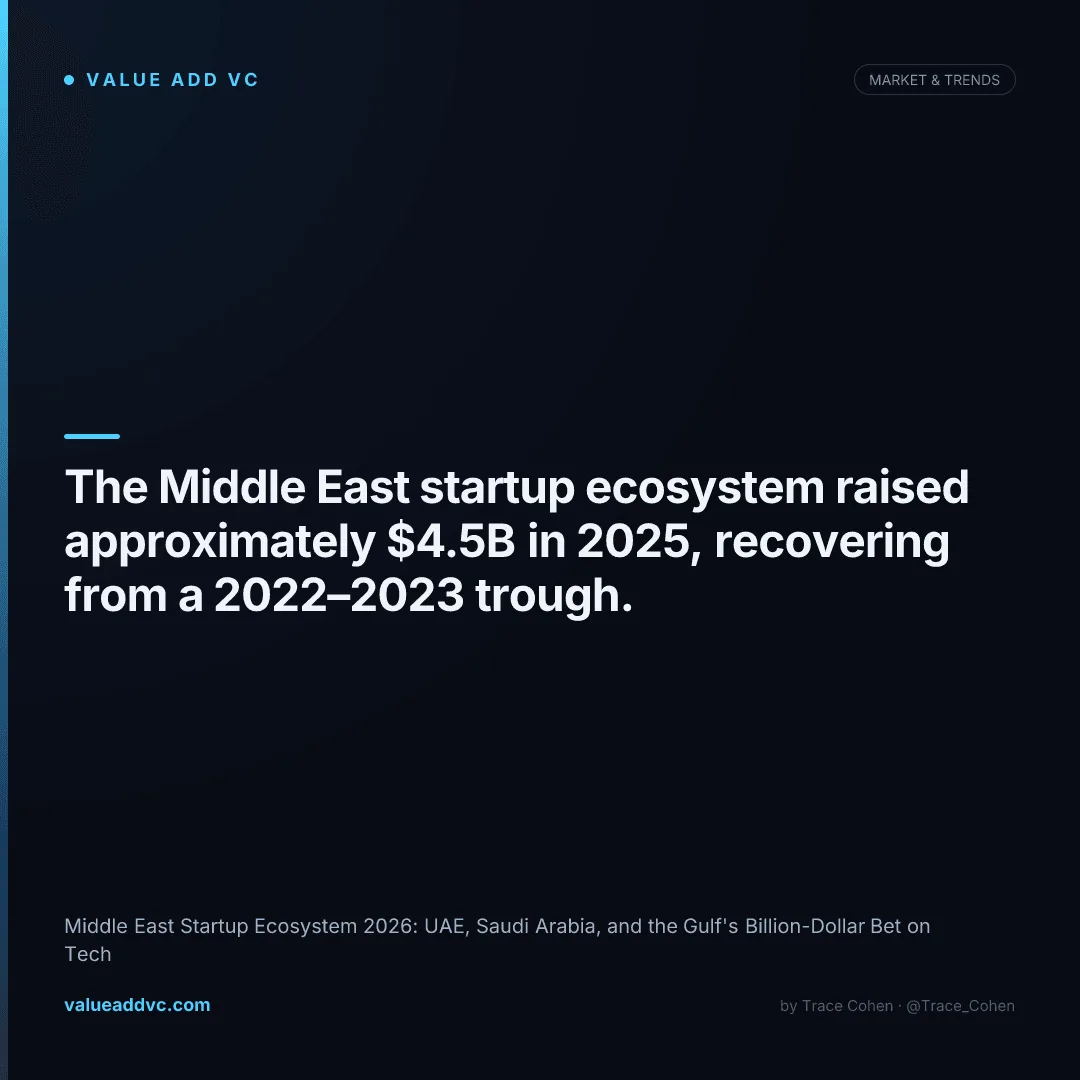
The Middle East startup ecosystem raised approximately $4.5B in 2025 — a meaningful recovery from the $2.8B trough of 2022 and a signal that sovereign capital and private VC are finally pulling in the same direction.
For years, the Gulf was primarily an LP base. Sovereign wealth funds like Abu Dhabi Investment Authority (ADIA) and Kuwait Investment Authority (KIA) allocated billions to US and European VC funds while homegrown ecosystems struggled for deal flow, talent, and exits. That story is changing — not completely, but meaningfully. UAE has built regulatory infrastructure that rivals Singapore. Saudi Arabia is using Vision 2030 as a national mandate to build technology companies. And the region's unicorns — Tabby, Tamara, Kitopi — are proving that consumer internet and fintech can scale in the Gulf.
Middle East Startup Ecosystem 2026: Funding by Country
Dubai + Abu Dhabi; DIFC and ADGM regulatory hubs; fintech, AI, proptech
Vision 2030 mandate; STV, Wa'ed, PIF-backed; fintech and logistics dominant
Largest talent base in MENA; fintech and e-commerce; Paymob, Capiter notable names
Strong engineering talent; Liwwa, Tamatem historically active; seed-stage focus
Kuwait, Bahrain, Morocco, Tunisia; early-stage activity growing
UAE: The Middle East Startup Ecosystem's Dominant Hub
Dubai and Abu Dhabi have built a structural advantage that other regional cities struggle to replicate: world-class regulatory frameworks, a zero-income-tax environment, and genuine infrastructure for international founders to operate from day one. The Dubai International Financial Centre (DIFC) and Abu Dhabi Global Market (ADGM) are free-zone structures that give startups access to common-law courts, English-language governance, and fast-track licensing — none of which exist at the same quality anywhere else in the region.
The UAE's fintech-first approach is not accidental. A large expatriate population (over 85% of residents are non-citizens), high mobile penetration, and historically underserved digital financial services created natural demand. Tabby, the BNPL leader valued at $3.3B in its most recent raise, and Tamara — its Saudi-headquartered competitor — both operate heavily in the UAE market. Kitopi, the cloud kitchen operator, built its operating model to serve the UAE's uniquely food-delivery-obsessed consumer base before expanding regionally.
Saudi Arabia and Vision 2030: Sovereign Capital Meets Startup Ambition
Saudi Arabia is the most structurally interesting story in MENA right now. Vision 2030 — Crown Prince Mohammed bin Salman's program to diversify the Saudi economy away from oil — has created the largest directed government spending on tech ecosystem development of any country outside China. The Public Investment Fund (PIF) manages over $770B in assets and has committed to deploying significant capital domestically, including through STV (Saudi Telecom Company's VC arm, one of MENA's most active investors) and direct NEOM investment. Startup funding is really just the visible edge of a far bigger number — the kingdom's broader $100B+ AI infrastructure push through HUMAIN and Alat dwarfs anything flowing to seed and Series A startups.
The risk in Saudi Arabia is that ecosystem development driven primarily by sovereign capital can produce activity without sustainable private-market signals. Startups winning government contracts and non-dilutive grants are not the same as startups winning because they have genuine product-market fit. The best signals to watch are fintech companies that can demonstrate organic user acquisition and unit economics — and those are starting to emerge.
Top Sectors in the Middle East Startup Ecosystem
Large unbanked population, strong BNPL demand, Islamic finance digitization
Notable: Tabby, Tamara, Paymob, Lean Technologies, Tarabut Gateway
Rapid adoption of delivery and last-mile; young, mobile-native consumer base
Notable: Sary, Deliveroo MENA, Pure Harvest, Floward
UAE real estate booming; Saudi megaprojects creating unprecedented demand
Notable: Property Finder, Huspy, Stake, Silkhaus
Aging Gulf population, government digitization mandates, cash-pay market
Notable: Altibbi, Cura, Okadoc, Vezeeta
Multinational demand for Arabic-language AI; NEOM and Vision 2030 create captive market
Notable: Unifonic, Mozn, Inception (ADNOC), G42 portfolio
UAE has one of the world's highest food-delivery penetration rates per capita
Notable: Kitopi, iKcon, Qlub
Who Is Investing in the Middle East Startup Ecosystem?
The investor landscape in MENA is a mix of region-native funds, global funds with local offices, and sovereign vehicles operating like strategic investors. The most active names by deal count in 2025:
What the MENA Exit Market Actually Looks Like
The brutal honest truth about the Middle East startup ecosystem is that exits are rare and mostly small. Careem's $3.1B acquisition by Uber in 2020 remains the landmark transaction — and it happened because Careem had genuine cross-regional dominance before Uber decided buying was better than competing. Since then, the regional market has not produced a comparable exit.
Exit Tailwinds
- ✓ Tadawul (Saudi stock exchange) IPO window opening for tech companies
- ✓ Strategic acquirers from India, Southeast Asia, and US looking at MENA
- ✓ Sovereign funds willing to provide liquidity via continuation vehicles
- ✓ Growing secondary market through Nasdaq Dubai and direct LP sales
Exit Headwinds
- ✕ Limited domestic institutional investor base for public tech stocks
- ✕ Most successful companies still in growth phase, not IPO-ready
- ✕ Western acquirers wary of regulatory and geopolitical complexity
- ✕ Fragmented market — UAE + Saudi may each be too small alone
The Tadawul opportunity is real. Saudi Arabia is actively working to create conditions for domestic tech IPOs, and fintech companies like STC Pay have already demonstrated that the market can absorb tech listings. The question is whether the pipeline of companies that can list at meaningful scale will materialize before LP patience in the 2019–2021 vintage funds runs out.
Track global unicorn data including Middle East companies on the Unicorn Tracker at Value Add VC.
A Thesis on the Middle East Startup Ecosystem
The Gulf looks like a genuinely interesting but structurally different bet than Southeast Asia or LatAm. The TAM is smaller. The exit infrastructure is thinner. But the sovereign capital flywheel — where government mandates create enterprise customers who fund startup revenue who attract private VC who validate companies for follow-on — is more powerful here than anywhere else.
Fintech is the clearest opportunity. The region has 450M+ people, less than 50% banked in parts of North Africa and the Levant, a massive remittance market ($50B+ flows annually), and a growing Islamic finance digital layer that traditional Western fintechs are not equipped to build. Tabby and Tamara proved BNPL can scale here — the next wave will be in embedded finance for SMBs, B2B payments infrastructure, and insurance.
One caution: companies that are built to win government contracts but have no path to organic, private-sector revenue. Vision 2030 creates real demand today but it doesn't last forever — and the startups that survive the transition to a post-oil-capital ecosystem are the ones building durable unit economics now.
The Gulf is not building a Silicon Valley clone.
It is building something optimized for its own market — and the companies that understand that will win.
Track global unicorn data including MENA companies on the Unicorn Tracker. Monitor AI company valuations globally on the AI Valuations Dashboard. Originally published in the Trace Cohen newsletter.
Latest from the Pulse
Get VC data most people never see
— free to subscribe
Trace's notes on venture, AI and startups, a few times a week. Join 5,000+ subscribers. No spam.