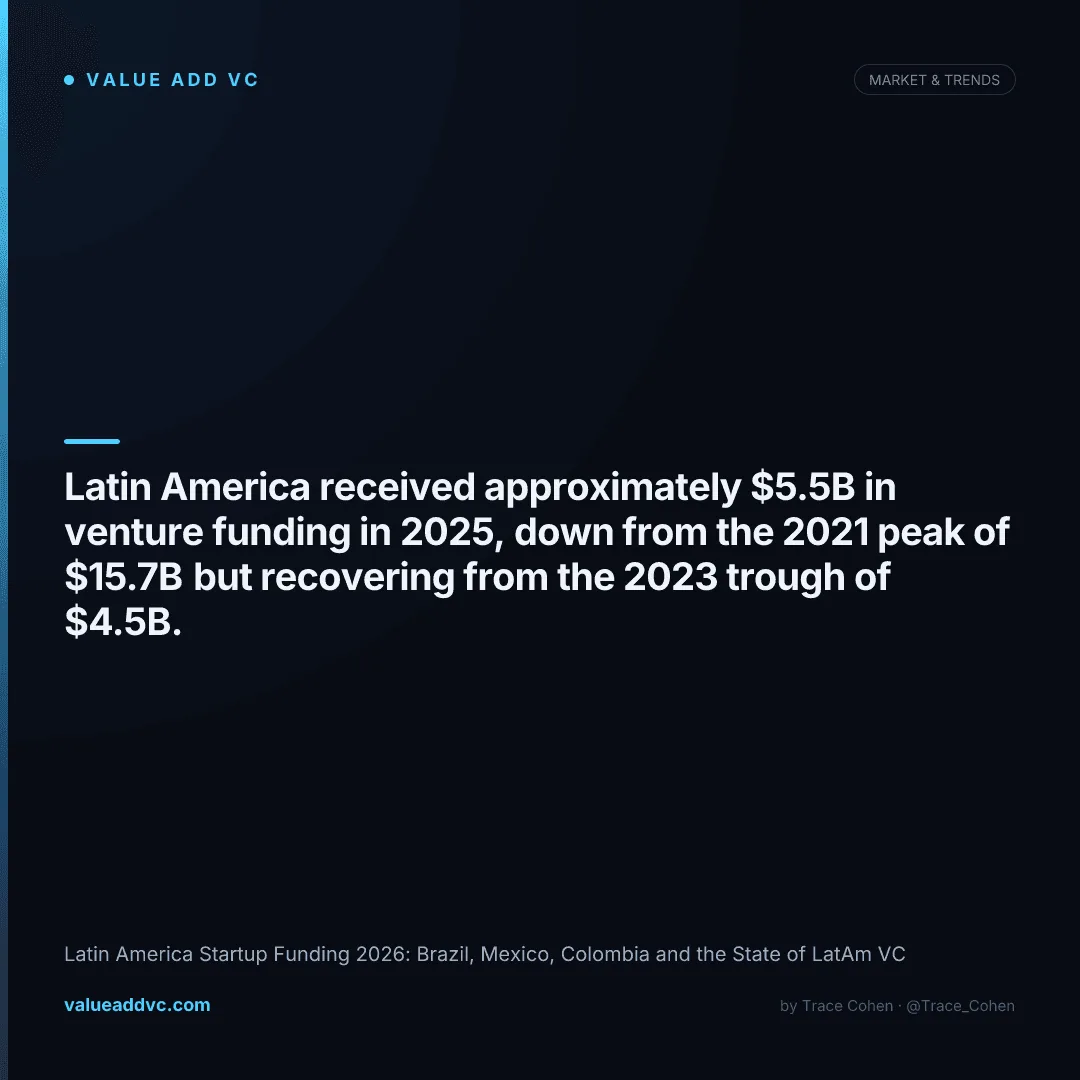
Latin America raised $15.7B in venture capital in 2021. By 2023, that number had fallen to $4.5B — a 71% collapse in two years. In 2026, the region is recovering, but not to boom-era levels, and that's probably fine.
The 2021 supercycle was driven by SoftBank's $8B Latin America fund, Tiger Global writing checks at peak multiples, and ZIRP-fueled capital chasing emerging market growth. When rates rose, the tourists left. What remains is a leaner, more disciplined market — and a handful of genuinely durable companies that survived the reset.
Latin America Startup Funding by Year
| Year | Total VC | Context |
|---|---|---|
| 2019 | $4.5B | Pre-boom baseline |
| 2020 | $4.2B | COVID dip, but fintech accelerated |
| 2021 | $15.7B | SoftBank + ZIRP supercycle peak |
| 2022 | $7.2B | Rate hike correction begins |
| 2023 | $4.5B | Trough — near 2019 baseline |
| 2024 | $5.0B | Modest recovery, AI interest builds |
| 2025 | ~$5.5B | AI-native fintech/health gaining traction |
| 2026E | ~$6.0B | Recovery trajectory continues |
Source: LAVCA (Latin American Private Capital Association) regional data
Latin America Startup Funding by Country
Brazil dominates, but Mexico is growing faster in relative terms. Colombia punches above its weight in health tech and agritech. Argentina has extraordinary engineering talent but macro volatility continues to suppress institutional investment. Cross-border remittance fintech is one of the corridor's hottest categories — Félix Pago's $1.4B valuation for WhatsApp-based remittances is a recent example.
LatAm's Unicorn Map: Who Survived the Reset
Latin America has produced roughly 40+ unicorns as of 2026, though many have seen valuation corrections from 2021 peaks. The durable companies share a common theme: they attacked large, underserved markets with mobile-first infrastructure and real unit economics.
Track global unicorn data on the Unicorn Tracker at Value Add VC.
Who's Investing in Latin America in 2026
The investor base has consolidated. The tourists — Tiger Global, Coatue, SoftBank Vision Fund writing $200M checks at 100x revenue — are largely gone. What remains is a healthier mix of specialist LatAm funds and disciplined global generalists who understand the market and can stomach the currency risk.
What's Driving latin america startup funding 2026 Recovery
The recovery is real but narrow. It's concentrated in three structural dynamics that weren't present in the 2021 boom:
AI-native fintech hitting product-market fit
LatAm's 400M+ underbanked adults are ideal for AI-powered credit scoring, insurance underwriting, and digital wallets. Founders who couldn't crack legacy data deserts are now using alternative data and ML to build credit models from scratch. This is a genuine structural advantage unavailable to incumbents.
Health tech filling massive infrastructure gaps
Public healthcare systems across Brazil, Mexico, and Colombia are overwhelmed. Digital health, telemedicine, and AI diagnostics are seeing genuine traction. Companies like Sami and Nilo Saúde are building private infrastructure where the state has failed — and charging accordingly.
Vertical SaaS for the 80M+ LatAm SMB market
LatAm has 80M+ SMBs, the vast majority running on spreadsheets. Vertical SaaS — for restaurants, clinics, agribusiness operators, logistics companies — is growing quietly. Dollar-denominated SaaS revenue paired with local-cost engineering teams creates exceptional gross margin profiles.
LatAm VC Sector Mix in 2026
| Sector | Share of Deals | Trend |
|---|---|---|
| Fintech | 30–35% | Stable — AI credit and neobanking growing |
| E-commerce / Logistics | 18–22% | Declining share vs. 2021 peak |
| Health Tech | 10–12% | Growing — telemedicine, AI diagnostics |
| SaaS / Enterprise Software | 10–12% | Growing — vertical SaaS for SMBs |
| AgriTech | 6–8% | Growing — Brazil agribusiness = massive TAM |
| EdTech | 4–6% | Declining — post-pandemic correction |
| PropTech | 4–5% | Stable — QuintoAndar, Loft continue |
| Other (AI, Climate, Mobility) | 8–12% | Expanding as new categories emerge |
The Honest Assessment
Why LatAm Works
- ✓ 650M+ people, 400M+ mobile internet users
- ✓ Massive underbanked population = real fintech TAM
- ✓ Strong technical talent, especially Brazil and Argentina
- ✓ Nubank proved the model works at global scale
- ✓ AI-native startups can skip legacy infrastructure
- ✓ Dollar-denominated SaaS + local-cost teams = margin
Why It's Still Hard
- ✕ Argentina macro volatility suppresses institutional LP interest
- ✕ Exit routes remain thin — few IPOs, fewer strategic buyers
- ✕ Global LPs still underweight LatAm vs. Southeast Asia
- ✕ Currency risk compresses real returns for USD investors
- ✕ Regulatory fragmentation across 6+ major markets
- ✕ 2021 vintage marks still creating overhang and LP fatigue
LatAm isn't a "next Southeast Asia" story anymore. It's its own thing.
The founders who survived the correction are building real businesses — not venture-subsidized growth for growth's sake. That's a better foundation.
Track global unicorn and startup funding data on the Unicorn Tracker at Value Add VC. Originally published in the Trace Cohen newsletter.
Latest from the Pulse
Get VC data most people never see
— free to subscribe
Trace's notes on venture, AI and startups, a few times a week. Join 5,000+ subscribers. No spam.