Southeast Asia venture capital is not a homogeneous market — it's six distinct economies with different consumer bases, regulatory regimes, and startup maturity curves, all competing for the same pool of international capital.
The 2021 boom inflated valuations across the region. The 2023 bust corrected them violently. What's emerging in 2026 is something more disciplined: a smaller number of higher-conviction bets, a stronger preference for B2B over consumer, and a bifurcation between managers who stayed active through the downturn and those who retreated.
The question for LPs and founders is no longer "is Southeast Asia a real market?" — Sea Ltd, Grab, and GoTo settled that debate. The question is which wave of the region's development is worth backing in 2026.
Southeast Asia VC Funding by Year
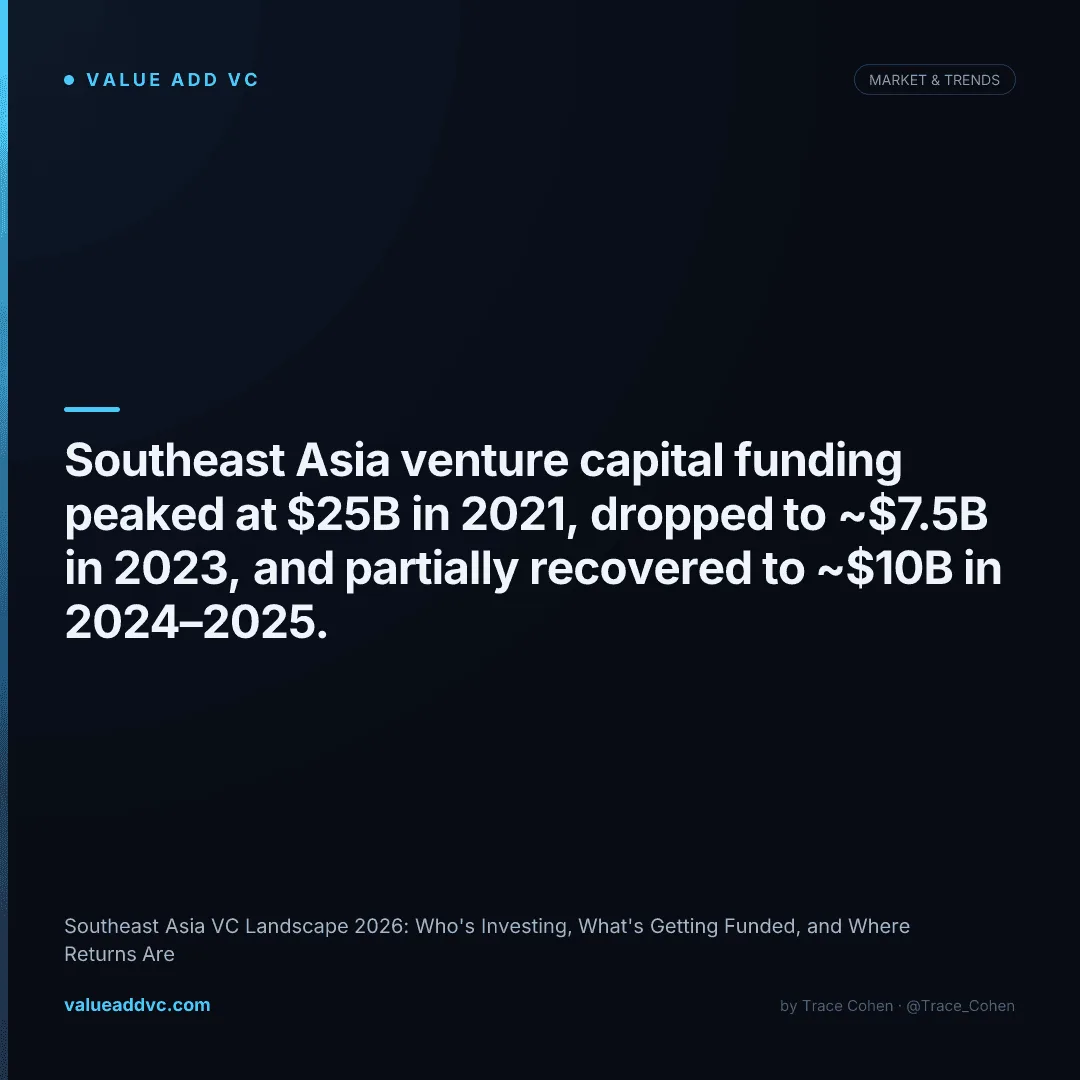
The macro story is familiar: a 2021 peak driven by global ZIRP liquidity, a painful 2022–2023 correction, and a slow recovery that is still incomplete. SEA was hit harder than most regions because so much capital concentrated in a handful of super-apps with unclear paths to profitability.
Pre-pandemic baseline
Covid acceleration in digital services
Peak — global ZIRP + super-app mania
Rate shock hits late-stage rounds first
Trough — Series B/C drought across region
Partial recovery, AI adds a new vertical
Continued recovery, fintech + AI leading
Sources: Bain & Company SEA VC Report, Google-Temasek-Bain e-Conomy SEA 2024, DealStreetAsia data.
Southeast Asia VC by Country: Where the Money Goes
Indonesia ~35% of deal value
Largest consumer market; fintech, e-commerce, logistics dominate
Singapore ~30% of deal count
Regional HQ hub; most international fund offices; B2B SaaS skews higher
Vietnam Fastest growing
Strong manufacturing + export tech base; software outsourcing evolving into product
Philippines ~8% of deal value
BPO → fintech transition; OFW remittance infrastructure is a structural opportunity
Thailand ~7% of deal value
Tourism tech, agri-tech; local corporate VC more active than international
Malaysia ~6% of deal value
Stronger institutional infrastructure than deal volume suggests; deeptech emerging
Singapore's outsized role is structural: most regional funds domicile there for legal, tax, and regulatory reasons, which inflates its "deal count" relative to actual startup formation. The real consumer-market bets are denominated in Indonesian rupiah and Vietnamese dong.
Who's Writing Checks: Top VC Investors in Southeast Asia
The investor landscape bifurcated sharply after 2021. Funds that had raised on 2021 vintage capital deployed aggressively — and are now sitting on marked-down portfolios. Funds that held dry powder through 2022–2023 are entering 2026 with the best deal flow in a decade. Several of the largest names here, like Peak XV, run the same playbook across the water — see how the biggest India-focused firms are deploying capital for the parallel picture.
Peak XV Partners
Broad mandate across SEA and India; largest SEA-focused fund with $2.85B Fund IX; Cred, Meesho, Groww in India; strong SEA consumer and fintech
Vertex Ventures SEA
Temasek-backed; co-led early rounds in Grab and PatSnap; consistent presence across all six markets
GIC / Temasek
Singapore sovereign wealth — wrote the largest SEA checks in 2021; now more selective; co-invest frequently at Series C+
Jungle Ventures
$600M+ AUM; India + SEA portfolio; known for backing B2B and fintech early
AC Ventures
Indonesia-focused; $150M+ fund; strong local operator network; fintech and logistics
Alpha JWC Ventures
Indonesia-first, now expanding regionally; backed Kopi Kenangan, Aruna
Golden Gate Ventures
Singapore-based; exits-focused strategy; one of the earliest SEA-dedicated funds
Openspace Ventures
Malaysia/Singapore HQ; known for data-driven approach; $200M+ fund III
Monk's Hill Ventures
Enterprise + B2B SaaS focus; technical founders; Singapore and Vietnam primary
B Capital Group
BCG partnership; US-SEA bridge; fintech, health, logistics verticals
What's Getting Funded in Southeast Asia in 2026
The sector mix has rotated significantly since 2021. Consumer super-apps and ride-hailing aggregators no longer dominate deal flow. The 2026 cycle favors companies with near-term revenue visibility and defensible wedges.
Sectors with Active Funding (2026)
- ✓ Fintech: embedded finance, BNPL maturation, insurance-tech
- ✓ AI-native B2B software for regional SMBs
- ✓ Logistics and last-mile delivery infrastructure
- ✓ Healthcare digitization (telehealth, pharmacy, diagnostics)
- ✓ Climate-tech and renewable energy platforms
- ✓ Cross-border trade and payments
Sectors Facing Funding Headwinds
- ✕ Consumer super-apps (market saturated, unit economics unclear)
- ✕ On-demand delivery (Grab Food, GoFood consolidation complete)
- ✕ Ed-tech (post-Covid correction persists)
- ✕ NFT/crypto-native consumer apps
- ✕ Late-stage growth rounds (2021 vintage companies still digesting)
The Exit Problem: Where Southeast Asia VC Returns Actually Come From
The inconvenient truth about SEA venture capital: most returns come from a tiny number of exits, and those exits were clustered in 2021–2022. Sea Ltd's NASDAQ IPO created enormous DPI for early investors like GIC and Tencent. Grab's $40B SPAC listing paid out early Vertex and GGV positions.
Since then, the exit market has been quiet. The local public equity markets — Indonesia Stock Exchange, Singapore Exchange, Vietnam's HOSE — have limited depth for tech companies. NASDAQ listings require a compliance and governance infrastructure that most regional startups haven't built.
This creates a structural tension: LPs are asking for DPI, but the exit pathways are narrow. The 2026 exit pipeline is dominated by strategic M&A (regional banks acquiring fintech, e-commerce platforms acquiring logistics), secondary sales to late-stage funds, and a small number of IPO-track companies targeting the SGX or NASDAQ.
| Company | Exit Type | Year | Valuation at Exit |
|---|---|---|---|
| Sea Ltd | NASDAQ IPO | 2017 (peak 2021) | $200B+ at peak |
| Grab | SPAC / NASDAQ | 2021 | $40B |
| GoTo (Gojek + Tokopedia) | IDX IPO | 2022 | $28B at listing |
| Bukalapak | IDX IPO | 2021 | $6B |
| Traveloka | Still private | — | $3–4B (est.) |
| Xendit | Still private | — | $1.2B (last round) |
What the Southeast Asia Venture Capital Opportunity Actually Looks Like in 2026
From where I sit after 65+ investments: SEA is a real market with a real venture opportunity, but it's not a monolith. Indonesia is a different bet than Vietnam, which is a different bet than Singapore. Funds that treat "Southeast Asia" as a single thesis will underperform funds that know which country and which sector they're underwriting.
The structural tailwinds are undeniable: 670M people, median age under 30, smartphone penetration over 80%, fintech infrastructure still early relative to China or India. But the same tailwinds have been present since 2015. What's different in 2026 is that AI creates a genuine shortcut — SEA companies can now build with foundation models rather than training from scratch, which compresses the technical moat disadvantage relative to Silicon Valley incumbents. China's own corporate investors haven't slowed down either — Meituan and Tencent's joint bet on a Shenzhen smart-glasses maker shows how much conviction capital still flows into differentiated hardware, a category SEA funds have mostly stayed away from.
Track the global unicorn pipeline — including SEA emerging companies — on the Unicorn Tracker and monitor how regional AI valuations compare globally on the AI Valuations Dashboard at Value Add VC.
The 2021 SEA cohort is digesting. But the infrastructure they built — payments, logistics, identity — is the foundation for the next generation of B2B and AI-native companies.
The best SEA vintage may not be the one that caught the peak. It's the one being written right now.
Track global unicorn formation and VC performance on the VC Performance Dashboard at Value Add VC. Originally published in the Trace Cohen newsletter.
Latest from the Pulse
Get VC data most people never see
— free to subscribe
Trace's notes on venture, AI and startups, a few times a week. Join 5,000+ subscribers. No spam.