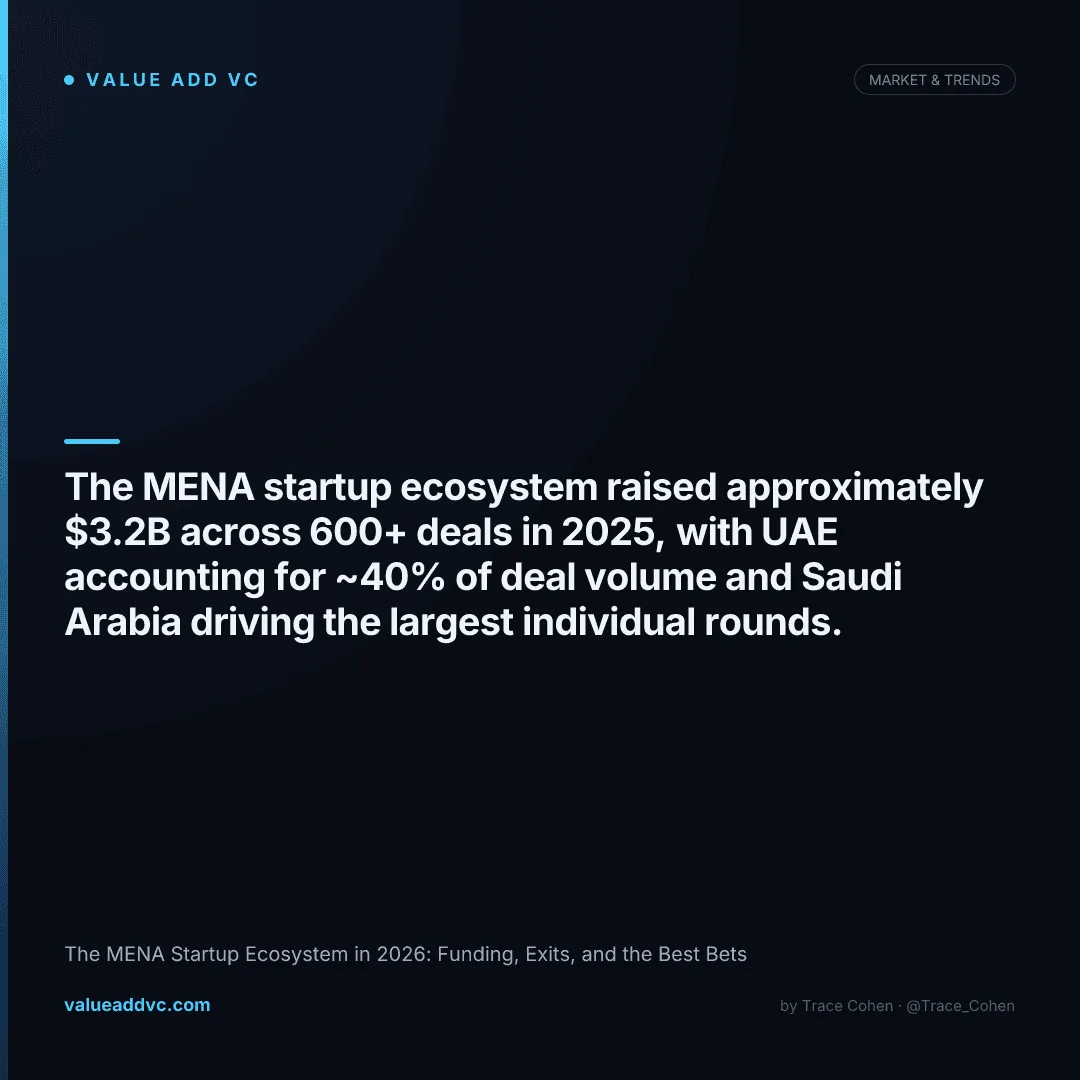
MENA startups raised $3.2B in 2025 — more than the entire US venture market raised in 2005. The difference is that almost nobody in the US is paying attention.
That asymmetry is both the opportunity and the risk. The MENA startup ecosystem is real, growing, and increasingly institutionalized — but it is also heavily shaped by government mandates, sovereign capital, and dynamics that don't map cleanly onto the Valley playbook. Understanding what's actually happening requires separating genuine market pull from policy-driven stimulus.
MENA Startup Funding by the Numbers
The headline numbers are encouraging. But the distribution matters more than the total.
| Year | Total Raised | Deal Count | Median Round |
|---|---|---|---|
| 2021 | $2.6B | ~540 | $3.2M |
| 2022 | $3.9B | ~640 | $4.1M |
| 2023 | $2.7B | ~580 | $3.0M |
| 2024 | $2.9B | ~595 | $3.1M |
| 2025 | $3.2B | ~615 | $3.4M |
Source: MAGNiTT, Wamda Research, and regional GP reported data.
Who's Actually Funding the MENA Startup Ecosystem
The funding stack in MENA is structurally different from Western markets. Government-linked capital — either directly through sovereign funds or indirectly through mandates on SWF-backed LPs — is the dominant force at every stage above pre-seed.
Sovereign Wealth Funds
Mubadala (Abu Dhabi) and PIF (Saudi Arabia) are not classic VCs but their LP commitments and co-investment mandates shape round dynamics. Mubadala alone has deployed $3B+ into tech globally with significant MENA allocation.
Government-Backed Local VCs
STV (STC-backed, $1B+ AUM), Saudi Aramco's Wa'ed Ventures, and ADQ's portfolio funds provide institutional capital with implicit policy alignment requirements for rounds above $20M.
Independent Regional Funds
Shorooq Partners, BECO Capital, Global Ventures, Wamda Capital, and Algebra Ventures (Egypt) represent genuine market-driven VC. Collectively they manage $800M–$1B and lead the majority of Seed to Series A rounds.
International Crossover VCs
Tiger Global, SoftBank, and select US Series B+ investors have followed into marquee rounds (Tabby, Tamara, Kitopi) but remain deal-by-deal opportunists rather than committed MENA allocators.
The implication: foreign founders entering MENA need to understand that localization requirements — particularly in Saudi Arabia — are not optional for accessing growth capital. Saudi Vision 2030 mandates that companies in regulated sectors establish local legal entities, and many of the largest government-adjacent investors will not lead rounds in companies that haven't committed to a Riyadh or Jeddah presence. That mandate sits underneath a much larger bet — Saudi Arabia's $100B+ commitment to AI infrastructure via PIF, HUMAIN, and Alat, which is what's actually pulling chip and cloud giants into the region.
The Cities: What Each Market Actually Offers
Dubai, UAE
Regional HQ capital0% personal income tax, English-language business environment, deep access to international capital markets and Indian/South Asian talent diaspora. Freezone structures allow 100% foreign ownership. Best for fintech, logistics, and any business requiring multi-country MENA distribution.
Watch: Cost of living and salary expectations now rival London.
Riyadh, Saudi Arabia
Largest domestic market, fastest growth40M+ person market with GDP per capita around $27K. Saudi Vision 2030 has created 100+ programs effectively subsidizing tech adoption across healthcare, education, logistics, and government services. The largest MENA unicorn rounds are increasingly Saudi-headquartered.
Watch: Regulatory complexity and the requirement to maintain local teams for most B2G contracts.
Cairo, Egypt
Talent hub, price-efficient early stage105M population, deep engineering and product talent at 30-50% of UAE salary costs. Home to Algebra Ventures and Flat6Labs. Best for capital-efficient pre-seed and seed rounds where iteration speed matters more than market size.
Watch: Currency devaluation (EGP has lost 60%+ vs USD since 2022) creates FX risk for dollar-denominated funds with EGP-cost operations.
Amman, Jordan
Niche tech talent, diaspora capitalDisproportionately strong cybersecurity and enterprise software talent relative to market size. Wamda and Jabbar Internet Group historically active. Emerging as a nearshore tech hub for Gulf-headquartered companies.
Watch: Small domestic market limits B2C scale; primarily a build market, not a sell market.
The Sectors Producing Real Exits in the MENA Startup Ecosystem
Fintech has dominated MENA startup activity for five years and continues to. BNPL in particular has moved from concept to category — Tabby and Tamara together have raised over $800M and serve tens of millions of users across Saudi Arabia and UAE. The structural driver is straightforward: credit card penetration across MENA is 15-25%, versus 65%+ in the US, creating a massive addressable market for alternative consumer credit infrastructure.
Fintech (BNPL, Payments, Neobanking)
Tabby ($1.5B+ valuation), Tamara ($1B+), Lean Technologies (API banking infrastructure)
Logistics & Supply Chain
Sary (B2B food distribution), Trukker (cross-border freight), Rabbit (rapid commerce Egypt)
B2B SaaS & Enterprise Tech
Foodics (restaurant management), Workmotion (HR infrastructure), Madar (supply chain SaaS)
HealthTech
Cura (Saudi telehealth), Altibbi (Jordan), Vezeeta (Egypt diagnostics)
E-Commerce & Consumer
Noon (Emaar-backed marketplace), Floward (floral delivery), Homzmart
What's Actually Holding MENA Back
The structural gaps are well-documented but not improving at the rate the funding headlines suggest. Exit liquidity is the core problem. Careem's $3.1B Uber acquisition in 2020 remains the single benchmark event — there has been nothing comparable since. The Nasdaq listing via SPAC for Anghami and a handful of Tadawul IPOs exist, but the exit market is thin relative to the capital that has entered.
- ✕Exit illiquidity: MENA has no equivalent of Nasdaq or a deep M&A market for tech. Strategic buyers are mostly regional telcos, banks, and retailers — all of whom move slowly and value control over premium pricing.
- ✕DPI problem for LPs: Most MENA-focused funds raised between 2018 and 2022 are showing strong TVPI on paper (Tabby, Tamara markups) but near-zero DPI. LPs committing to Fund II will demand clearer paths to realized returns.
- ✕Talent fragmentation: The best technical talent is distributed across Cairo, Amman, and Bangalore — not concentrated in the markets where capital is deployed. This creates operational complexity that compounds at Series B+.
- ✕Market fragmentation: MENA is not a market — it is 22 countries with different regulatory regimes, languages, and consumer behaviors. Companies that raise on MENA TAM frequently discover that unit economics in Saudi Arabia don't port to Egypt or vice versa.
Where I'd Focus in the MENA Startup Ecosystem in 2026
If I'm deploying capital into MENA in 2026, the thesis is simple: government-mandated sectors where digitization is being funded top-down, and where the regulatory moat protects early movers from the fragmentation problem.
B2B SaaS for Saudi compliance & localization
Vision 2030 is creating thousands of new regulatory requirements across healthcare, construction, and finance. Software that helps enterprises navigate local compliance is defensive and recurring.
Fintech infrastructure for SMBs
80%+ of MENA SMBs are still underbanked or unbanked. The digital payments rails being built now (Lean, Tap Payments) will underpin the next five years of B2B SaaS distribution.
HealthTech in Saudi Arabia
Saudi Vision 2030 has explicitly committed to reducing foreign healthcare dependence. Government procurement for digital health is real money, moving fast, and currently under-competed.
MENA is not a frontier market hedge. It's a government-backed infrastructure build-out with venture-scale upside in specific verticals.
The best MENA bets in 2026 all have one thing in common: a government mandate paying for their distribution.
Track global startup funding trends on the Unicorn Dashboard and VC performance data on the VC Performance Dashboard at Value Add VC. Originally published in the Trace Cohen newsletter.
Latest from the Pulse
Get VC data most people never see
— 100% free
Weekly benchmarks, valuations, and fund data. Join 5,000+ investors. No spam.