European VC raised €19 billion in 2023. The US raised $170 billion. That 9:1 gap tells you almost everything about why the returns differ — but not the whole story.
The comparison between European VC and US VC is often framed as a competition, but it's really a structural divergence rooted in LP composition, exit market depth, and risk culture. Understanding those differences matters if you're a founder choosing where to raise, an LP allocating to emerging markets, or a fund manager deciding where to operate.
The European VC vs US VC Size and Depth Gap
The raw numbers illustrate the scale difference across every stage of the market:
| Metric | US VC | European VC |
|---|---|---|
| Annual VC raised (2023) | $170B+ | €19B (~$21B) |
| Annual deal count (2023) | ~14,000 | ~4,000 |
| Median Series A check | $15–25M | $8–12M |
| Median Series B check | $30–60M | $15–35M |
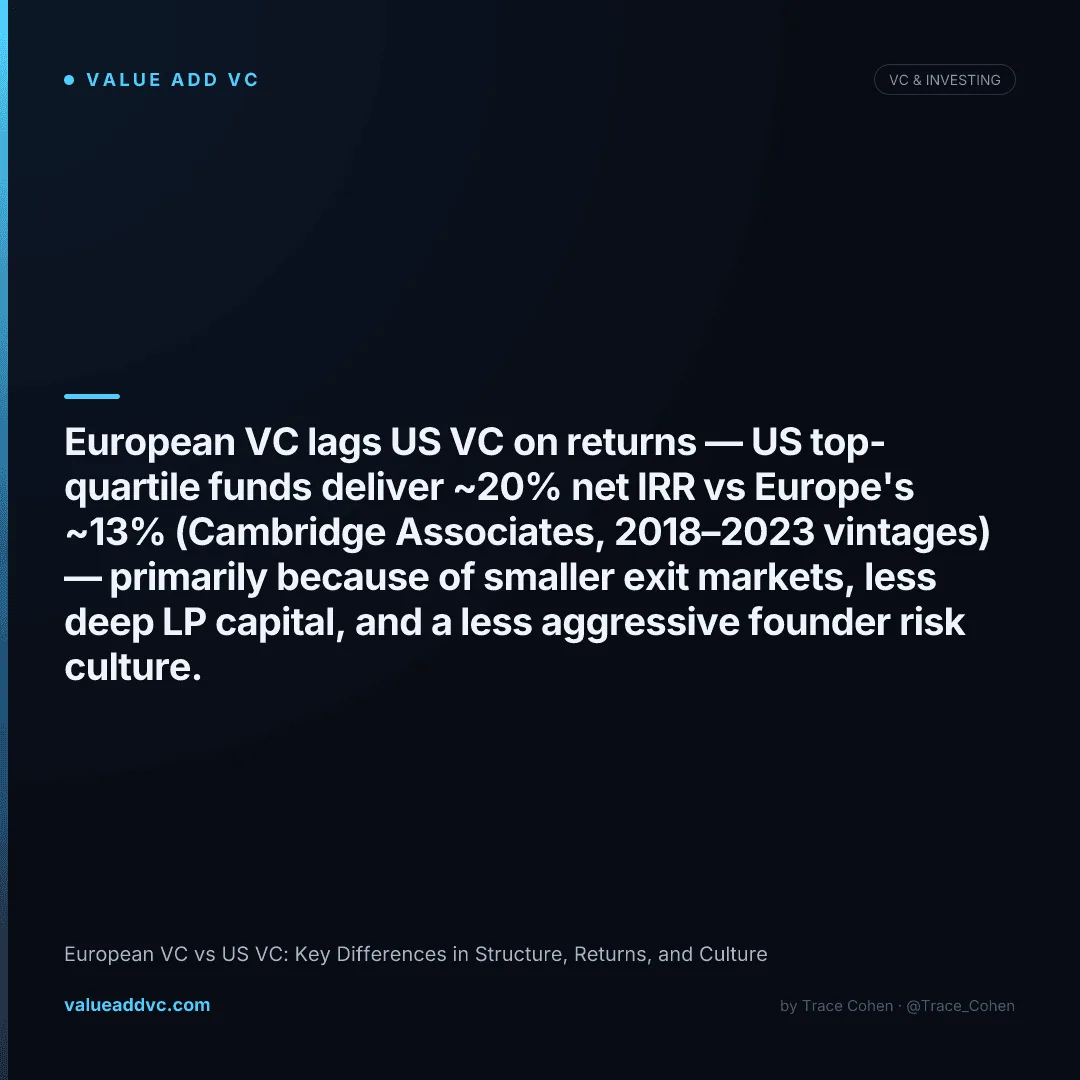
| Top-quartile net IRR | ~20% | ~13% |
| Active unicorns (2024) | 700+ | ~140 |
| Avg flagship fund size | $500M+ | €150–300M |
Sources: PitchBook, Cambridge Associates, Dealroom, Atomico State of European Tech 2024.
Returns: Where Europe Actually Stands on European VC vs US VC Performance
Cambridge Associates data on 2018–2023 vintages shows US VC delivering approximately 20% net IRR at the top quartile versus Europe's roughly 13%. The median gap is similar. But there are two important nuances:
Top-quartile European funds are globally competitive
Accel Europe, Index Ventures, and Balderton have delivered US-comparable returns over 10+ year horizons. The issue is median performance, not the ceiling.
Exit multiples are compressed by M&A not IPO
Most large European tech exits are acquisitions by US companies — often at 5–10x revenue vs the 15–25x that a Nasdaq IPO would price. Spotify and Adyen are exceptions, not the rule.
DPI lags even when TVPI is strong
European funds often sit on unrealized gains longer because IPO markets are shallow. UK's AIM and Euronext are not NASDAQ — secondary liquidity is limited.
The gap is closing in AI
Paris has emerged as Europe's AI capital — Mistral, H Company, and Poolside attract global LP capital and valuations that match Silicon Valley benchmarks.
Track how fund performance benchmarks compare across vintages on the VC Performance Dashboard.
Structural Differences That Drive the Gap
The performance delta isn't about founder quality — European companies like Spotify, Klarna, Revolut, Adyen, and Wise prove that. It's about three structural factors:
LP composition
🇺🇸 US VC
Dominated by university endowments (Harvard, Yale, Stanford), large pension funds, and sovereign wealth funds with 15–20%+ return expectations
🇪🇺 European VC
Heavy reliance on government-backed LPs — EIB, Bpifrance, British Patient Capital — which accept lower returns and longer timelines. Less pressure for power-law outcomes.
Founder risk culture
🇺🇸 US VC
Failure is a badge — founders who burned through $50M and shut down raise again faster. 'Go big or go home' is the operating ethos.
🇪🇺 European VC
Failure carries significant reputational cost in most markets. Founders optimize for sustainable growth and earlier profitability rather than blitzscaling into losses.
Exit market depth
🇺🇸 US VC
NASDAQ and NYSE provide liquid IPO exits with 20x+ revenue multiples for high-growth software. Secondary markets are deep.
🇪🇺 European VC
IPO exits are rare and thin. The dominant exit is acquisition — often by US BigTech or PE — which caps outcome multiples and compresses fund DPI.
Where European VC Is Genuinely Competitive
The narrative that European VC is inferior misses where it punches above its weight. Several European hubs now produce companies that compete globally — and attract US-caliber capital.
Fintech capital of the world
Revolut ($45B+), Wise ($9B), Monzo, Starling
Europe's AI epicenter
Mistral AI ($6B), H Company, Poolside — all attracting US LP capital
Deep tech and consumer at scale
Spotify ($30B+), King, Klarna — all achieved global market leadership
B2B SaaS and marketplaces
Personio, GetYourGuide, Delivery Hero — consistent €1B+ exits
Scale-ups in travel and commerce
Booking.com, Adyen ($50B+), TomTom — Dutch tech punches at 3x its market size
The Top European VC Firms and Their Strategies
The firms that consistently outperform have one thing in common: they operate transatlantically, not just regionally.
Early stage, globally competitive. London office focuses on European Series A/B with US-caliber follow-on reserves.
Dual-headquartered London/SF. Led early rounds in Slack, Figma, Dropbox, and Robinhood from its European base.
London-anchored, Series A focus. Portfolio includes Revolut, Darktrace, and GoCardless.
Founded by Skype co-founder Niklas Zennström. Growth-stage European focus, publishes annual State of European Tech report.
Part of PE giant EQT. Uses an AI-driven deal sourcing tool (Motherbrain) to systematically find Series A opportunities.
What Founders Should Know When Choosing European vs US VCs
The practical implications for founders differ at each stage:
Reasons to raise from a European VC
- ✓ Building primarily in Europe — relationships matter more locally
- ✓ Need regulatory expertise in GDPR, financial services, or healthcare
- ✓ Prefer governance-focused, longer-term investors with lower dilution pressure
- ✓ Planning a European M&A exit rather than a NASDAQ IPO
- ✓ Seed/Series A — check sizes are competitive and LPs are more accessible
Reasons to raise from a US VC
- ✓ Targeting US enterprise sales from day one
- ✓ Need larger follow-on reserves at Series B and beyond
- ✓ Building toward a Nasdaq IPO — US fund brand matters for roadshow credibility
- ✓ Category-defining ambition requiring $100M+ rounds
- ✓ Network effects business where US market is the primary moat
The European VC vs US VC debate misses the point for the best companies.
The top European funds operate globally. The best European founders raise from both. The right question isn't geography — it's who adds the most value at each stage of the journey.
Track VC fund performance benchmarks on the VC Performance Dashboard and compare fund returns across vintages on the Benchmarking Tool at Value Add VC. Originally published in the Trace Cohen newsletter.
Latest from the Pulse
Get VC data most people never see
— 100% free
Weekly benchmarks, valuations, and fund data. Join 5,000+ investors. No spam.