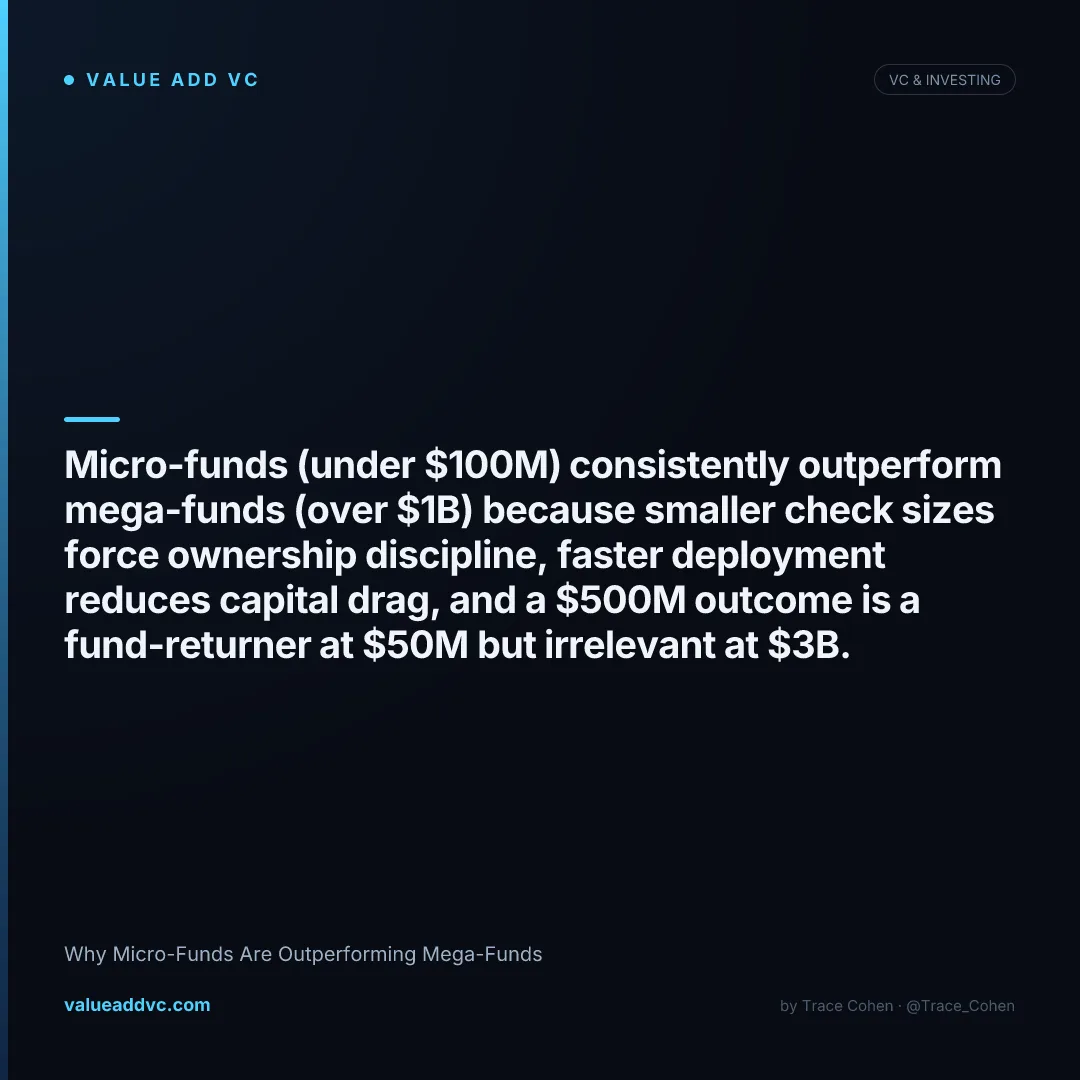
The biggest secret in venture capital is hiding in the performance tables: funds under $100M have been beating funds over $1B for fifteen consecutive vintages.
This isn't a statistical fluke. It's structural. And the LPs who figured it out early are sitting on some of the best-performing portfolios in the asset class right now.
What the Data Actually Shows
Cambridge Associates, Preqin, and Pitchbook all tell the same story. Funds in the sub-$100M cohort consistently produce higher net IRRs and TVPIs than funds above $500M across every recent vintage — the full TVPI, DPI, and loss-rate breakdown shows just how wide that gap runs. The gap isn't marginal:
Sub-$100M funds — top quartile TVPI
Vintages 2015–2020, Cambridge Associates
$100M–$500M funds — top quartile TVPI
Same vintage cohort
Over $1B funds — top quartile TVPI
Mega-fund median sits near 1.6x net
Net IRR spread (micro vs mega)
Micro-funds outperform on net IRR in 12 of last 15 vintages
The performance gap narrows at the very top — the best mega-funds (think Sequoia, Benchmark, Accel) absolutely produce elite returns. But the median mega-fund barely returns 1.5x net. That's a problem when your cost of capital is 6–8%.
The Structural Reasons Are Obvious — If You Do the Math
I've invested in or evaluated 200+ VC funds across my career. The math always comes back to the same thing: fund size determines the minimum exit size required to matter. And minimum exit size determines what you can invest in.
A $50M fund writing $2M checks at seed needs a portfolio company to reach $200M–$400M in exit value to return meaningful capital. That's achievable for hundreds of companies. A $3B fund writing $150M checks at Series B needs $3B–$6B exits to matter. That's a much narrower universe — maybe 15–20 companies per year globally reach that threshold.
Micro-fund advantage
- →Can own 10–20% at seed before dilution
- →A $300M exit = potential 3–5x fund return
- →Access to deals too small for large funds
- →Deploy in 2–3 years, not 5–7
Mega-fund structural drag
- →Need $2B+ exits to move the needle
- →2% management fee on $3B = $60M/yr overhead
- →Slower deployment creates cash drag
- →Forced into later-stage, more competitive deals
Why Mega-Funds Keep Raising (And Why LPs Keep Writing Checks)
If the data is this clear, why did the 2021–2023 vintages see record mega-fund raises? Softbank Vision Fund II closed at $56B. a16z has crossed $35B in cumulative AUM. Tiger Global deployed $65B+ at peak. The answer is simple and depressing: fee economics.
A 2% management fee on a $3B fund generates $60M per year in fees before any carry. A $50M micro-fund generates $1M. The GP incentive to raise large funds is enormous — and it has almost nothing to do with what produces the best returns for LPs.
On the LP side, large institutional investors — endowments, pension funds, sovereign wealth funds — often can't practically deploy meaningful capital into micro-funds. A $100B pension fund writing a $5M check into a $50M micro-fund barely moves the needle. They're structurally forced to write $100M–$500M checks, which means they're structurally forced into underperforming vehicles. This is the dirty secret the asset class rarely discusses openly.
In my experience working with LPs, the ones who can access micro-funds — family offices, high-net-worth individuals, smaller endowments — are capturing meaningfully better returns than their institutional counterparts. The information asymmetry is finally starting to close as platforms like AngelList, Allocate, and Moonfare democratize access.
Where Mega-Funds Still Win
To be fair: mega-funds aren't categorically broken. They serve real purposes:
Brand and LP relationships
Being in a Sequoia or a16z fund has non-return value — deal flow, brand halo, co-investment rights
Growth stage capital deployment
Writing $50M–$200M checks at Series C/D is a legitimate strategy mega-funds execute well
Operational infrastructure
Talent networks, portfolio support, legal/HR resources that micro-funds can't replicate
Top-decile returns still exist
The best mega-funds — true top decile — still produce elite returns that justify allocation
The case against mega-funds isn't that they're bad — it's that median mega-fund performance is remarkably uninspiring relative to the fees charged and the brand premium LPs pay. You're essentially paying for optionality on a top-decile outcome that's unlikely to materialize.
What This Means for LPs in 2026
The playbook is getting clearer. Sophisticated LPs are running a barbell strategy: a small allocation to top-tier mega-funds (Sequoia, Benchmark, Accel — funds with consistent top-decile track records) paired with a meaningfully larger allocation to curated emerging managers and micro-funds.
The operational challenge is real. Evaluating a $50M micro-fund run by a two-person team requires different diligence than evaluating Andreessen Horowitz. The information is harder to find, the track record may be angel deals and SPVs rather than formal fund performance, and the GP risk is concentrated. But the alpha exists — and it's not priced in. Our VC Performance dashboard lets you filter by fund size to see the data for yourself.
For LPs willing to do the work: the emerging manager space has never been more interesting. Post-2021 reset, the boom-era tourists have left the building. The GPs raising $30M–$75M funds in 2024–2026 are largely people who genuinely believe they have edge — not brand-chasers trying to ride a rising market. That selectivity, paradoxically, makes the cohort better.
The best-performing VC portfolios of the next decade won't be built on Tier 1 brand names.
They'll be built on disciplined micro-fund selection — done by LPs willing to do the unglamorous work of manager diligence that institutional mandates won't allow.
Latest from the Pulse
Get VC data most people never see
— 100% free
Weekly benchmarks, valuations, and fund data. Join 5,000+ investors. No spam.