Everyone blames rising interest rates, the frozen IPO market, or the 2021 valuation bubble. Those are proximate causes. The real reason is math — and it was hiding in plain sight.
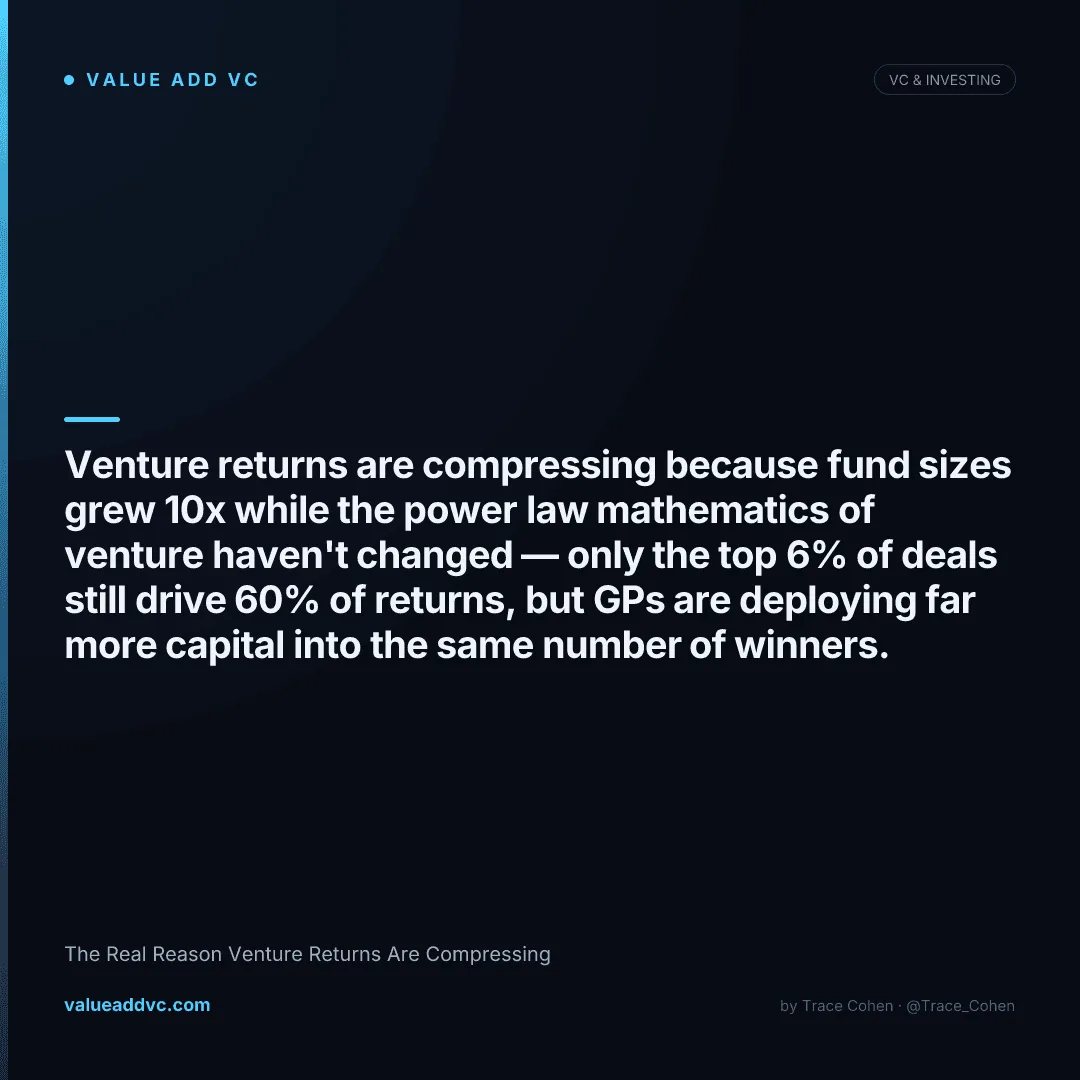
The structure of venture capital is built around a power law: a small number of companies produce almost all of the returns. That has not changed. What has changed is how much capital is chasing those same outcomes — and the mismatch is destroying IRRs at scale.
The Power Law Has Not Changed. Capital Has.
Horsley Bridge Partners analyzed $28B+ in VC fund investments over 30 years and found a consistent pattern: approximately 6% of deals generate 60% of total returns. The top 10% of investments account for over 80%. This distribution holds across vintages, geographies, and market cycles.
In 2010, the average US venture fund size was $140M. By 2021, the median had crossed $250M and the average was above $400M. Andreessen Horowitz raised $35B across multiple funds between 2020 and 2023. Tiger Global deployed $65B into private markets at peak. Sequoia restructured into a permanent capital vehicle with no defined limit.
The number of breakout companies did not grow 10x. The number of IPOs capable of returning a $1B fund did not grow 10x. Deployment volume grew 10x into a power law that rewards concentration, not scale.
The Exit Math Is Broken at Fund Scale
Here is the math problem no one wants to say out loud. A $500M fund charging 2-and-20 needs to return $1B just to break even on net fees to LPs — before outperformance. To return a 3x net, which is considered a strong fund, the GP needs to generate $1.5B in realized exits. That requires either one $3B exit at 50% ownership (impossible at this fund size), or roughly 15-20 meaningful exits above $100M.
In 2023 and 2024, the US saw fewer than 60 venture-backed IPOs per year (see our live Tech IPO tracker). There are currently over 1,200 unicorns globally sitting on private cap tables — companies marked above $1B with no clear exit path. The backlog does not clear itself.
Meanwhile, median holding periods have stretched from the historical 5-7 years to 8-12 years for 2018-2022 vintages. Longer holds mechanically compress IRR — time is the denominator in the rate calculation. A 3x return over 7 years is a 17% IRR. The same 3x over 12 years is 9.6%.
Five Structural Forces Compressing Returns
Fund size inflation
Average fund size grew 3x from 2015 to 2022. Multiples compress as deployment targets grow faster than the number of returnable outcomes.
Entry valuation reset
Seed rounds that closed at $15-20M post in 2021 now require exits above $150-200M just to return 10x — a bar that eliminates most M&A outcomes.
TVPI vs DPI divergence
Most 2019-2022 vintage funds report TVPI above 1.5x but DPI below 0.3x. Paper gains are not cash. LPs are sitting on illiquid positions with no distributions.
Extended hold periods
IPO windows closing in 2022-2024 forced 18-36 month extensions on hold periods that were already at historical highs, eroding net IRR without changing exit values.
Follow-on capital dilution
In large funds, pro-rata follow-on rights require deploying more capital into winners to maintain ownership — but later rounds enter at prices that reduce blended returns on the position.
What This Means for LPs and Emerging Managers
Institutional LPs allocating to venture in 2026 face a real selection problem. Cambridge Associates benchmarks show that only the top quartile of VC funds — returning 17%+ net IRR over 10 years — justify the illiquidity and J-curve against a 60/40 portfolio. The median fund is a negative risk-adjusted bet.
The structural advantage shifts to smaller, more concentrated funds. A $30-50M fund with 15-20 positions only needs one $300-500M outcome to return the fund. It can generate 3x with a single acquisition that a $500M fund could never care about. Ownership percentage matters more than check size when the exit pool is limited.
Emerging managers willing to stay small, stay concentrated, and stay disciplined on entry price have a structural advantage that the largest names in the asset class cannot replicate. The irony is that the denominator of "more capital" has actually created the opportunity for smaller funds to outperform by staying out of the way.
Related Resources
The power law of venture has not changed in 30 years.
The funds that forget this — and raise capital at scale anyway — are the ones compressing the returns.
Latest from the Pulse
Get VC data most people never see
— 100% free
Weekly benchmarks, valuations, and fund data. Join 5,000+ investors. No spam.