Every aspiring fund manager has the same vision: raise $50M, write meaningful checks, build a portfolio, and generate life-changing carry. The reality is far more brutal.
I have been on both sides of this equation — as a founder raising from these funds and as someone who has invested in and alongside them. The $50M fund is one of the hardest businesses in venture to make work. Here is the actual math.
The Management Fee Reality
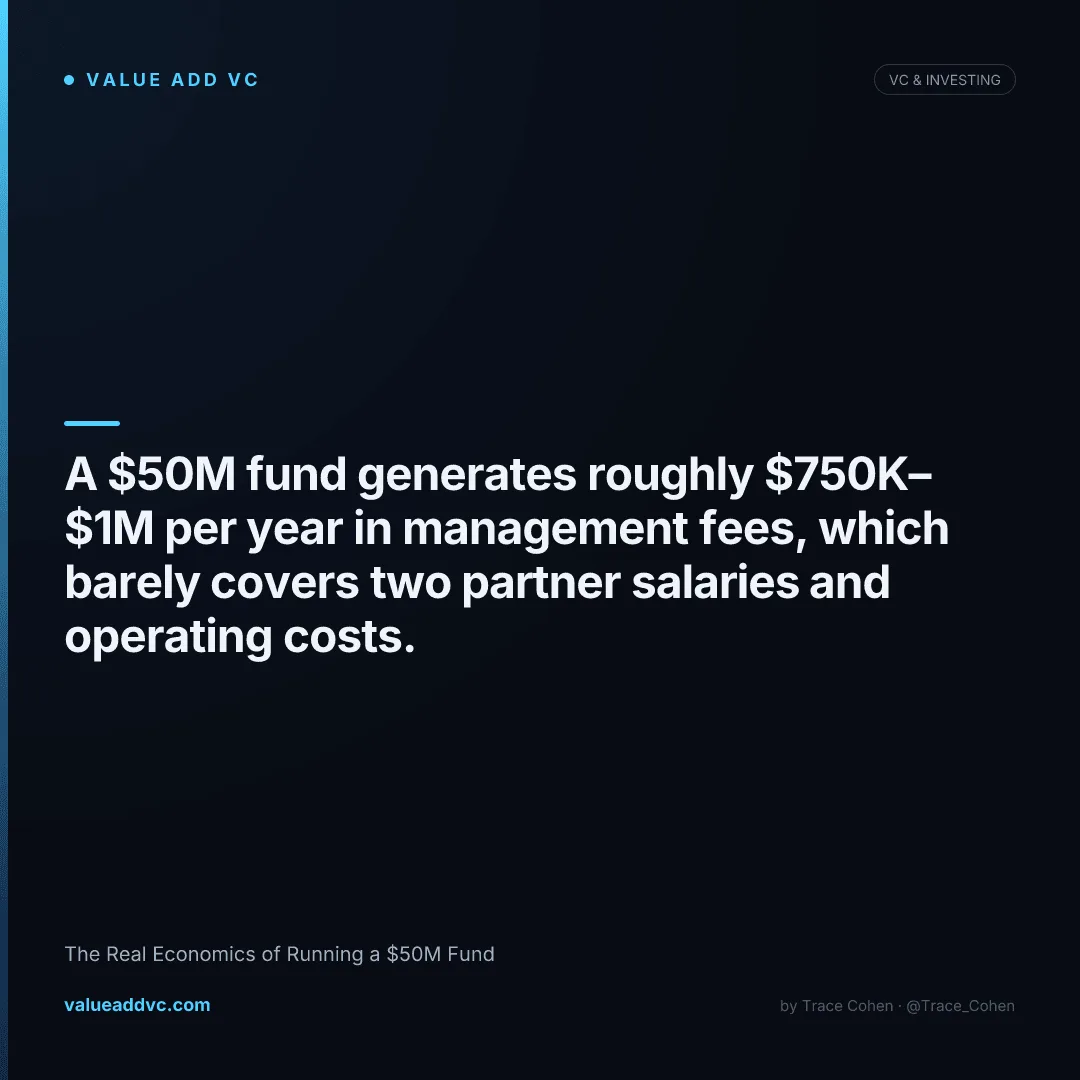
The standard 2-and-20 structure sounds straightforward. Two percent management fee, 20% carried interest. On a $50M fund, that 2% generates $1M per year. Over the typical 5-year investment period — before fees often step down — you collect $5M in base management fees, then another $3–4M in reduced fees during harvest years, for a total of roughly $8–9M over the fund's life.
Annual management fee
~$1M
2% on $50M committed
Total fees over 10 years
~$8–9M
Stepped down after year 5
Typical annual expenses
$700K–$850K
Salaries, legal, admin, travel
GP take-home (2 partners)
$75K–$150K each
After fund operating costs
That means two partners are each taking home $75K–$150K per year in base GP salary from management fees — less than a mid-level software engineer at a public tech company. The only way this makes financial sense is if the carry is substantial. And that only happens if the fund works.
The Carry Math: What It Actually Takes
Carry is 20% of profits above the preferred return (typically 8% hurdle). To generate meaningful GP wealth on a $50M fund, here is the cascade of outcomes you need:
1x net return
LPs get their capital back, GPs get nothing
Total Value
$50M returned
GP Carry
$0
2x net return
Modest carry, split over 10+ years across 2–4 partners
Total Value
$100M returned
GP Carry
~$8M
3x net return
Strong fund, meaningful but not life-changing per partner
Total Value
$150M returned
GP Carry
~$18–20M
5x net return
Top-decile outcome — rare, requires a true outlier position
Total Value
$250M returned
GP Carry
~$38–40M
Top-quartile venture funds return 2.5–3.5x net. Only the top decile exceeds 5x. For a $50M fund hitting 3x — a genuinely good outcome — each of two partners walks away with roughly $9–10M in carry over a decade. That is good money. It is not the generational wealth creation narrative that draws people to the asset class.
The Portfolio Construction Problem
A $50M fund deployed across 20–25 companies means $1–2M initial checks, targeting 8–12% ownership. The structural tension is everywhere:
- →At pre-seed, you are oversized. Rounds are $1–3M total — writing $1M makes you a lead when you are not ready to own the process.
- →At seed, you compete against $100–200M multi-stage funds writing the same check but with deeper reserves for follow-on.
- →At Series A, your maximum initial check ($2–3M) is a rounding error in a $10–15M round. You cannot set terms or secure meaningful pro-rata.
- →Pro-rata rights matter enormously at $50M. Exercising even 50% of pro-rata into a winner at Series B can cost $3–5M — 6–10% of total fund capital in a single follow-on.
- →Reserves matter: most $50M funds allocate 40–50% for follow-on. That leaves only $25–30M for initial checks — about 15–20 positions at $1.5M average.
Why This Size Is Structurally Awkward
The VC market has effectively bifurcated into micro-funds (sub-$25M) that win on access and conviction at the earliest stages, and scaled platforms ($150M+) that can lead, reserve, and provide platform support. The $50M fund lives in neither tier.
Micro-Fund ($5–25M)
Advantages
- ✓ Fastest check decisions
- ✓ Pre-seed access
- ✓ High ownership at low cost
- ✓ Low LP expectation on DPI timing
Disadvantages
- ✕ No follow-on capital
- ✕ Cannot lead seed+
- ✕ LP base is thin
$50M Fund
Advantages
- ✓ Credible check sizes
- ✓ Can reserve selectively
- ✓ Institutional LP signal
Disadvantages
- ✕ Too big for pre-seed
- ✕ Too small for Series A
- ✕ Reserves dilute initial deployment
- ✕ GP salaries barely covered
Scaled Platform ($150M+)
Advantages
- ✓ Lead rounds at Series A
- ✓ Deep reserves for winners
- ✓ Platform services attract founders
- ✓ Can absorb portfolio losses
Disadvantages
- ✕ Higher return threshold needed
- ✕ Harder to concentrate in winners
- ✕ Slower deployment pace
What Actually Makes a $50M Fund Work
The funds in this size range that generate real returns typically share a few characteristics:
Deep vertical specialization
The best $50M funds win deals that larger generalists miss because they are the most credible investors in a specific category — not because they are the cheapest or fastest.
Concentrated portfolios (15–18 companies)
Spreading across 25+ companies at $50M is a diversification illusion. Conviction-based concentration gives reserves meaning and creates the ownership needed for carry.
Genuine deal sourcing advantage
If your deal flow is the same as every other fund, you will get the same median outcomes. The funds that work have proprietary access — operator networks, specific communities, or thesis-driven inbound.
LP base aligned on a 10-12 year timeline
Many $50M fund disasters happen when LPs with 7-year liquidity needs pressure GPs into premature distributions. Aligning on a longer horizon is a structural requirement, not a preference.
A $50M fund is not a stepping stone to $200M. It is a full business that needs to justify its own economics.
If the carry math only pencils out at the top decile, the strategy needs to be built for the top decile from day one.
Explore more on fund construction and emerging manager strategy at Value Add VC. Originally published in the Trace Cohen newsletter.
Latest from the Pulse
Get VC data most people never see
— 100% free
Weekly benchmarks, valuations, and fund data. Join 5,000+ investors. No spam.