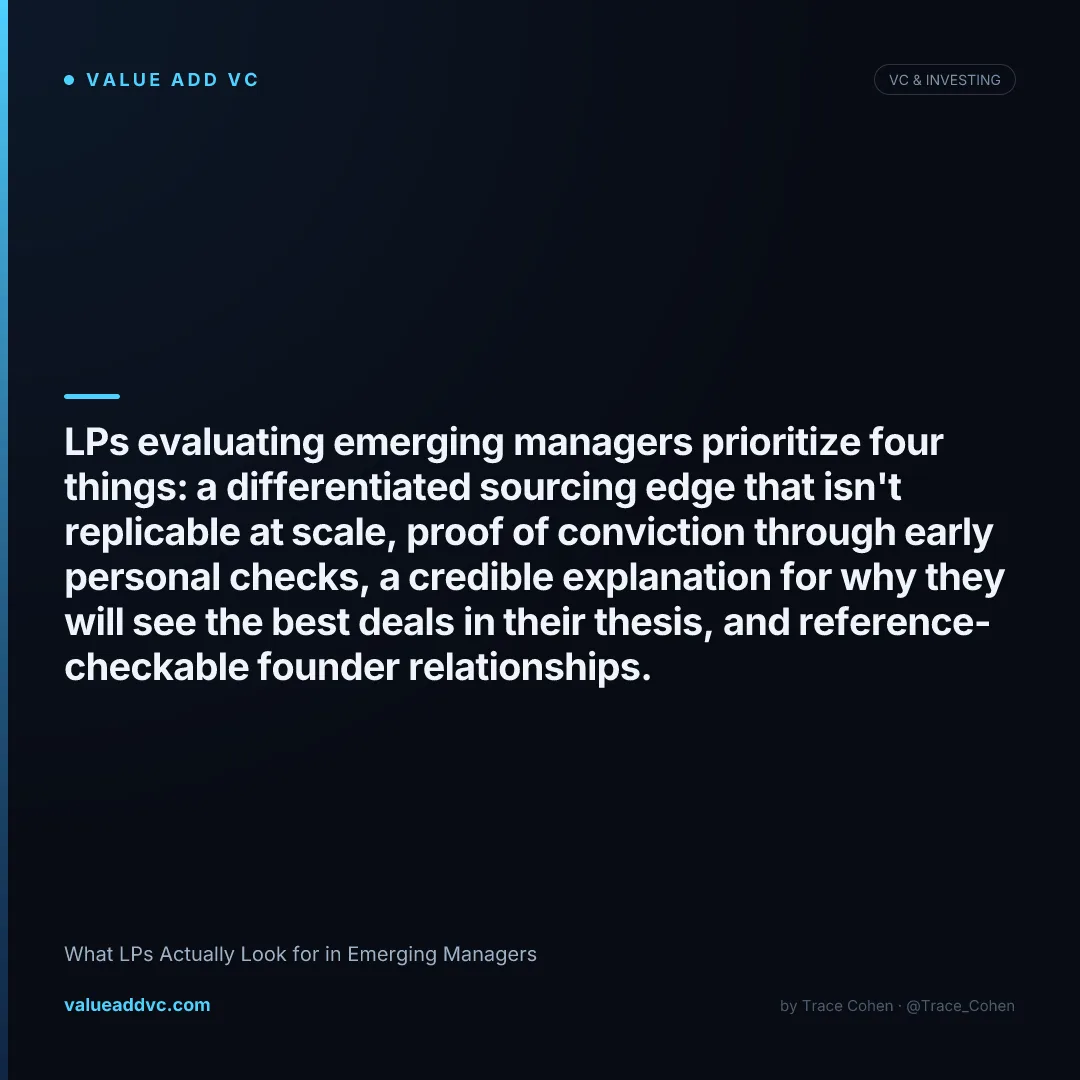
Most emerging managers pitch their deal flow. LPs don't fund deal flow — they fund edge. After watching dozens of fund managers raise, the pattern is clear: the ones who close fast lead with a reason they will see deals that Sequoia won't. Everything else is noise.
Fewer than 5% of first-time fund managers successfully raise from institutional LPs on their first fund. The process is genuinely hard — but most of the failure is self-inflicted, driven by pitching the wrong things to the wrong LPs in the wrong order.
What LPs Are Actually Trying to Solve
An LP allocating to an emerging manager is making a 10-year bet on a person, not a portfolio. Institutional LPs — endowments, foundations, fund-of-funds — have long investment committees, fiduciary obligations, and limited appetites for first-time fund risk. When they do write emerging manager checks, they're typically sizing at $2–5M, which means they need to be extremely selective about who gets into the portfolio at all.
Family offices and high-net-worth individuals move faster and are more willing to back first-time managers on the basis of a personal relationship. That's where most Fund I closes actually happen — not at pension funds or endowments. Understanding this changes how you build your LP funnel.
The mistake I see most often: emerging managers building institutional LP decks and pitching them to non-institutional LPs. A $1M check from a family office requires a different conversation than a $2M check from a fund-of-funds. If you can't articulate why this particular LP's check matters to your fund strategy beyond the dollars, you're leaving relationships on the table.
The Four Things LPs Actually Evaluate
- •Differentiated sourcing edge — Not "I have a strong network." A specific, explainable reason why the best founders in your thesis will call you before they call anyone else. Community depth, operator reputation, geographic edge, or vertical domain expertise that established funds can't replicate at their fund size.
- •Proof of conviction — Personal angel checks, not paper markups. LPs want to see that you invested your own money, that founders took it, and that you can articulate why you had conviction before the signal was obvious. Five personal checks at $25K each tell more than 50 LP-funded investments.
- •Tight, time-bound thesis — LPs have seen hundreds of "future of work" and "enterprise SaaS" pitches. A thesis that explains the specific market shift happening right now and why a $30M fund captures it better than a $500M fund is what gets a second meeting.
- •Reference-checkable founder relationships — LPs will back-channel. If they can't find three founders who will say you made their company better, the diligence call goes cold. This is the hardest thing to fake and the most predictive signal of long-term performance.
What Doesn't Move the Needle
Pedigree matters less than emerging managers think. Having worked at a top-tier fund for three years tells an LP you can execute within an existing system — not that you can build one from scratch. The more important question is: what did you do that the fund didn't ask you to do? Proactive investments, thesis development, and founder introductions that weren't your job tell the story that LPs are looking for.
Deal volume is also not a differentiator. "We see 50 companies a month" is a signal that you're doing inbound, not that you have edge. The top-performing micro-fund managers I've observed see 15–20 companies a month, deeply — because they're in specific communities where founders trust them before any fundraise starts.
Fund size positioning matters too. I've watched emerging managers pitch $75M funds when the market called for a $20M vehicle. The right fund size for a first-time manager is the one that generates 8–12% ownership at your entry check, with 40–50% reserves for follow-ons, across 15–20 companies. Anything bigger and LPs know the math breaks.
How to Build Your LP Funnel the Right Way
The fund raise is a structured sales process. The managers who close fastest run it that way:
- •Start with 5–10 anchor LPs who understand your thesis deeply, not 50 cold LP emails — anchors validate the thesis and create social proof for the next tier
- •Target family offices and HNW individuals for Fund I — they move faster, accept smaller allocation minimums, and don't require ILPA template compliance on your first close
- •Apply to emerging manager programs — Sapphire Partners, 50 South Capital, and a16z scout programs explicitly back first-timers and provide institutional validation that unlocks downstream checks
- •Set a hard 90-day close deadline and communicate it — urgency is not manufactured in fund fundraising, it's structural; LPs who know you have a deadline make decisions faster than LPs who think you'll always be raising
- •Send quarterly LP updates before you close — most managers wait until they have a fund to communicate; managers who update their prospective LPs on portfolio companies they've backed personally build credibility before the ask
LPs don't fund managers who pitch well. They fund managers who have already proven they can see something the rest of the market missed — and have the founder relationships to prove it.
Stay current with VC and startup trends at Value Add VC. Originally published in the Trace Cohen newsletter.
Latest from the Pulse
Get VC data most people never see
— 100% free
Weekly benchmarks, valuations, and fund data. Join 5,000+ investors. No spam.