I get roughly 50 cold investor emails a week. I respond to maybe 3. The other 47 are not bad companies — they are bad emails.
The 5-Second Rule
When a VC opens a cold email, you have about 5 seconds before they decide to keep reading or hit delete. That's not cynicism — that's inbox reality. Top-tier funds receive 3,000+ inbound pitches per year. Andreessen Horowitz, for example, has publicly noted they fund fewer than 1% of companies they review. The math on attention is brutal.
Those first 5 seconds are determined entirely by three things: the subject line, the first sentence, and whether the email is longer than three paragraphs. If you fail any one of those three, you are done before you start.
I have seen genuinely impressive companies lose meetings because their cold email read like a press release. I have also seen pre-product founders land meetings with top-tier VCs because their email was sharp, specific, and showed they had done their homework.
The Anatomy of an Email That Works
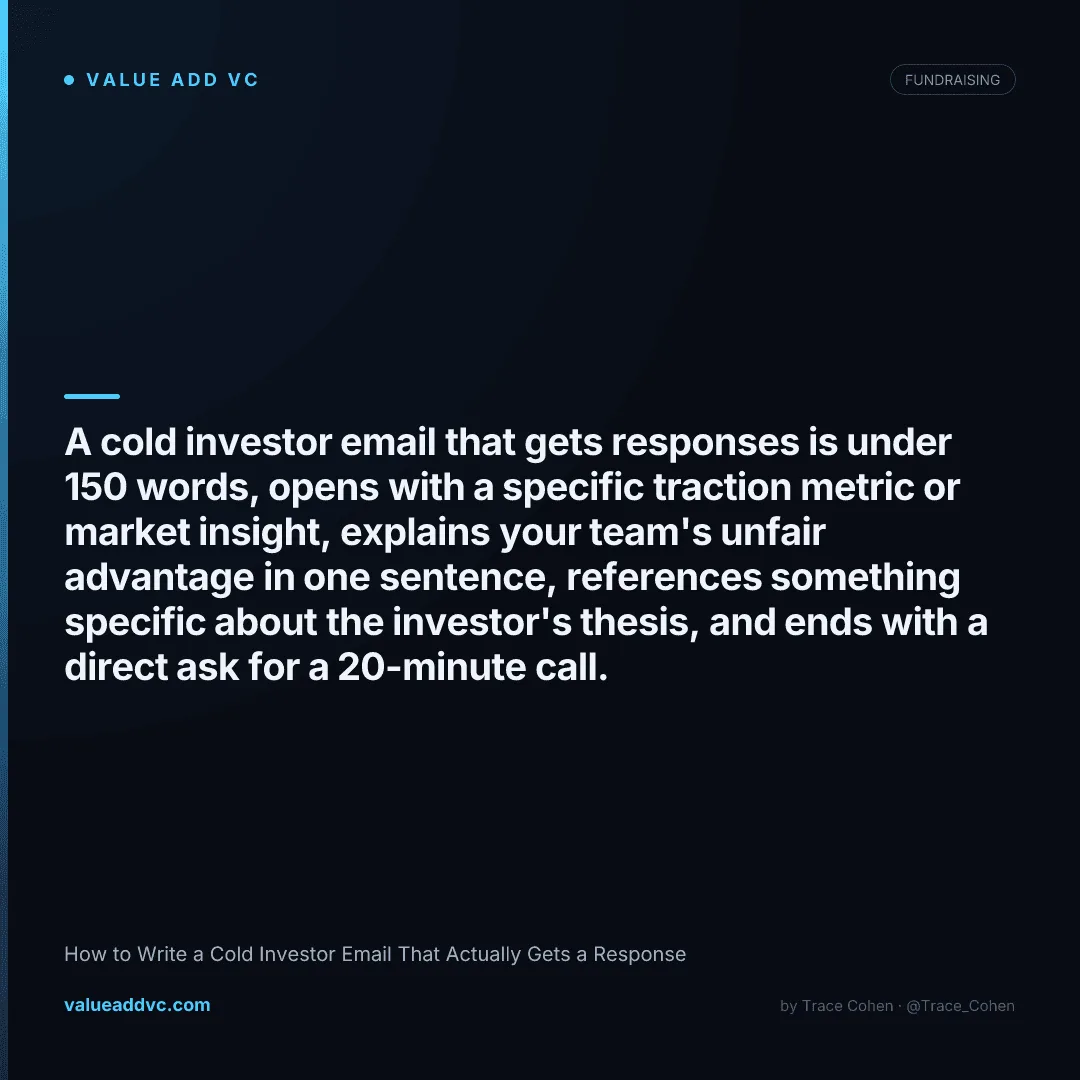
The emails that get responses follow a tight structure. Here's the framework I use when I advise founders:
Subject line: One punchy sentence that states what you are building and why it matters now. "$2M ARR in 14 months — AI compliance for regional banks" is 10x better than "Exciting opportunity to connect." The subject line is a headline. Treat it like one.
Opening line: State the one number or fact that makes your company interesting. Not your mission statement — a number. Revenue, growth rate, retention, a customer name. If you are pre-revenue, lead with the market insight that explains why this problem exists and why now is the right time to solve it.
Why you: One to two sentences on why your team is the one to build this. Unfair advantages only. Domain expertise, prior exits, proprietary data, relationships. Skip the generic "passionate team" language — every founder in every email is passionate.
Why them: This is the most missed step. One sentence showing you did actual research. Reference a specific portfolio company, a blog post they wrote, a thesis they have articulated publicly. VCs invest in people who pay attention. Prove you have.
The ask: Make it frictionless. "Would a 20-minute call this week or next work?" Not "I would love to explore synergies at your convenience." Be direct. VCs respect directness.
What Kills Cold Emails Instantly
- •Opening with "I hope this email finds you well" — signals you did not write this specifically for them
- •Attaching a 40-slide deck before any response — forces the reader to do work before deciding if you are worth their time
- •Saying "we are disrupting a $500B market" without any evidence — TAM inflation is the oldest red flag in the pitch playbook
- •CCing multiple VCs on the same email — instantly signals you are mass-blasting, which kills the perception that this is a hot deal
- •Emails over 300 words — if you cannot explain your company in three paragraphs, you do not understand your company yet
- •No specific traction — "strong early interest" without a number means nothing; even "10 paid pilots at $5K/month" changes the conversation entirely
The Warm Intro Advantage — and When Cold Still Works
I will be direct: a warm introduction from a founder in the investor's portfolio converts at 3-5x the rate of a cold email, full stop. If you have any path to a warm intro, take it. LinkedIn second-degree connections, accelerator networks, fellow founders — exploit every option before going cold.
That said, cold emails do work when the signal is strong enough. I have invested in companies that first contacted me cold. The ones that worked had one thing in common: the email was short, specific, and made me feel like passing would be a mistake. That's the bar.
One tactical tip that moves the needle: follow the investor on Twitter or LinkedIn, engage with their content genuinely for two to three weeks before sending the email, then reference that content in your first line. "Your thread on why vertical SaaS is still the safest bet in a down market convinced me you'd want to see what we're doing in insurance tech" is a real opener. It shows pattern matching, not flattery.
Follow-Up Is Not Optional
Most VCs are not ignoring you. They are buried. A single follow-up one week after your initial email, sent in-thread with a brief update ("wanted to follow up — we just signed our 5th paying customer this week"), has a response rate that surprises most founders. New information justifies the follow-up and reframes the email as a live deal update rather than a repeated ask.
Do not follow up more than twice. After two follow-ups with no response, the answer is no. Move on. The VC universe is smaller than founders think — reputation for being respectful of people's time compounds over time, just like the bad reputation for being aggressive does.
If you are managing outreach across 30 or 40 investors simultaneously, a tool like Apollo helps you track who you have emailed, when you followed up, and who has opened your messages — so nothing falls through the cracks and you follow up at the right moment.
A cold email is not a pitch — it is an application to pitch. Write it accordingly: short, specific, and impossible to ignore.
Stay current with VC and startup trends at Value Add VC. Originally published in the Trace Cohen newsletter.
Latest from the Pulse
Get VC data most people never see
— 100% free
Weekly benchmarks, valuations, and fund data. Join 5,000+ investors. No spam.