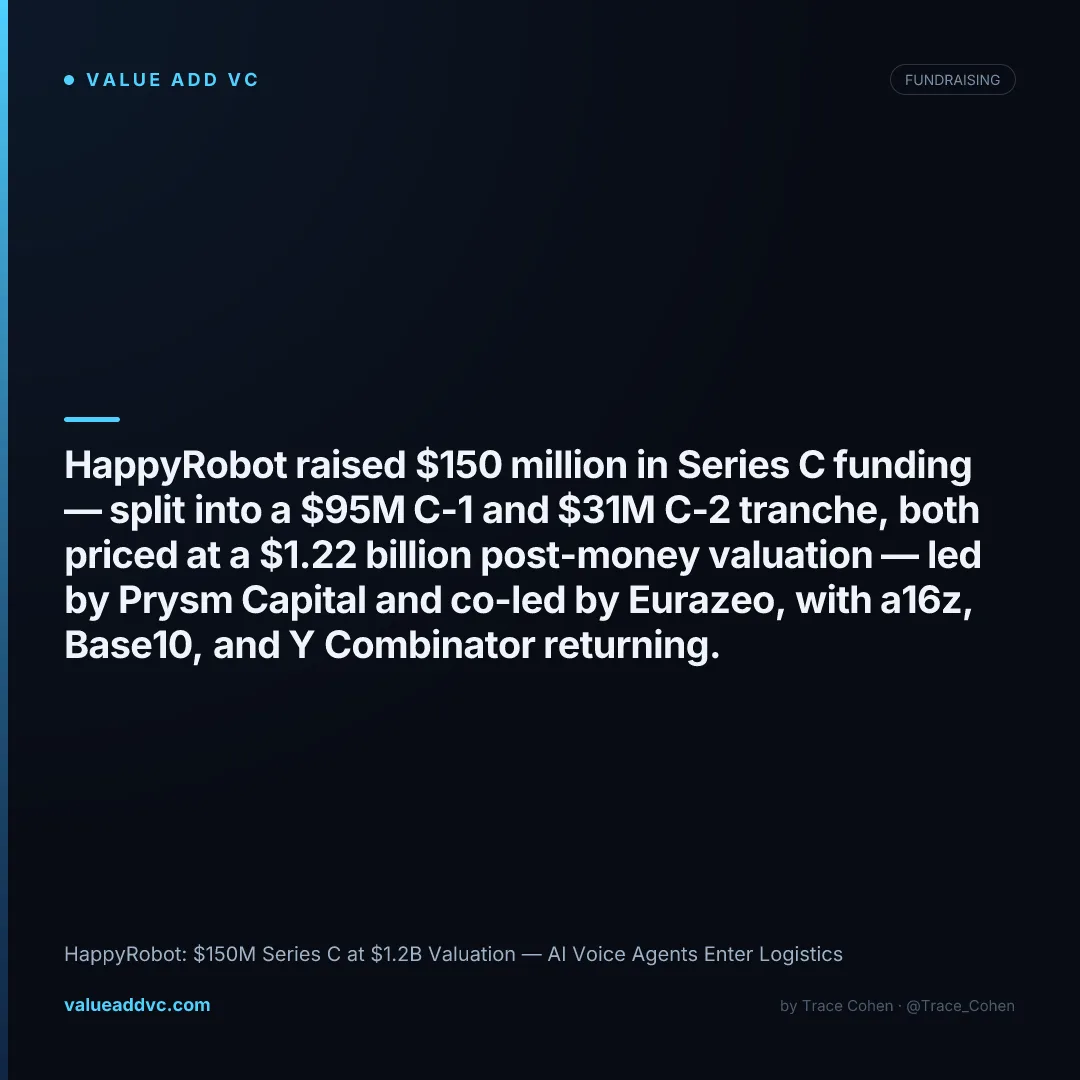
HappyRobot raised $150 million at a $1.2 billion valuation led by Prysm Capital and Eurazeo. What they priced is a voice-first AI agent company, valued by growth-equity investors rather than pure early-stage VCs, on the back of automating the phone calls that keep freight, insurance, and energy operations running.
Most of the AI agent funding headlines this year have gone to chat-based copilots and coding assistants. HappyRobot's round is a reminder that a huge amount of enterprise operational work still happens over the phone — and that the company automating the least glamorous part of that stack just became a unicorn.
HappyRobot $150M Series C: Round Terms and Lead Investors
HappyRobot's Series C is $150 million, split into a $95 million C-1 tranche and a $31 million C-2 tranche, both priced at the same $1.22 billion post-money valuation — a structure that lets investors size their exposure to conviction rather than forcing one uniform check size into a single up-round. Prysm Capital led the round, with Eurazeo co-leading, and existing backers Andreessen Horowitz, Base10 Partners, and Y Combinator all returned. The strategic bench is notable for a Series C: Koch Disruptive Technologies, KFund, Orange, T.Capital (Deutsche Telekom's venture arm), Bankinter, Endeavor Catalyst, and Wave-X all participated — a mix that reads like a list of companies HappyRobot wants as future customers, not just check-writers.
Figures from HappyRobot's Series C announcement (Business Wire, August 4, 2026), Tech.eu, and Fortune as of August 2026.
What HappyRobot Actually Automates
HappyRobot's product is voice AI agents that make and take phone calls — not a chatbot widget, not an email assistant. In freight, that means negotiating rates with carriers, confirming pickup and delivery windows, and chasing down status updates that used to require a human dispatcher on the phone for hours a day. The company has since expanded the same agent architecture into insurance claims intake, energy dispatch coordination, and telecom customer operations, which is exactly the "beyond logistics" expansion this round is meant to fund.
The technical bet behind that expansion is that generic voice APIs don't survive contact with real operational phone calls. Freight dispatch calls are loud, accented, full of jargon, and frequently involve crosstalk — the conditions that break off-the-shelf text-to-speech and voice-activity-detection models. HappyRobot has built proprietary fine-tuned models specifically for TTS, voice activity detection, and end-of-turn detection, reportedly running six specialized models per call rather than one general-purpose stack. That's the moat argument: not the agent orchestration layer everyone is building, but the underlying voice models tuned for the messiest phone calls in the economy.
Why Growth-Equity Firms Led a Series C, Not a Traditional VC
Prysm Capital and Eurazeo are growth-equity investors with track records in infrastructure, industrials, and later-stage buyouts — not the typical Series C lead you'd expect for a company that just joined the ranks of billion-dollar startups at three years old. That matters because it signals HappyRobot is being underwritten the way you'd underwrite a company with real, sticky revenue: 150+ enterprise logos, multi-year contracts with logistics majors like DHL and Kuehne+Nagel, and expansion revenue into adjacent verticals — not the pure top-line growth multiple that's driven most 2025-2026 AI funding rounds.
That's a different flavor of AI unicorn than the foundation-model or coding-copilot names dominating the funding conversation this year. HappyRobot's customers are logistics, insurance, and energy companies — industries with thin margins and long sales cycles, where "the AI agent replaced three dispatchers" is a number a CFO can underwrite immediately. Compare that to the broader agent landscape we've mapped in our look at the $100B AI agent market: most of that market is still chat-interface software. HappyRobot is one of the few names building specifically for voice, which we've argued is a bigger and less-contested opportunity than text-based AI for business precisely because so much of enterprise operations still runs on phone calls nobody wants to make.
HappyRobot vs. the Rest of the Freight-Tech AI Stack
| Company | Focus | Latest Valuation | Key Backers |
|---|---|---|---|
| HappyRobot | Voice AI agents for freight/insurance/energy ops | $1.22B (Aug 2026) | Prysm Capital, Eurazeo, a16z, YC |
| Aurora Innovation | Autonomous trucking (driverless freight) | Public (Nasdaq: AUR) | Various institutional, public markets |
| Kodiak Robotics | Autonomous trucking, defense/commercial | Public via SPAC (2024) | Various institutional, public markets |
| Fish Audio | General-purpose voice AI / TTS API | $400M+ (2026 seed) | Undisclosed |
| ElevenLabs | Enterprise voice AI, dubbing, agents | $3.3B (2025) | a16z, ICONIQ, Sequoia |
Figures from company announcements, Business Wire, and prior Value Add VC coverage as of August 2026. Valuations for private companies reflect last disclosed priced rounds.
HappyRobot sits in an interesting seam: it's not competing with autonomous trucking companies like Aurora and Kodiak, which are trying to remove the driver, and it's not a horizontal voice-AI platform like ElevenLabs or Fish Audio selling APIs to anyone who needs TTS. It's a vertical agent company that owns the workflow — the actual freight-booking and claims-processing phone call — end to end, which is a harder sell but a much stickier one once it's live in a customer's operations. For context on how the driver side of freight automation is developing in parallel, see our breakdown of the autonomous freight race between Aurora and Kodiak.
What This Round Signals for Vertical AI Agent Funding
Three things stand out. First, the round size and structure — two tranches priced identically rather than a step-up — suggests HappyRobot didn't need to negotiate a higher price to get the capital it wanted; the demand was there at a flat valuation across both checks, which is a healthier signal than a forced markup. Second, the strategic investor list (Orange, Deutsche Telekom's venture arm, Koch Disruptive Technologies) reads like a pre-built enterprise pipeline for the insurance, energy, and telecom expansion HappyRobot is funding with this round — those aren't passive checks. Third, and most importantly: this is now one of the largest funding rounds of 2026 for a company that makes actual phone calls, not one that just answers them in a chat window. That's a meaningful data point for where enterprise AI agent spend is actually landing — not in flashy consumer-facing chat interfaces, but in unglamorous operational workflows that were always going to get automated first because the ROI is immediate and easy to measure.
HappyRobot just became a unicorn on phone calls, not chat windows.
$150M at $1.2B says the biggest AI agent opportunity might be the one nobody's excited to talk about.
The Bottom Line
HappyRobot's $150 million Series C at a $1.22 billion valuation is a strong signal that vertical, voice-first AI agents are attracting serious growth capital — not just seed-stage hype. Prysm Capital and Eurazeo underwrote this round the way they'd underwrite an infrastructure business: real enterprise contracts, measurable operational savings, and a clear expansion path from logistics into insurance, energy, and telecom. If HappyRobot can hold its retention numbers as it scales beyond freight, this round marks the moment voice AI agents graduated from a feature into a category with its own unicorns.
Track AI agent funding and enterprise infrastructure deal flow at Value Add VC. Reach out at t@nyvp.com or @Trace_Cohen.
Latest from the Pulse
Get VC data most people never see
— 100% free
Weekly benchmarks, valuations, and fund data. Join 5,000+ investors. No spam.