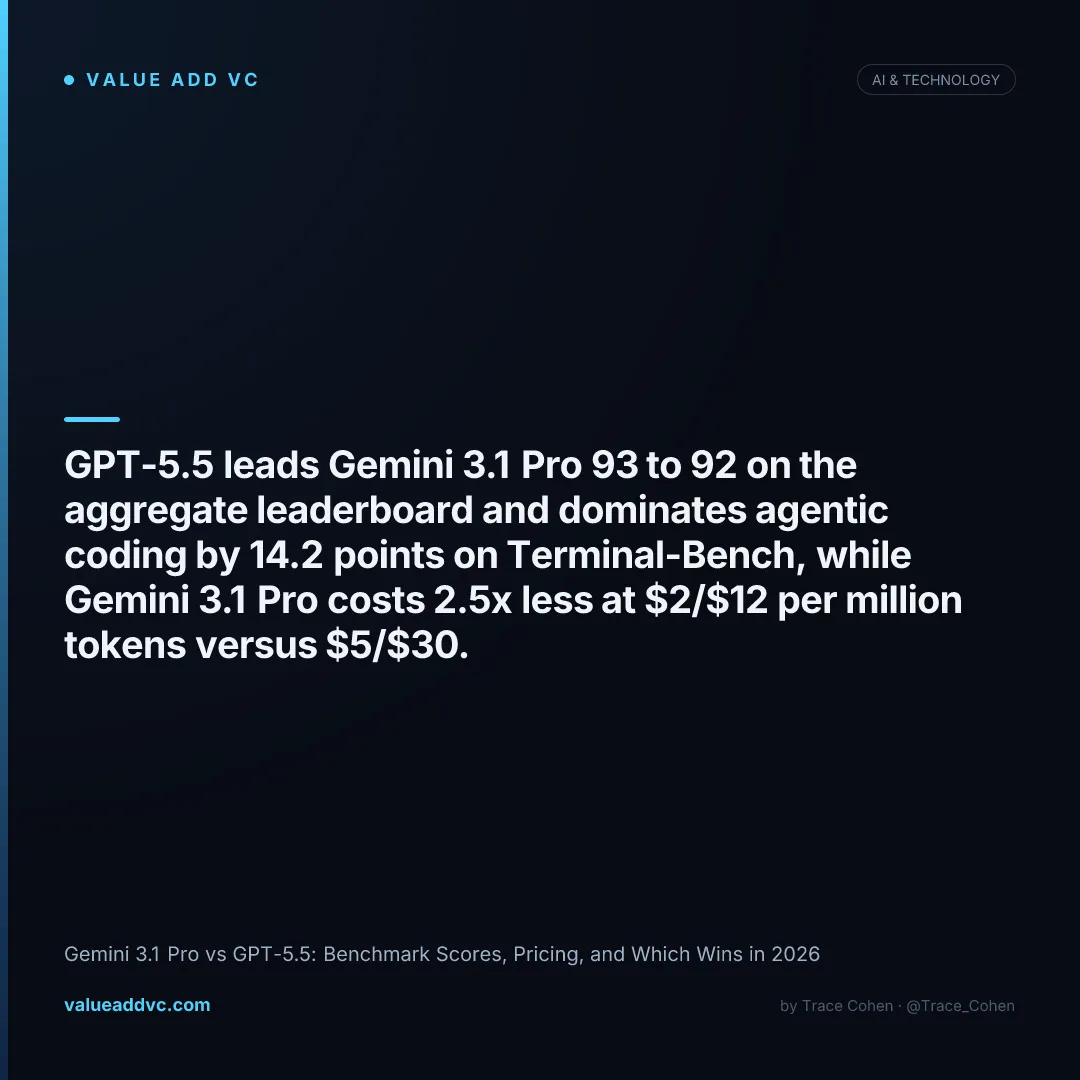
GPT-5.5 beats Gemini 3.1 Pro 93 to 92 on the aggregate model leaderboard, but the real story is a 2.5x price gap that runs the other way. And which model "wins" flips entirely depending on whether the workload is agentic coding or multimodal, cost-sensitive inference.
I run both models against real diligence workloads every week — summarizing data rooms, checking cap tables, drafting memos — and the gap between them is smaller in daily use than the benchmark charts suggest. What actually separates them is price and what each is optimized to do well, not which one "wins" a leaderboard that most founders and investors will never look at directly.
Figures are July 2026 benchmark and pricing data blended from BenchLM.ai, CloudZero, TokenCost, and UsagePricing model comparison trackers.
Gemini 3.1 Pro vs GPT-5.5: Which Model Actually Wins in 2026?
Gemini 3.1 Pro vs GPT-5.5 comes down to a near-tie on paper and a clear split in practice: GPT-5.5 scores 93 to Gemini 3.1 Pro's 92 on the aggregate leaderboard and leads by 14.2 points on Terminal-Bench coding tasks and 4.4 points on SWE-bench Pro, while Gemini 3.1 Pro charges $2.00/$12.00 per million tokens against GPT-5.5's $5.00/$30.00 — a 2.5x price gap in Google's favor on both input and output.
| Metric | Gemini 3.1 Pro | GPT-5.5 |
|---|---|---|
| Aggregate leaderboard score | 92 | 93 |
| BenchAlign aggregate score | 55.3 | 73.51 |
| Reasoning average | 77.1 | 85.0 |
| Math average | 31.8 | 47.6 |
| Multimodal/grounded average | 82.6 | 70.4 |
| Input price per 1M tokens | $2.00 | $5.00 |
| Output price per 1M tokens | $12.00 | $30.00 |
| Context window | 1M tokens | 1M tokens |
| Preview/release date | Feb 19, 2026 | 2026 |
Figures blended from BenchLM.ai, Evolink, Introl, and DataCamp model comparison trackers, July 2026. Benchmark scores reflect published aggregate suites at time of writing and may shift with future model updates.
Benchmark Breakdown: Where Gemini 3.1 Pro Beats GPT-5.5 and Where It Doesn't
The aggregate scores hide a more useful split. GPT-5.5 dominates agentic coding, beating Gemini 3.1 Pro by 14.2 points on Terminal-Bench and 4.4 points on SWE-bench Pro, and it also leads reasoning (85.0 vs. 77.1 average) and math (47.6 vs. 31.8 average) benchmarks. Gemini 3.1 Pro flips the script on multimodal and grounded tasks, averaging 82.6 versus GPT-5.5's 70.4 — a meaningful edge for anything involving image, video, or document-grounded analysis rather than pure text reasoning.
Gemini 3.1 Pro vs GPT-5.5 Pricing: The 2.5x Cost Gap
Pricing is where Gemini 3.1 Pro makes its strongest case. At $2.00 input and $12.00 output per million tokens, it undercuts GPT-5.5's $5.00/$30.00 by 2.5x on both ends — a gap that compounds fast at production scale. Gemini's pricing does step up for very long prompts: anything above 200K tokens in a single call moves to $4.00 input and $18.00 output per million. On the high end, GPT-5.5 Pro — OpenAI's research-grade variant — charges $30 input and $180 output per million tokens, 6x standard GPT-5.5 and 15x Gemini 3.1 Pro's base input rate.
API Pricing Per Million Tokens: Gemini 3.1 Pro vs GPT-5.5
TokenCost and UsagePricing API pricing trackers, July 2026.
For a founder or fund running high-volume workflows — document review, portfolio monitoring, or an internal research agent — that 2.5x gap is the difference between a tool that's a rounding error on the budget and one that shows up as a real line item. I track which AI-native tools are actually converting this cost advantage into revenue on our AI Valuations dashboard.
Run the math on a realistic diligence workload and the gap stops being abstract. Processing 500 data rooms a year at an average of 40,000 input tokens and 4,000 output tokens each works out to roughly 20 million input tokens and 2 million output tokens annually. On GPT-5.5 that's about $100 in input cost plus $60 in output cost — $160 total. On Gemini 3.1 Pro, the same volume runs $40 input plus $24 output — $64 total, a savings of $96 a year on this workload alone. Scale that to a fund running agentic research across a portfolio of 50+ companies, generating memos, and re-processing updated cap tables monthly, and the multiplier moves from double digits to thousands of dollars a year — money that either goes back to LPs or funds another analyst hire.
Reliability and Tool Use: The Gap Benchmarks Don't Capture
Aggregate scores and per-token pricing are the two numbers everyone quotes, but the variable that actually determines whether a model is usable in a production agent loop is how consistently it calls tools and follows structured output formats without silent failures. GPT-5.5's 14.2-point Terminal-Bench lead and 4.4-point SWE-bench Pro edge over Gemini 3.1 Pro both come from agentic, multi-step benchmarks specifically designed to stress tool-calling reliability under long-horizon tasks — not single-turn Q&A — which is why the gap shows up more in coding agents than in chat interfaces.
Gemini 3.1 Pro's 1M-token context window matching GPT-5.5's for the first time in mid-2026 closes what used to be Google's single clearest differentiator. What's left standing on Gemini's side is the 12.2-point multimodal and grounded-task advantage (82.6 vs. 70.4) — relevant for any workflow that ingests PDFs, screenshots, pitch decks, or scanned filings rather than clean text, which describes a meaningful share of what actually crosses a VC's desk.
Who's Actually Winning Enterprise AI Adoption in 2026?
Neither Google nor OpenAI currently leads enterprise adoption — Anthropic does. Per Ramp's 2026 AI Index, Anthropic commands roughly 32-40% of enterprise LLM API spend versus OpenAI's 25-27% and Google's 21%, and Anthropic overtook OpenAI in overall business adoption for the first time in April 2026, capturing 34.4% of AI tool spending share to OpenAI's 32.3%. Anthropic also captures over 73% of spending among companies buying AI tools for the first time as of March 2026, versus a roughly 50/50 split just ten weeks earlier.
The consumer picture flips the ranking entirely. ChatGPT holds 53.9% of worldwide AI chatbot web traffic in July 2026, well ahead of Gemini's 27.9% and Claude's 9.2%, and OpenAI leads total revenue at roughly $13B ARR against Anthropic's $5B, powered by more than 800 million weekly ChatGPT users. Google's Gemini sits in the middle on both fronts — a strong consumer number two, a distant third in enterprise share, but the only one of the three with a model that's genuinely cheaper per token than its closest rival.
How to Decide Between Gemini 3.1 Pro and GPT-5.5
My own rule of thumb after running both in production: pick GPT-5.5 when the workload is agentic coding, multi-step reasoning, or math-heavy analysis where its 14.2-point Terminal-Bench edge and 85.0 reasoning average actually matter to output quality. Pick Gemini 3.1 Pro when the workload is high-volume, multimodal, or cost-sensitive — its 82.6 multimodal average beats GPT-5.5's 70.4, and the 2.5x price advantage means you can run more passes, more retries, and more parallel agents for the same budget.
Most teams I advise end up running both behind a router rather than picking one exclusively — GPT-5.5 for the coding agent and final-answer synthesis, Gemini 3.1 Pro for bulk document processing and anything involving images or long grounded context. That's also consistent with where the market itself is voting: Anthropic's Claude is winning enterprise coding share (~42% versus OpenAI's ~21%) even as GPT-5.5 wins the raw coding benchmark, which tells you benchmark leadership and market share don't always move together — see our full three-way enterprise breakdown of Claude, GPT-5, and Gemini for the deal-by-deal detail. Compare where each lab's valuation is heading on our AI Valuations tracker.
What This Comparison Means for Startups Building on Either Model
For the AI-native startups I invest in, this comparison isn't academic — it's a build decision that shows up in gross margin. A wrapper company charging a flat monthly fee while routing every request through GPT-5.5 at $5/$30 per million tokens is carrying 2.5x the inference cost of a competitor smart enough to route multimodal or high-volume calls to Gemini 3.1 Pro instead. I ask founders in diligence which model (or models) they've architected around and why, because "we just use whatever OpenAI ships" is a weaker answer in 2026 than it was two years ago, when GPT-4o had no real Gemini-tier competitor on multimodal grounding.
The bigger signal is that neither Google nor OpenAI has a durable, structural lead anymore — a 1-point leaderboard gap and a 2.5x price gap both close or reverse with the next model release, which happens every few months at this point. That volatility is exactly why Anthropic's steadier climb in enterprise share (32-40%, up from roughly 12% in 2023) matters more to a startup's long-term model strategy than whichever lab is winning the current benchmark cycle — durable adoption trends outlast any single release.
93 vs 92 on the leaderboard, a 2.5x price gap, and a 12.2-point multimodal swing in Gemini's favor.
There's no outright winner here — there's a cheaper model and a marginally sharper one, and the right pick depends entirely on what you're actually building.
The Bottom Line
Gemini 3.1 Pro vs GPT-5.5 isn't the blowout the leaderboard's single-point gap suggests. GPT-5.5 earns its edge in coding and reasoning, Gemini 3.1 Pro earns its edge in cost and multimodal work, and both now match each other on the 1M-token context window that used to be Gemini's exclusive advantage. The more interesting number in this whole comparison isn't 93 vs 92 — it's that Anthropic, not either of these two labs, is the one actually winning enterprise adoption in 2026.
Track how each AI lab's valuation and revenue are moving on AI Valuations, or see how model-layer startups compare against category benchmarks on Benchmarking.
Follow VC and AI market data on Value Add VC. Reach out at t@nyvp.com or @Trace_Cohen.
Latest from the Pulse
Get VC data most people never see
— free to subscribe
Trace's notes on venture, AI and startups, a few times a week. Join 5,000+ subscribers. No spam.
No spam, unsubscribe anytime. Sent via Substack · Privacy · or subscribe on Substack ↗