
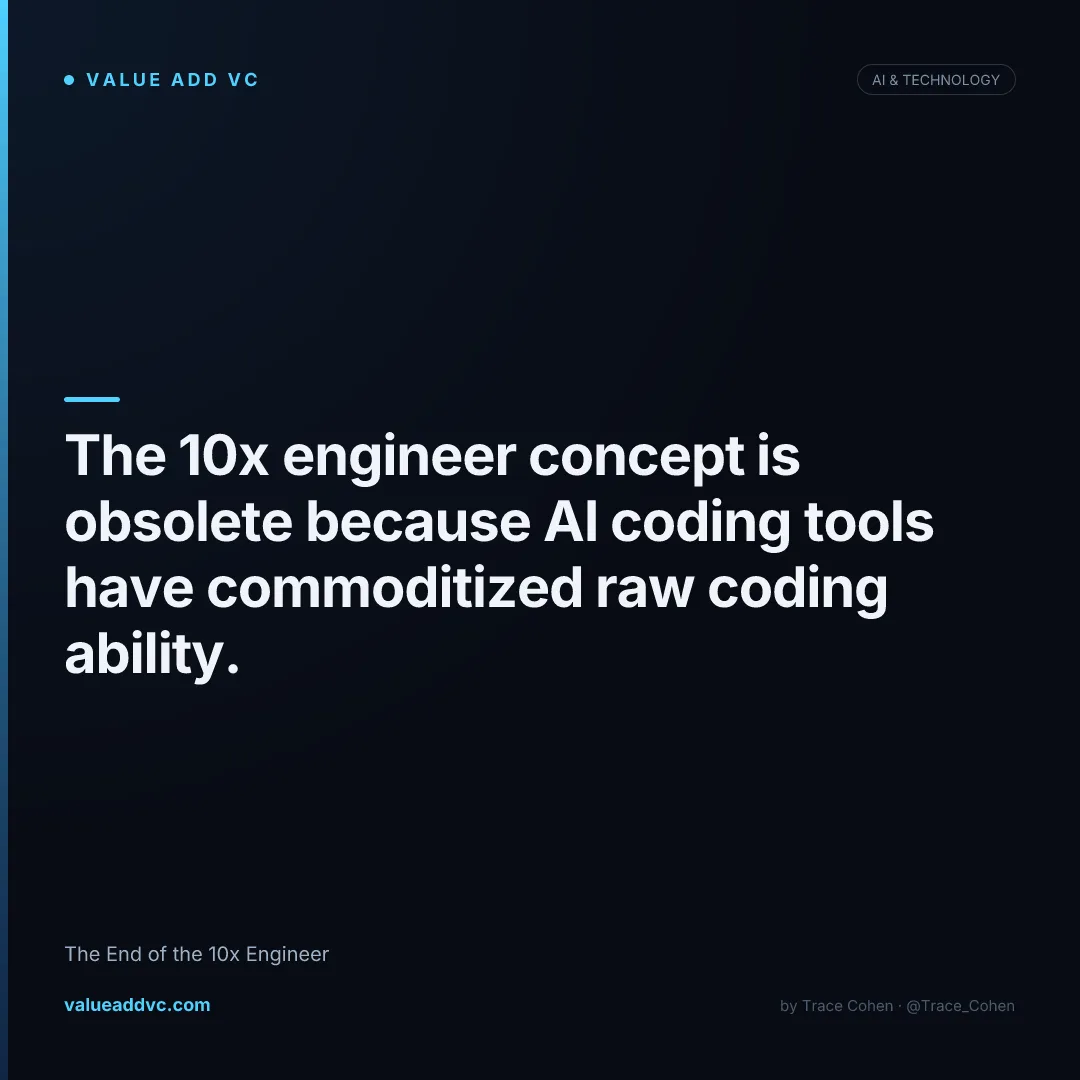
The 10x engineer was always a myth dressed up as a metric. But at least the myth was useful. Now it's not even that.
For two decades, Silicon Valley worshipped the idea that one exceptional programmer could produce ten times the output of an average one. Entire hiring cultures were built around this belief. Companies paid $500K+ to attract “10x” talent. VCs evaluated teams based on whether they had a “rockstar” CTO.
That world is ending. Not because 10x engineers stopped existing, but because the thing that made them 10x — raw coding ability — is being commoditized at an unprecedented rate.
Code Is Becoming a Commodity
Let me be specific about what's happening.
Cursor, Claude, GitHub Copilot, Windsurf, Devin — the AI coding ecosystem is exploding. These tools don't just autocomplete your code. They write entire functions. They debug. They refactor. They generate tests. They scaffold entire applications from a description.
A junior developer with Cursor today ships more functional code per hour than a senior developer with Vim did five years ago. That's not a knock on the senior developer. It's a statement about leverage: in GitHub's own controlled study, developers using Copilot completed the same task 55% faster than developers who didn't.
When everyone has a power tool, the person who can cut the straightest line isn't the one with the strongest arm. It's the one with the best eye.
The 10x advantage was about scarcity of ability. AI eliminates the scarcity.
What remains scarce is taste, judgment, and the ability to know what to build.
The New 10x: Taste Over Talent
If AI can write code, what separates the best builders from everyone else?
Product sense. Knowing what to build, not just how to build it. Understanding why a feature matters, what problem it actually solves, and what to leave out. This is a design skill, not an engineering skill.
Speed of iteration. The ability to ship, get feedback, and ship again before your competitor finishes their sprint planning meeting. AI doesn't make you fast if you don't know what direction to run.
Taste. The hardest one to define and the most important. Taste is knowing the difference between software that works and software that feels right. It's the gap between a technically correct UI and one that delights. AI generates options. Taste picks the right one.
Systems thinking. Understanding how the pieces fit together. Architecture decisions that compound. Technical choices that scale. AI is brilliant at local optimization. Humans are still better at global coherence.
Old 10x (Deprecated)
- \u2715Writes code faster than anyone
- \u2715Knows every API by memory
- \u2715Ships solo, needs no team
- \u2715Valued for output volume
New 10x (Required)
- \u2713Decides what to build next
- \u2713Knows which AI output to trust
- \u2713Orchestrates AI + humans
- \u2713Valued for output quality
The Hiring Earthquake
If you're a startup founder reading this, the implications for your first hire are massive.
Stop hiring for coding ability. Start hiring for product judgment.
The technical interview — the whiteboard algorithm gauntlet — is becoming an anachronism. You're testing for a skill that AI provides for free. Instead, ask candidates: “Look at this product. What would you change? Why? What would you ship first?”
The best engineers today aren't the ones who write the most elegant code. They're the ones who build the right thing on the first try because they understood the user problem deeply before opening their editor.
The math is shifting:
Productivity boost from AI coding tools
Smaller eng teams at top startups vs 2022
Skill VCs now look for: product sense
The Valuation Reset
This shift has a direct impact on how startups should be evaluated.
A team of two with AI tools can now build what a team of fifteen built three years ago. That's extraordinary for founders — but it also means the “we have a great team” premium is fading. When the barrier to building drops this fast, the premium shifts from who can build to who understands the customer.
A startup with three engineers who ship daily looks more promising than one with thirty engineers who don't. The small team that iterates fast with AI is more dangerous than the large team that moves through committees.
The AI startup landscape is full of companies that raised huge rounds to build engineering teams they no longer need at that size. The smart ones are realizing this and restructuring. The rest will burn through their runway wondering why velocity isn't improving despite more headcount.
The Solo Founder Renaissance
Here's the most provocative consequence: the solo technical founder is becoming viable again.
For years, VCs demanded co-founding teams. “You need a technical co-founder.” The reasoning was sound — one person couldn't build and sell simultaneously. The technical workload was too high.
AI changes that equation. A solo founder with taste, product sense, and AI tools can build a functional product in weeks. They can iterate based on customer feedback in hours. They can ship a v2 while their competitor is still hiring their engineering team.
Solo founders aren't always better. But the bar for “you need a co-founder” has moved significantly, and investors are increasingly open to solo founders who demonstrate taste and speed over teams that demonstrate headcount and credentials.
The Deeper Question
Moats are dead. The 10x engineer is dead. What else dies when AI commoditizes execution?
Maybe the entire notion that technology companies are defined by their technology.
If anyone can build anything, the winners aren't the best builders. They're the ones who understand the problem most deeply, move the fastest, and have the taste to know when something is right. Those are human skills. And ironically, in the age of AI, human skills are more valuable than ever.
Those are the interview questions that matter now. Not “reverse a binary tree.”
The 10x engineer wrote the most code.
The 10x builder writes the least.
This essay reflects patterns Value Add VC is tracking across the broader startup ecosystem. The teams winning fastest right now are the smallest ones with the best taste. For more on how AI is reshaping startups, explore the AI Landscape tracker and our analysis of which AI startups are real vs. overhyped.
Latest from the Pulse
Get VC data most people never see
— free to subscribe
Trace's notes on venture, AI and startups, a few times a week. Join 5,000+ subscribers. No spam.
No spam, unsubscribe anytime. Sent via Substack · Privacy · or subscribe on Substack ↗