Setting up an SPV in 2026 costs anywhere from $1,500 to $14,500 depending on the platform, and only one of the five major providers — AngelList — still takes a cut of the carry. That's the short answer. The longer answer determines which platform actually saves you money.
SPVs stopped being an edge case for venture investing years ago — in 2025 they became a core strategy for emerging managers who want to back one company without raising a full fund. But the platform you pick to administer that SPV now swings your total cost by 5x or more, and the fee structures are different enough (flat fee vs. percentage of capital, with or without platform carry) that comparing them requires more than glancing at a homepage pricing page.
Figures from Allocations' 2026 platform comparisons, Sydecar's Q2 2026 disclosures, AngelList's published pricing page, and Play Money's fee schedule, as of July 2026.
The Best SPV Platforms for Venture Capital in 2026, Ranked
Five platforms now serve the bulk of US angel syndicates and emerging VC managers running SPVs: AngelList, Sydecar, Allocations, Carta, and Play Money. Assure, once a serious competitor, effectively exited the market in 2025–2026, and its former customers largely landed on Carta. The ranking below weighs total cost (setup fee plus any platform carry), transparency of pricing, and scale of the platform's own track record — not just which one has the flashiest homepage.
AngelList vs Sydecar: Where the Real Cost Difference Is
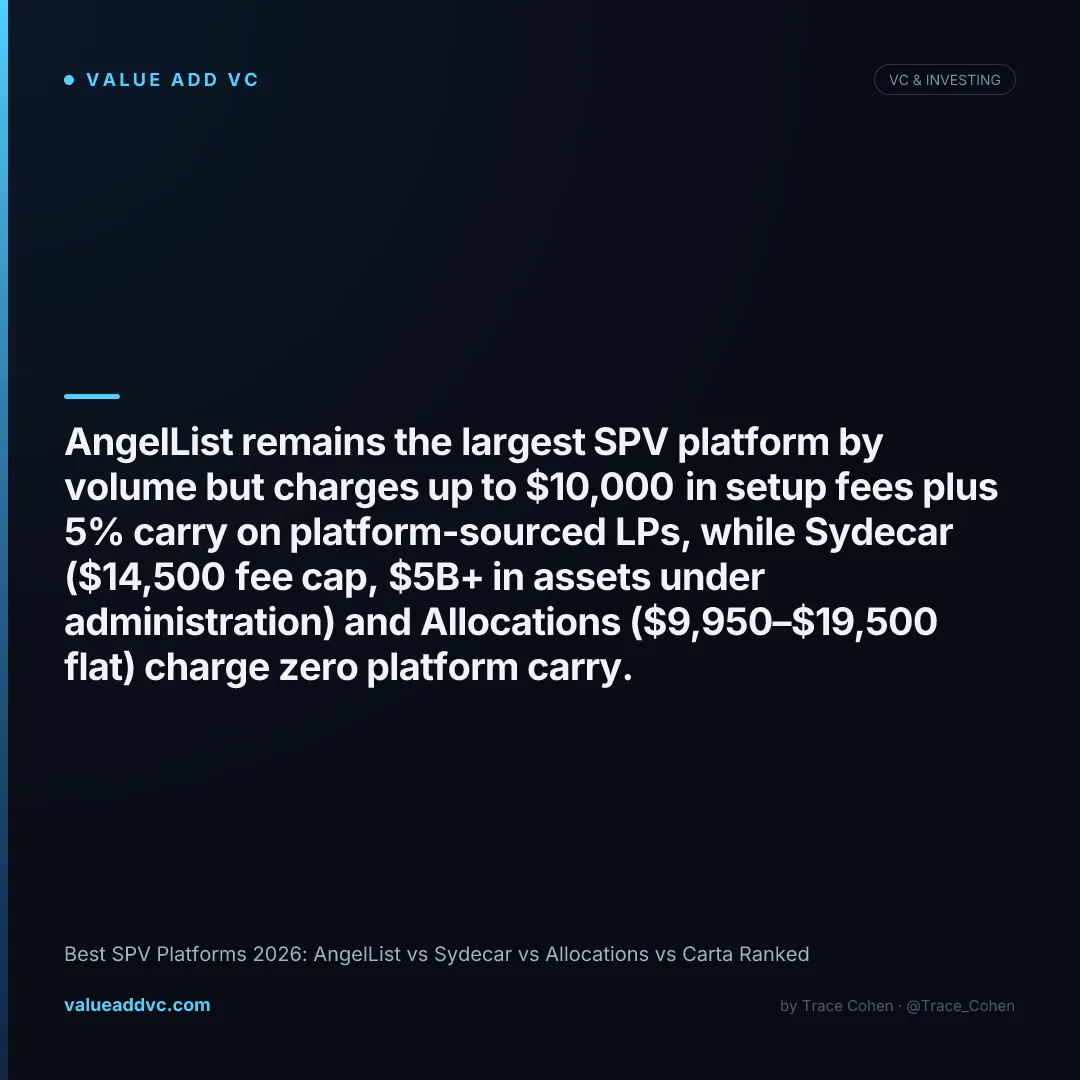
On setup fees alone, AngelList looks cheaper than Sydecar — roughly $10,000 versus Sydecar's $14,500 cap. But that comparison misses the bigger number: AngelList's 5% platform carry on profits from platform-sourced LPs. On a $500,000 SPV that returns 3x, a 5% carry cut on the gains can easily exceed the entire fee difference between the two platforms. Sydecar and Allocations both let the GP or syndicate lead keep 100% of whatever carry they charge their own LPs.
AngelList vs Sydecar: Fee Structure Comparison
AngelList pricing page, Sydecar published fee schedule, 2026
AngelList's carry applies specifically to LPs sourced through its own platform network, not to LPs the syndicate lead brings independently.
Full SPV Platform Comparison Table
Here's every platform side by side on the terms that actually determine total cost: setup fee, platform carry, minimum raise, and scale.
| Platform | Setup Fee | Platform Carry | Minimum Raise | Scale (2026) | Best For |
|---|---|---|---|---|---|
| AngelList | $8K + $2K filing (10% cap) | 5% on platform LPs | $80,000 | Largest by volume, est. 10K+ SPVs formed | Leads using AngelList's LP network |
| Sydecar | 2% of capital, $4.5K–$14.5K cap | 0% | No stated minimum | $5B+ AUA, 1,700+ customers | Mid-size SPVs, no-carry priority |
| Allocations | $9,950–$19,500 flat | 0% | No stated minimum | Positioned as top AngelList alternative | High-volume GPs wanting flat pricing |
| Carta | ~$1,500 + custom admin | 0% | Sales-quoted | Absorbed former Assure customers | GPs already on Carta cap tables |
| Play Money | $1,500 cap, $500 min per investor | 0% | No stated minimum | Deal-flow network + admin hybrid | Smaller, high-frequency angel checks |
| Assure | N/A — exited market | N/A | N/A | Wound down 2025–2026 | Not recommended — migrate to Carta or Sydecar |
Figures are 2026 estimates blended from Allocations' platform comparison reports, AngelList's published pricing page, Sydecar's Q2 2026 disclosures, and Play Money's fee schedule. Carta's admin pricing is quote-based and varies by deal complexity.
Why Assure's Exit Matters for Platform Selection
Assure was, until recently, one of the more established names in SPV administration. Its effective wind-down in 2025–2026 is the clearest reminder yet that SPV platform choice isn't just about today's fee schedule — it's a multi-year commitment, since an SPV can stay open for the life of the underlying investment, sometimes 7-10 years for a venture-backed company. Former Assure customers have largely migrated to Carta, in part because Carta already held their cap table data and made the switch less disruptive.
That's a real argument for weighting platform scale and balance-sheet stability alongside fees when you're picking a provider — Sydecar's $5 billion in assets under administration and AngelList's decade-plus track record both matter more once you're three years into an SPV's life and need the platform to still exist. If you're weighing an SPV against a full fund structure, run the numbers through our SPV dashboard first — platform selection is a second-order decision that only matters once you've confirmed an SPV is the right vehicle.
How to Choose Between SPV Platforms
Start with deal size and frequency. A single $2 million SPV for a hot late-stage round can absorb AngelList's fees without much friction; ten $150,000 SPVs a year for an active angel syndicate cannot, and the 5% carry AngelList takes on platform-sourced LPs compounds fast at that volume. For GPs running multiple SPVs annually who bring their own LP base, Sydecar or Allocations save real money — often thousands of dollars per deal once you strip out AngelList's carry.
Second, weigh whether you already run cap tables or fund admin somewhere. If you're on Carta for your main fund, keeping SPVs on the same platform reduces reconciliation work even if the sticker price isn't the lowest. And third, use our SPV calculator to model the actual dollar impact of setup fees plus carry across a realistic return scenario — a platform that looks cheaper on setup fees alone can end up costing more once a deal actually returns capital.
Bottom line: AngelList still has the brand recognition and the largest LP network, but its 5% platform carry makes it the most expensive option for GPs who already have their own backers. Sydecar and Allocations have built real scale — $5 billion-plus in assets under administration for Sydecar alone — on a simple pitch: zero platform carry and transparent, published fees. For most emerging managers running more than a couple of SPVs a year in 2026, that pitch wins on the math.
Latest from the Pulse
Get VC data most people never see
— 100% free
Weekly benchmarks, valuations, and fund data. Join 5,000+ investors. No spam.