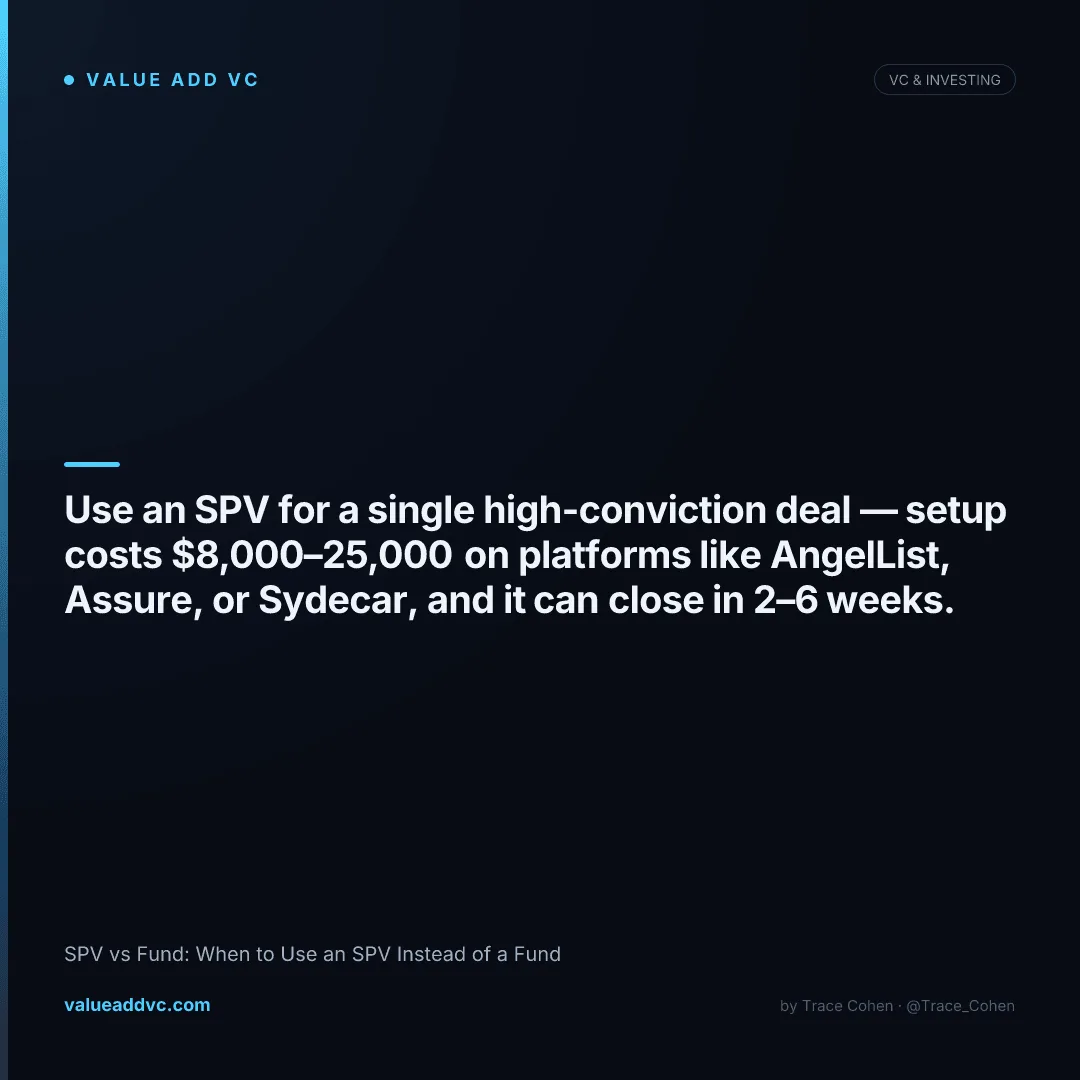
The SPV vs fund decision comes down to three questions: Do you have a deal right now? Do you have consistent deal flow? And can your LP relationships support ongoing fund commitments?
If you answered yes, no, and no — you want an SPV. If you answered yes to all three, you might be ready for a fund. Most people get this wrong by launching a fund too early, before they have the deal flow or LP base to justify $50K–150K+ in upfront costs.
SPV vs Fund: The Side-by-Side Comparison
| Factor | SPV | Fund |
|---|---|---|
| Formation cost | $8K–25K all-in | $50K–150K+ (legal alone) |
| Time to launch | 2–6 weeks | 6–18 months |
| Number of deals | 1 (single deal) | 20–40+ over 3–5 years |
| GP discretion | None — deal is set | Full discretion |
| LP commitment | Deal-by-deal opt-in | Committed capital upfront |
| Annual admin cost | $3K–8K/year | $20K–50K/year |
| Typical LP minimum | $25K–100K | $100K–500K+ |
| Fund life | Until exit (3–10 years) | 10 years standard |
| Regulatory exemption | 3(c)(1) or 3(c)(7) | 3(c)(1) or 3(c)(7) |
| Best for | One deal, emerging managers | Established deal flow + LP base |
When an SPV Is the Right Choice
SPVs are structurally underrated. I've seen first-time investors run $500K SPVs into breakout companies and build more credibility than managers who raised $10M funds with weak portfolios. The structure forces you to have conviction on a single deal — and that is actually a feature, not a bug.
You have a specific deal in hand
A hot round closing fast, a founder who knows you — SPVs can move in days vs. months for a fund
You are co-investing alongside a lead VC
Many top-tier VCs actively encourage SPV co-investors to fill out rounds without complicating their cap table
You are building a track record
2–3 SPV deals with marks or exits is the credibility base for your first fund pitch to institutional LPs
You are a scout or operator
SPVs let you formalize a deal without quitting your job or raising a fund — common for senior execs with deal flow access
Your LP network is deal-specific
Some LPs want exposure to specific sectors or companies, not discretionary mandates — SPVs match that preference
You want to test LP relationships
Running a $500K–$2M SPV shows who actually writes checks vs. who talks about writing checks
When a Fund Is the Right Choice
A fund is a business, not just a structure. You are committing to 10 years of investor relations, annual audits, quarterly reports, and LP management — before you deploy a single dollar into a company. I have seen managers underestimate this overhead badly.
Launch a fund when all of these are true: you have consistent deal flow (not just one great deal), you have LP relationships who will commit $100K–500K+ to a discretionary vehicle, and you have the infrastructure to manage a fund (or budget to outsource it).
You have 20+ deals you could have made in the last 2 years
Consistent proprietary deal flow is the core fund thesis signal
3–5 LPs have committed $500K+ each verbally
You need anchor LPs before launch — soft circles before legal spend
You want 10 years of dry powder
Fund capital lets you follow on, not just get in — SPVs rarely have reserve capacity
You are building a firm, not just investing
Hiring an associate, building systems, formal brand — these require fund economics to justify
The SPV-to-Fund Pathway Most Emerging Managers Take
The most common emerging manager trajectory I see: 2–3 SPVs in years 1–2, then a $5M–$15M Fund I in year 3 or 4. The SPVs serve as proof of concept — deal access, judgment, and LP relationships. The fund formalizes what is already working.
Year 1
First SPV
One high-conviction deal. $250K–$1M raised from 5–15 LPs. Learn the legal structure, LP communication, and K-1 process.
Year 1–2
Second & Third SPVs
Build LP base. Test deal selection publicly. Start developing repeatable sourcing — sector, geography, stage.
Year 2–3
Pre-Fund Prep
First marks or exits from SPVs. Formalize thesis. Build LP track record doc. Soft-circle anchor LPs ($500K–$2M each).
Year 3–4
Fund I Launch
$5M–$25M Fund I targeting 20–25 deals. Same LP network from SPVs, with 2–3 institutional anchors for credibility.
Platform Comparison: Where to Run Your SPV
The three platforms that dominate emerging manager SPV formation — and the key differences:
AngelList
Largest LP network, deal sourcing side benefits, strong brand recognition
$8K–10K
setup cost
Assure
White-glove service, more control over terms, better for complex deals or international LPs
$10K–15K
setup cost
Sydecar
Fastest legal turnaround (~2 weeks), clean UX, good for repeat SPV operators
$7.5K–12K
setup cost
Carta Launch
Integrated with portfolio tracking, good if you are already using Carta for cap table
$5K–8K
setup cost
Use the SPV Calculator to model net LP returns across different carry structures and exit multiples before you finalize your terms.
The Mistakes That Kill SPVs and Funds
SPV Mistakes
- ✕ Raising an SPV with no lead — you become the lead by default
- ✕ Closing on your own pro-rata instead of a deal you sourced for others
- ✕ Setting a 30% carry when LPs expect 20% (kills LP trust fast)
- ✕ No LP update cadence — LPs forget they invested within 18 months
- ✕ Raising an SPV into a deal that is not yet closed
Fund Mistakes
- ✕ Launching a fund with fewer than 3 anchor LP commitments
- ✕ Choosing a $50M target when $10M is more fundable
- ✕ Spending $100K on legal before confirming LP interest
- ✕ Blurring SPV carry and fund carry — LPs notice inconsistency
- ✕ Underestimating fund admin: audits, K-1s, LP reports = $30K–60K/year
The right structure is the one you can actually execute.
An SPV you can close in 3 weeks beats a fund you spend 18 months raising and never deploy.
Model your SPV returns, carry, and LP economics with the SPV Calculator at Value Add VC. Track fund performance benchmarks on the VC/PE Performance Dashboard. Originally published in the Trace Cohen newsletter.
Latest from the Pulse
Get VC data most people never see
— 100% free
Weekly benchmarks, valuations, and fund data. Join 5,000+ investors. No spam.