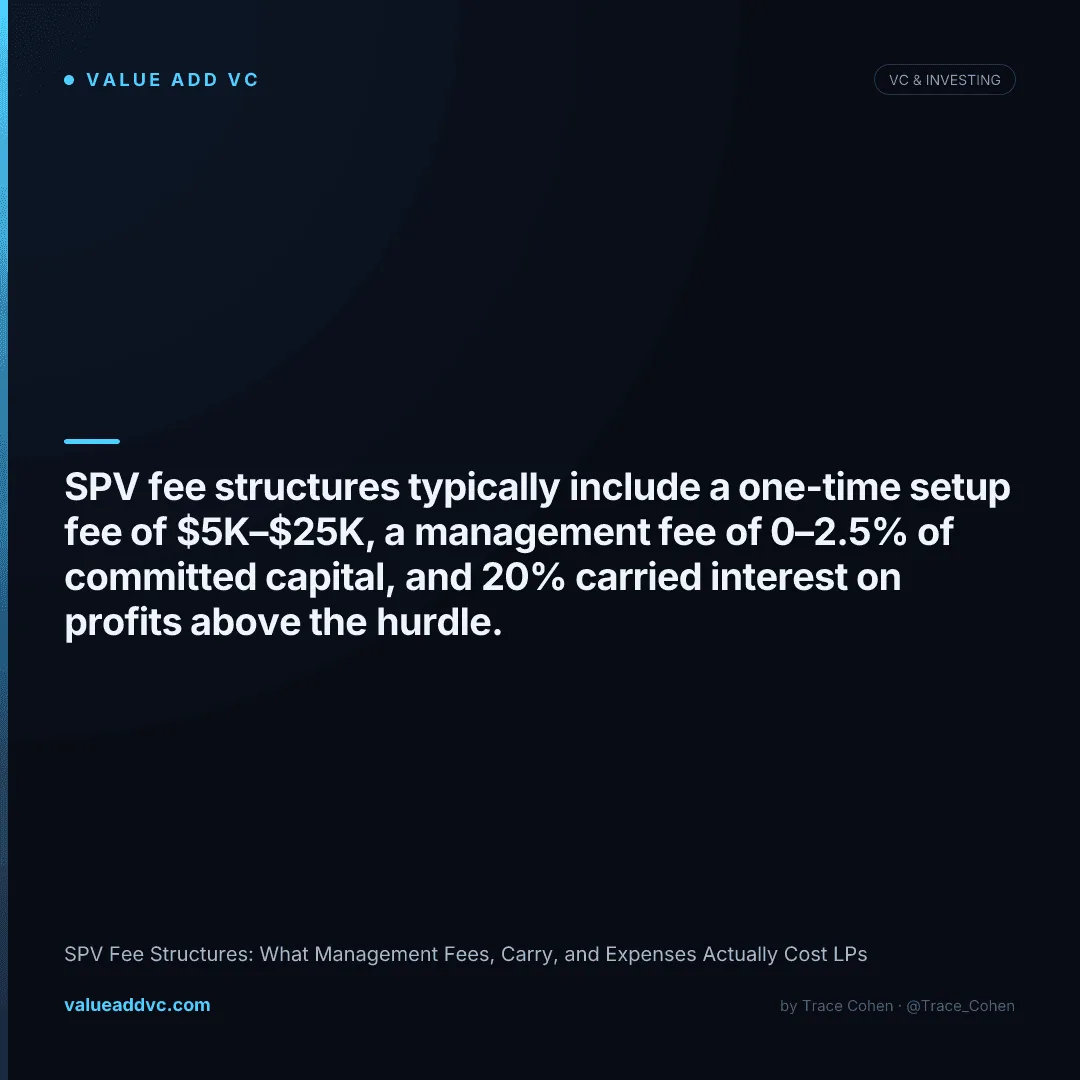
If you are investing in SPVs and not modeling the fee load, you are guessing at your actual return.
The headline return on an SPV deal — "10x gross" — is not the number that hits your account. Between setup fees, admin costs, and carried interest, LPs in a standard SPV structure walk away with meaningfully less than the gross multiple implies. After 65+ investments across funds and SPVs, I have seen founders, angels, and even institutional LPs get surprised by this math repeatedly. So let's put the exact numbers on paper.
The SPV Fee Structure: Three Layers of Cost
Every SPV has the same three cost layers. The amounts vary by platform, deal size, and lead investor terms — but the structure is universal.
1. Setup & Administration Fees
$5,000 – $25,000One-time cost to legally form the SPV, handle K-1 preparation, manage investor onboarding, and administer the entity life. Charged by the platform (AngelList, Carta, Assure, Sydecar, etc.).
Usually passed through to LPs as a direct deduction from committed capital
2. Management Fee
0% – 2.5% per yearAnnual fee on committed capital, charged by the lead investor or manager. Many SPVs charge zero — the lead is compensated purely through carry. Some charge 1–2% annually.
Single-deal SPVs typically charge no ongoing management fee
3. Carried Interest
20% – 30% of profitsThe lead investor's share of upside above the return of LP capital (and sometimes above a hurdle rate). Industry standard is 20%, though some experienced leads charge 25–30%.
The most significant cost on a high-returning deal
SPV Fee Structure by Platform (2025 Data)
Platform fees vary meaningfully. Here is the current state of the major SPV platforms — for a deeper look at how the major SPV platforms compare on cost, see our full ranking.
| Platform | Setup Fee | Annual Admin | Min. Deal Size |
|---|---|---|---|
| AngelList RUV | $6K (under $250K) / $10K (larger) | Included | $25K |
| Carta Launch | $10K–$20K | $3K–$5K/yr | $100K |
| Assure | $8K–$15K | $2K–$4K/yr | $100K |
| Sydecar | $5K–$12K | Included | $50K |
| Allocations | $7.5K flat | $1.5K/yr | $50K |
Fees approximate as of 2025. Lead investor carry is set independently of platform fees.
The Real Math: What LPs Actually Net
Let's model two common scenarios. Both assume a $1M SPV, $10K setup fee, no ongoing management fee, and 20% carry with a 1x capital return hurdle.
Scenario A: 10x Gross Exit
~8.1x net to LPs
Scenario B: 3x Gross Exit
~2.6x net to LPs
What Smart LPs Negotiate Before Committing
Most LPs accept the default SPV fee structure without pushback. The ones who have done this more than a few times know which levers actually move the needle:
Hurdle rate
Push for a 1x capital return hurdle before carry kicks in. Many SPV leads will accept this, especially if you are anchoring the round. Without a hurdle, carry applies to the first dollar of gain — even a 1.3x exit generates carry.
Carry percentage
20% is standard. For leads without a meaningful track record or proprietary deal access, 15% is a reasonable ask. For exceptional deals with a proven lead, 25% may be worth paying. The lead's value-add post-investment is worth pricing in.
Fee pass-through vs. deduction
Some leads charge setup fees as a direct deduction from LP capital (reducing deployed capital). Others add them on top. Know which structure you are agreeing to — the math differs.
Pro-rata rights
Not a fee, but a key term. If the lead has pro-rata rights in future rounds and intends to exercise them through a follow-on SPV, understand the economics of the full investment sequence.
SPV Fees vs. Traditional Fund Fees
The "2 and 20" fund model — 2% management fee annually plus 20% carry — charges a lot more over the life of a fund than a typical SPV structure. On a $10M fund over a 10-year life, a 2% management fee alone costs LPs $2M before a single carry dollar is paid. SPVs are generally cheaper on the fee side, but they offer no diversification. That is the real tradeoff.
| Structure | Setup Cost | Management Fee | Carry |
|---|---|---|---|
| SPV (single deal) | $5K–$25K one-time | 0% (most) | 20% |
| Micro-fund (emerging) | $25K–$75K formation | 2–2.5%/yr | 20% |
| Established VC fund | Included | 1.5–2%/yr | 20–30% |
| Fund of funds | Included | 0.5–1%/yr | 5–10% (on top of underlying) |
The fee structure is not the risk in an SPV. The company is.
But LPs who do not model the fees are making return assumptions that will not hold. Use the SPV Calculator before you commit.
Model your SPV returns — including fees and carry — on the SPV Calculator at Value Add VC. Originally published in the Trace Cohen newsletter.
Latest from the Pulse
Get VC data most people never see
— 100% free
Weekly benchmarks, valuations, and fund data. Join 5,000+ investors. No spam.