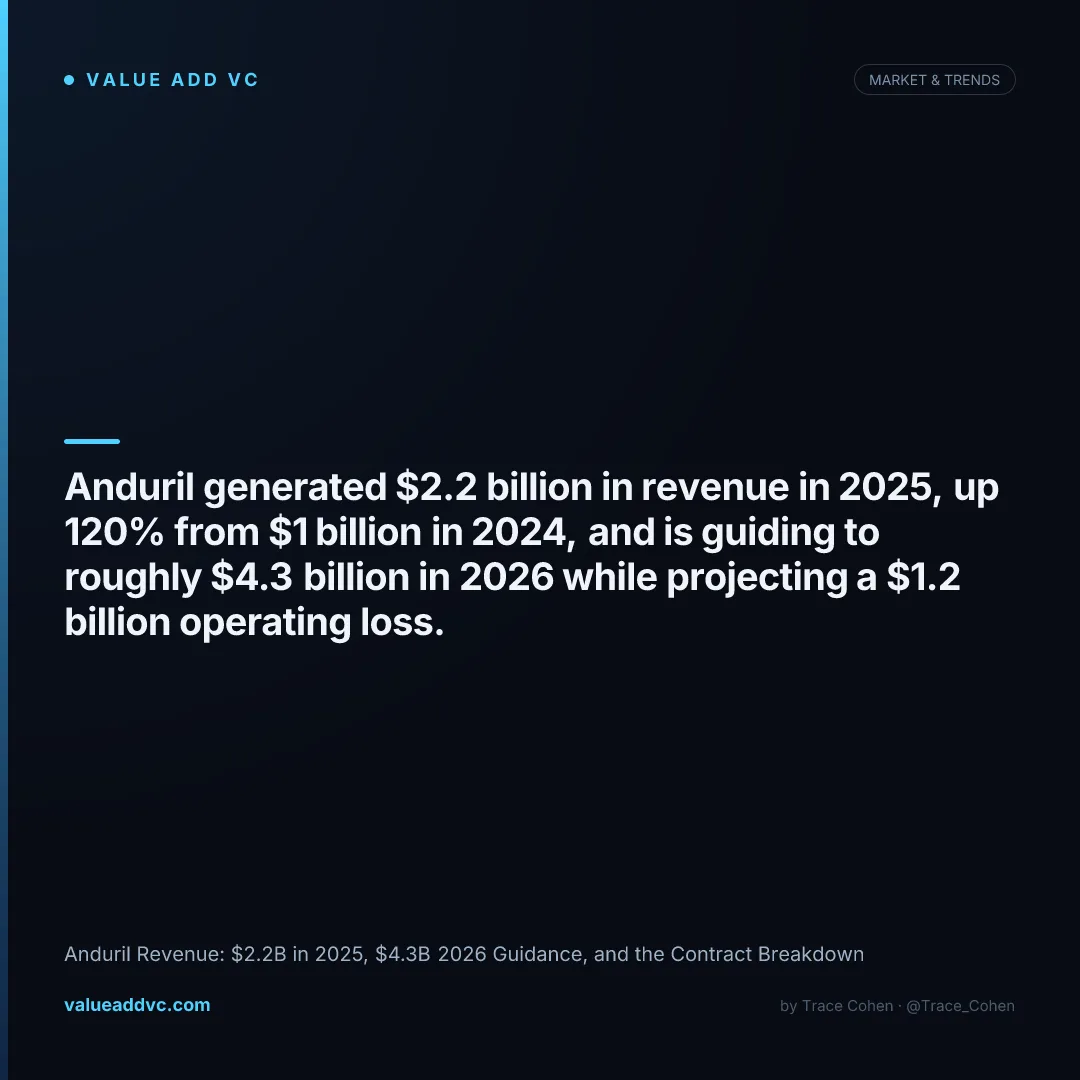
Anduril generated $2.2 billion in revenue in 2025, up 120% from $1 billion in 2024, and is guiding to roughly $4.3 billion in 2026 — even as it projects a $1.2 billion operating loss for the year. The company is now in talks to raise fresh funding at close to $100 billion, less than three months after closing a round that valued it at $61 billion.
Founded in 2017 by Palmer Luckey, Trae Stephens, Brian Schimpf, Matt Grimm, and Joe Chen, Anduril has gone from a $150 million-revenue startup in 2021 to a defense contractor whose single largest contract — a 10-year U.S. Army enterprise agreement — has a ceiling of $20 billion on its own. That trajectory is why Anduril keeps showing up in the same conversation as IPO speculation, even with no S-1 filed and no date set.
Figures from The Information, TechCrunch, Bloomberg, and Reuters reporting, 2025-2026.
Anduril Revenue: How Much Does the Defense Startup Actually Make?
Anduril's revenue hit $2.2 billion in 2025, up from $1 billion in 2024, $420 million in 2023, and $236 million in 2022 — roughly a 9x increase in three years. The company is guiding to approximately $4.3 billion in revenue for 2026, driven largely by Arsenal-1, its new Ohio manufacturing plant, ramping production of drones and missiles at scale.
Unlike most VC-backed companies covered on this site, Anduril's revenue is almost entirely government-sourced. It sells hardware and software directly to the U.S. Department of Defense, the Air Force, the Army, and a growing list of allied militaries — the U.K., the Netherlands, Poland, and Australia among them — rather than chasing enterprise software logos. Track how the broader private-market valuation environment is moving on our AI valuations dashboard.
Where Anduril's Revenue Actually Comes From
Anduril's revenue is concentrated in a handful of very large, multi-year government contracts rather than a broad base of recurring customers. The single biggest is a 10-year U.S. Army enterprise agreement signed in March 2026, with a ceiling of up to $20 billion, that consolidated more than 120 separate Army procurement actions into one framework — the largest deal in the company's history. Below are the largest disclosed contracts driving that revenue base.
| Contract / Program | Value | Timing | Detail |
|---|---|---|---|
| U.S. Army enterprise agreement | Up to $20B | 10-year deal, March 2026 | Consolidated 120+ separate Army procurement actions into one framework |
| Autonomous Surveillance Towers | $2B IDIQ | ~$818M obligated by Dec 2025 | Southern border surveillance towers under a multi-year ceiling contract |
| Kuwait counter-drone sale | $1.98B | U.S.-approved, 2026 | Foreign military sale of Anduril counter-drone systems |
| Ghost Shark (Australia) | A$1.7B (~$1.1B) | 5-year contract | Extra-large autonomous undersea vehicle fleet for the Royal Australian Navy |
| Thunderforge (with Anduril + Microsoft) | Undisclosed | Won March 2025 | Pentagon's flagship AI agent program for military planning |
| Arsenal-1 manufacturing facility | ~$1B invested | Pickaway County, Ohio | Produces Fury CCA, Roadrunner, and Barracuda-series hardware; up to 150 Fury aircraft/year at capacity |
Sources: U.S. Department of Defense contract announcements, Fed-Spend federal contracts analysis, and Anduril program disclosures, 2025-2026.
The Products Behind the Anduril Revenue Numbers
Anduril's revenue is spread across a small number of hardware product lines, each tied to a specific military use case: Fury, a Collaborative Combat Aircraft now in serial production at Arsenal-1; Barracuda, a family of low-cost cruise missiles; Roadrunner, a reusable interceptor drone; Ghost Shark, an extra-large autonomous undersea vehicle built for Australia; and Lattice, the AI software layer that networks all of it together and is increasingly sold as its own line item. All of it is manufactured, in large part, out of Arsenal-1, the nearly $1 billion Ohio facility Anduril built specifically to hit the production volume its government contracts now require.
Arsenal-1 is designed to eventually run three shifts producing up to 150 Fury aircraft a year, and Anduril says the site will employ 4,000 people within a decade and generate $2 billion in annual local economic output, according to Breaking Defense. That factory ramp is the mechanical reason 2026 revenue guidance nearly doubles 2025's number — Anduril has spent years winning contracts it didn't yet have the manufacturing capacity to fully deliver against.
Anduril's Valuation Is Growing Even Faster Than Its Revenue
Anduril's valuation has climbed from $8.5 billion in 2022 to $14 billion in August 2024, to $30.5 billion in June 2025, and then doubled again to $61 billion in May 2026 after a $5 billion round led by Thrive Capital and Andreessen Horowitz. By July 2026, the company was reportedly in talks to raise new capital at close to $100 billion — a jump of more than 60% in barely two months, according to Defense News.
At $61 billion against $2.2 billion in 2025 revenue, Anduril traded at roughly 28x trailing revenue. At a $100 billion valuation against $4.3 billion in guided 2026 revenue, the multiple compresses to about 23x forward revenue — high for a hardware-heavy defense contractor, but not unreasonable next to software-style multiples if the growth rate holds.
Anduril Valuation Progression, 2022-2026
TechCrunch, Bloomberg, Defense News, and Reuters reporting, 2022-2026
What the headline growth numbers miss
The revenue trajectory looks unambiguously bullish, but Anduril is still losing a lot of money to get there. The company's own 2026 guidance pairs $4.3 billion in revenue with an approximately $1.2 billion operating loss — a wider dollar loss than most of its own annual revenue just two years ago. Government revenue recognition on multi-year contracts also means headline contract "ceilings" like the $20 billion Army deal or the $2 billion IDIQ for surveillance towers are maximums, not guaranteed spend; the Army towers contract had only about $818 million obligated as of December 2025, well under half of its ceiling.
There's also concentration risk that doesn't show up in a single blended revenue number: a large share of growth is tied to U.S. Army and DoD budget cycles, which can shift with administrations, appropriations fights, or a change in Pentagon procurement priorities. A defense-tech downturn, or a slower-than-planned Arsenal-1 ramp, would hit 2026 revenue guidance directly — this isn't recurring SaaS revenue that's locked in regardless of who's in the Pentagon.
How Anduril's Revenue Compares to Traditional Defense Primes
At $2.2 billion in 2025 revenue, Anduril is still a fraction of the size of legacy primes like Lockheed Martin (over $70 billion in annual revenue) or RTX. But its growth rate — 120% in 2025 alone — is something none of the incumbents have posted in decades, and it's winning contracts, like the $20 billion Army enterprise deal, that used to be split among multiple traditional contractors. That combination of small base and triple-digit growth is exactly why growth investors are willing to pay 23-28x revenue for a hardware company, a multiple usually reserved for software.
If Anduril's 2026 guidance holds and it closes a round near $100 billion, it will have added roughly $70 billion of valuation in under 18 months — a pace that puts it in the same conversation as xAI's valuation run and other capital-intensive private companies scaling against government or hyperscaler demand rather than consumer adoption.
International Contracts Are Diversifying Anduril's Revenue Base
Anduril's revenue used to be almost entirely a U.S. Department of Defense story. That's changing: the company now holds contracts with the U.K. Ministry of Defence, the Dutch Ministry of Defence, NATO, Poland, and Australia, alongside the U.S.-approved $1.98 billion counter-drone sale to Kuwait. The Ghost Shark program alone — a five-year, roughly A$1.7 billion (about $1.1 billion) deal with the Royal Australian Navy for extra-large autonomous undersea vehicles — shows the company is winning prime contractor roles abroad, not just subcontracting to local defense firms.
That international expansion matters for revenue durability. A U.S.-only book of business is exposed entirely to Pentagon budget cycles and the political mood in Washington; a mix of U.S., NATO-member, and Indo-Pacific allied contracts spreads that risk across multiple governments with different election calendars, appropriations processes, and defense priorities. It's the same diversification logic other defense-tech startups are now chasing as the sector matures past its single-customer-concentration phase.
Bottom line: Anduril's revenue hit $2.2 billion in 2025, up 120% year-over-year, and the company is guiding to $4.3 billion in 2026 on the back of its Arsenal-1 factory ramp and a $20 billion Army enterprise contract. It's still losing roughly $1.2 billion a year to get there, and investors are now pricing that trajectory at close to $100 billion — nearly 12x higher than the $8.5 billion valuation Anduril carried just four years ago.
Latest from the Pulse
Get VC data most people never see
— 100% free
Weekly benchmarks, valuations, and fund data. Join 5,000+ investors. No spam.