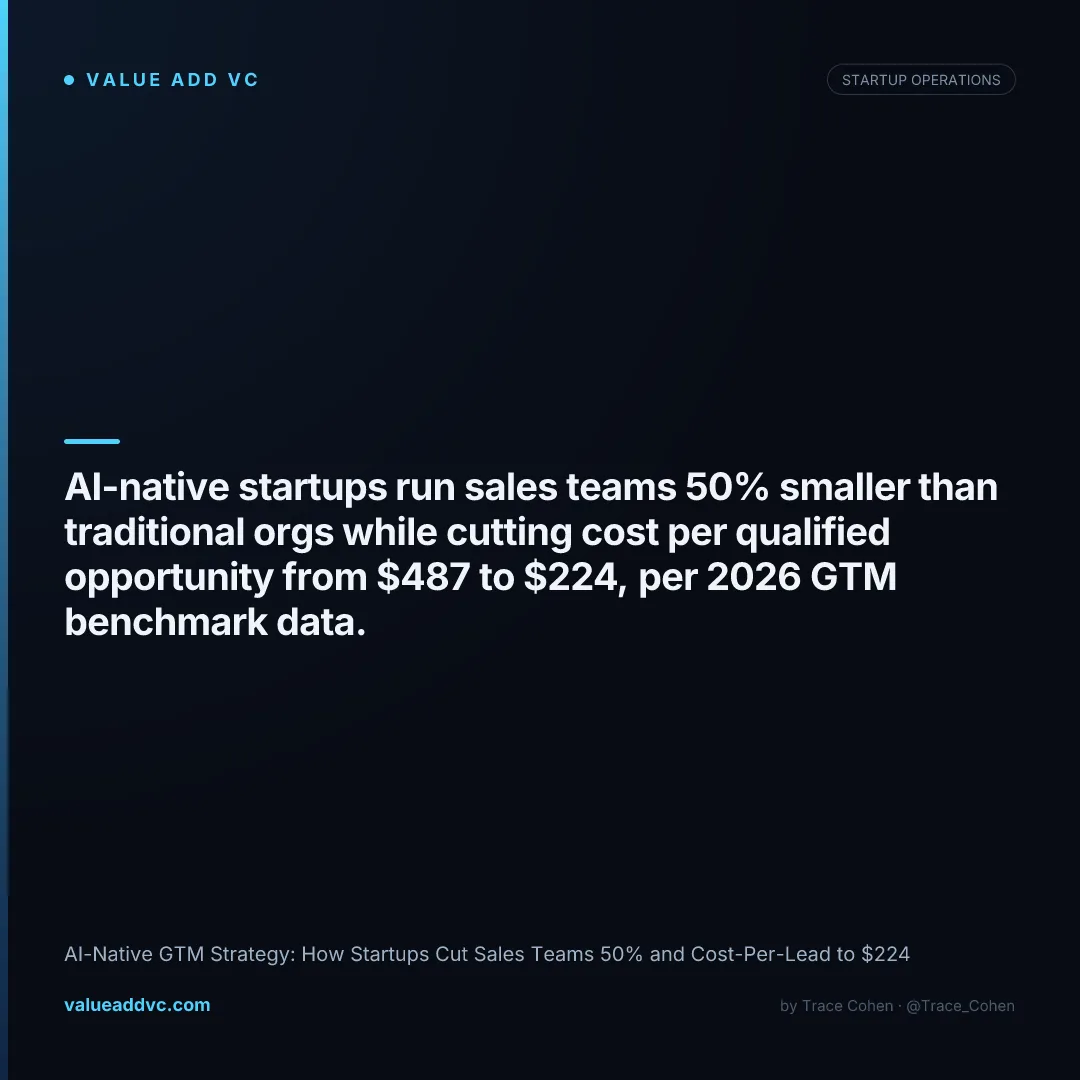
AI-native startups are running sales teams 50% smaller than their predecessors while cutting cost per qualified opportunity from $487 to $224 — a 54% drop. But this is less a headcount story than a redesign of who does the first 80% of the sales and marketing motion.
Enterprise AI SDR adoption jumped from 12% to 41% of B2B teams in a single year, and companies like Clay, 11x, and Artisan have raised real capital — Clay closed a $100 million Series C in April 2026 at a $3.1 billion valuation — to build the tooling underneath it. Founders restructuring entire GTM orgs around this shift aren't firing sales reps — they're just never hiring the first ten. We track how AI is reshaping team structure more broadly on our hiring dashboard.
What Is an AI-Native GTM Strategy for a Startup?
An AI-native GTM strategy for a startup means routing sales development, marketing content, and lead qualification through AI agents and automation platforms first, with humans stepping in only for late-stage, high-value conversations. Platforms like Clay, 11x, and Artisan prospect, personalize outreach, and respond to inbound leads in under a minute, and even teams that stick with more traditional B2B prospecting tools like Apollo are layering AI enrichment on top — which is why AI-native sales teams now run roughly 50% smaller than traditional teams at the same revenue.
This isn't the same as "using AI tools" inside an existing org chart. A true AI-native GTM motion is designed from day one assuming an AI agent handles the first touch, the qualification logic, and often the follow-up cadence — the human team exists to close, not to prospect. That's a structural difference from bolting a chatbot onto an existing 20-person sales floor.
Figures are 2025-2026 estimates blended from Fortune Business Insights AI SDR market sizing, Clara AI SDR and DigitalApplied 2026 industry benchmark reports, and reported Clay, 11x, and Artisan funding disclosures.
The AI SDR Market: How Big and How Fast
Fortune Business Insights sizes the global AI SDR market at $4.27 billion in 2025, growing to $5.22 billion in 2026 and a projected $24.32 billion by 2034 — a 21.2% compound annual growth rate. That trajectory tracks the enterprise adoption curve almost exactly: 41% of B2B teams with 500+ employees had at least one AI SDR in production as of Q1 2026, up from just 12% twelve months earlier, while mid-market sits at 27% adoption and SMB at 14%.
The gap between enterprise (41%) and SMB (14%) adoption is the tell: bigger companies have the deal volume to justify AI SDR tooling immediately, while smaller startups are still deciding whether to build an AI-native motion from scratch or bolt AI onto an existing process.
Who's Building the AI-Native GTM Stack: Clay, 11x, and Artisan
Clay is the clearest example of capital following adoption: it closed a $100 million Series C in April 2026 led by CapitalG at a $3.1 billion post-money valuation, roughly double the price of a May 2025 tender offer led by Sequoia. Clay's product lets GTM teams enrich and route leads with dozens of AI-driven data sources before a human ever touches the account.
11x built its "digital worker" pitch to nearly $10 million in ARR by 2024, raising a $50 million Series B led by Andreessen Horowitz after a Series A priced at a $50 million post-money valuation by Benchmark — pricing that, by early 2026, looked aggressive relative to 11x's actual retention and reliability numbers. Artisan, founded in 2024 behind the provocative "Stop Hiring Humans" campaign, raised an $11.5 million seed from Y Combinator, Sequoia, and HubSpot, betting that fully autonomous AI sales reps ("Artisans") can run outbound end-to-end.
The valuation spread between these three — a $3.1 billion Clay against sub-$100 million rounds for 11x and Artisan — reflects where each sits in the stack: Clay is infrastructure every AI-native GTM team touches regardless of which agent layer they choose, while 11x and Artisan compete directly for the same "replace the SDR" budget line.
Traditional GTM Team vs AI-Native GTM Team
The clearest way to see the shift is side by side. Every row below reflects a documented 2026 benchmark, not a hypothetical — and the pattern across all seven metrics is the same: AI-native teams don't just cut cost, they respond faster and convert a higher share of every lead they touch.
| Metric | Traditional GTM Team | AI-Native GTM Team |
|---|---|---|
| Sales team headcount (same revenue) | Baseline | ~50% smaller |
| Cost per qualified opportunity | $487 | $224 |
| First lead response time | Hours to next business day | Under 1 minute, 24/7 |
| Lead-to-qualified conversion (5 min vs 30 min contact) | 1x baseline | Up to 21x more likely to qualify |
| New pipeline from AI agents (first 90 days) | 0% | Up to 25% |
| Lead generation volume | Baseline | +50% |
| Overall GTM operational cost | Baseline | -60% |
| Company-wide headcount vs peers | Baseline | ~25% fewer employees |
Figures are 2026 estimates blended from Clara AI SDR benchmarks, DigitalApplied's AI SDR statistics report, and GrowthMarketer/FindNStart AI-native org structure research. "5 min vs 30 min contact" reflects lead response speed studies, not AI SDR-specific data.
Enterprise Adoption of AI-Native GTM by Company Size
Adoption isn't uniform, and the size gradient matters for founders deciding how hard to lean into an AI-native GTM strategy. Enterprise teams (500+ employees) lead at 41% adoption, mid-market sits at 27%, and SMBs trail at 14% — a gap that mostly reflects deal volume rather than technical readiness. A company running 50 outbound sequences a day gets far less signal from an AI SDR than one running 5,000.
Building an AI-Native GTM Strategy: The Startup Playbook
Start with data infrastructure, not the outward-facing agent. Clay's $3.1 billion valuation exists because enrichment and routing logic is the layer every downstream AI SDR or marketing agent depends on — get that wrong and even the best-sounding AI rep is qualifying leads against bad data. Layer in an outbound agent (11x, Artisan, or a comparable tool) only once your ideal customer profile and messaging are stable enough that an agent can execute them consistently. The same sequencing applies to nurture: pick an email platform that matches your actual stage before wiring AI agents on top of it — our Kit vs Mailchimp comparison breaks down which one fits a newsletter-first startup versus one running e-commerce lifecycle flows.
Keep humans on anything above a certain deal size or complexity threshold. The 21x qualification lift from fast response times is real, but it applies to top-of-funnel volume — nobody has shown AI agents closing six-figure enterprise contracts unassisted. The startups getting the most out of this shift are running AI for the first 80% of the funnel and a lean, senior human team for the last 20%, which is exactly how a five-person GTM org can outproduce a fifty-person department that hasn't made the switch.
Is an AI-Native GTM Strategy Right for Every Startup?
No — this doesn't hold up as a universal playbook. AI-native GTM works best for high-volume, lower-ACV motions — PLG SaaS, transactional B2B, anything where the sales cycle is short enough that agent-driven speed matters more than relationship depth. It works worse for long, consultative enterprise sales where buyers still expect to build trust with a specific human before signing.
The 11x situation is the cautionary tale worth remembering: a $50 million Series A priced at a $50 million post-money valuation looked reasonable in 2024 and aggressive by 2026 once retention and reliability numbers came in soft. Capital moved fast into this category before the product maturity fully caught up, and some of that will get repriced. Founders evaluating these tools should weight actual qualified-pipeline output over demo polish — the $487-to-$224 cost drop is real, but it's an average across companies that implemented AI-native GTM well and companies still working out the kinks.
The diligence question worth asking any company piloting one of these tools is simple: what percentage of qualified pipeline came from the AI agent versus a human rep re-working the same list afterward? Some vendors' 25%-of-pipeline claims hold up under that scrutiny; others turn out to be humans doing the real qualification work while the AI agent gets credited for the first email. That distinction is the difference between a genuine 50% headcount reduction and a tool that just adds another dashboard for a sales team that hasn't actually gotten smaller.
Bottom line: AI-native GTM strategy in 2026 means smaller sales teams (down ~50%), cheaper qualified opportunities ($224 vs $487), and a market — AI SDR tooling — growing from $5.22 billion to a projected $24.32 billion by 2034. Clay's $3.1 billion valuation shows where the capital is concentrating, but the real signal is enterprise adoption jumping from 12% to 41% in a single year. Startups that build the AI-first motion from day one, rather than bolting it onto an existing team, are the ones actually capturing the cost and speed advantage.
Latest from the Pulse
Get VC data most people never see
— free to subscribe
Trace's notes on venture, AI and startups, a few times a week. Join 5,000+ subscribers. No spam.