
$25.5 billion is the size of the global AI-in-cybersecurity market in 2026, per MarketsandMarkets, but AI-powered attacks are growing even faster — up 72% year-over-year and now hitting 87% of organizations. A defense market growing slower than the attacks it exists to stop — that imbalance is the story.
Security vendors pitching in 2026 overwhelmingly say some version of the same thing: "AI changed the threat model, so we built an AI-native defense." Most of them are right about the first half. Attackers are using AI to write better phishing emails, clone voices for deepfake fraud, and scan for vulnerabilities faster than any human red team ever could. The defense side is racing to keep up, and the money is following — but the gap between attack-side AI adoption and defense-side AI deployment is exactly where the next generation of security startups is being built, or isn't.
AI Cybersecurity in 2026: Attack Surface Expansion and the New Risk Equation
AI cybersecurity in 2026 describes a market split into two accelerating halves: a $25.5 billion AI-in-security product category selling detection, automated response, and AI-native SOC tooling, set against an attack landscape where AI-powered incidents rose 72% year-over-year. The "new risk equation" is that both attacker and defender now have access to the same class of tools, so the advantage goes to whoever integrates AI into their workflow faster and with better underlying data — which right now tilts toward attackers, since a phishing kit needs no compliance review and a defensive AI agent typically does.
How Big Is the AI Cybersecurity Market Right Now?
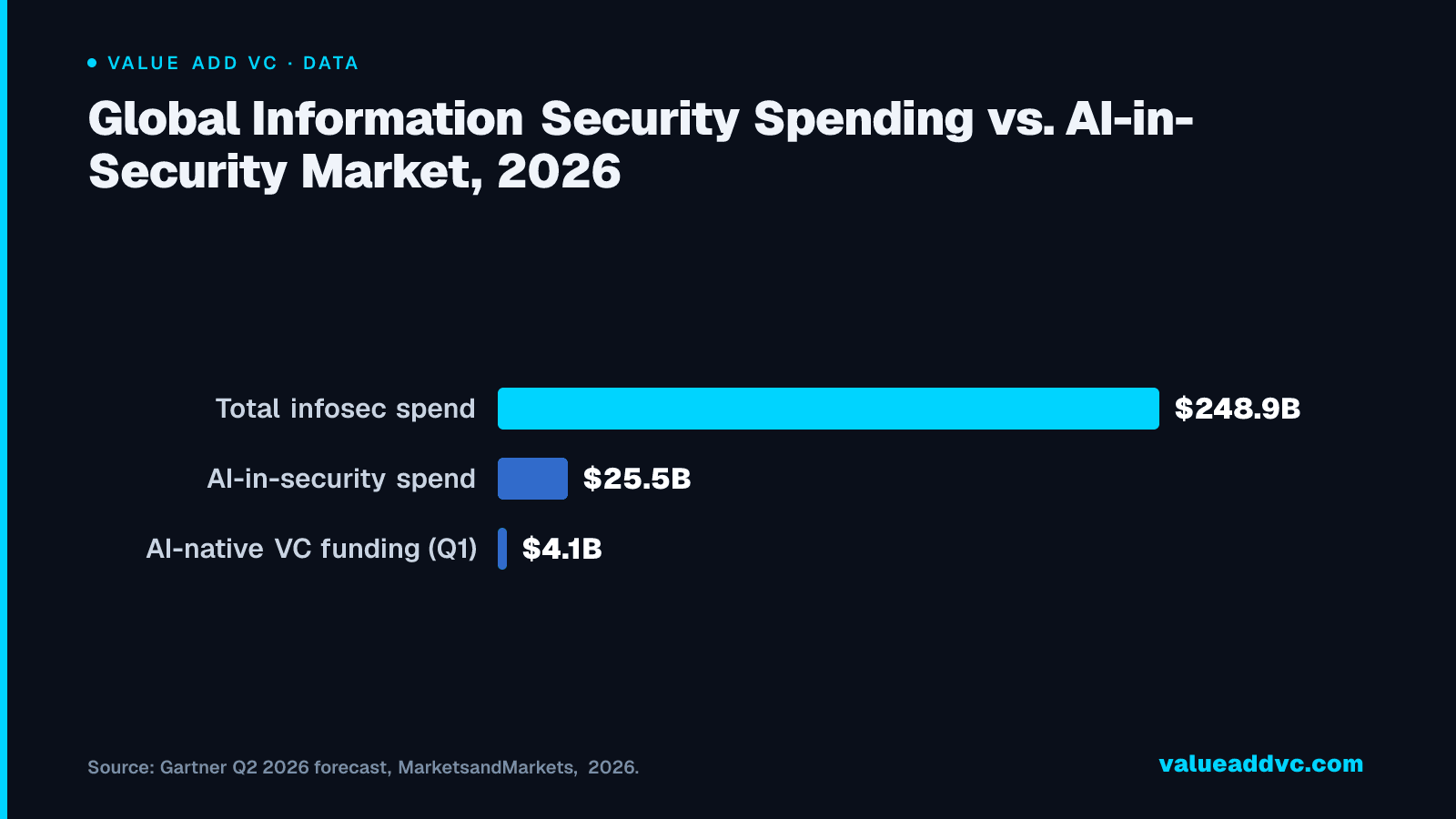
The exact number depends on who's counting. MarketsandMarkets sizes the AI-in-cybersecurity market at $25.5 billion for 2026; Precedence Research put the broader category at $29.6 billion for 2025; Fortune Business Insights, using a wider definition that folds in adjacent AI-security tooling, gets to $44.2 billion. Take the middle of that range and AI-specific security spend is somewhere around $30 billion — still a small slice of the $248.9 billion global information-security market Gartner tracked for 2026, up 12.7% year-over-year. But it's the fastest-growing slice by a wide margin: Gartner calls "securing AI" the only accelerating segment in its entire forecast, projecting it to climb from 16.3% of security budgets in 2026 to 20.1% by 2030 and to overtake endpoint protection as the single largest security category by 2029.
Global Information Security Spending vs. AI-in-Security Market, 2026
AI-specific security spend is still under 15% of the total infosec budget — but it's the only line item growing faster than the threat it's meant to counter.
Gartner Q2 2026 forecast, MarketsandMarkets, 2026.
Data
| Item | Value |
|---|---|
| Total infosec spend | $248.9B |
| AI-in-security spend | $25.5B |
| AI-native VC funding (Q1) | $4.1B |
The AI-Powered Attack Surface Is Expanding Faster Than Defense Spending
The attack-side numbers are the part that should worry every CISO's board. AI-powered cyberattacks rose 72% year-over-year, with automated vulnerability scanning now running at roughly 36,000 scans per second globally. 87% of organizations said they experienced at least one AI-enabled attack in the prior year, and 85% faced a deepfake-based threat specifically — deepfake incidents jumped to 179 confirmed cases in a single quarter (Q1 2025), a 2,137% increase since 2022. AI-driven credential theft rose 160% in 2025, with more than 14,000 breaches tied to stolen credentials recorded in a single month, and Microsoft reported detecting roughly 8.3 billion email-based phishing threats in Q1 2026 — a volume no human-written phishing campaign could have produced at that scale before generative AI made mass-personalized lures cheap.
The cost data backs up the urgency: the average AI-powered data breach cost $5.72 million in 2025, a 13% increase over the year before and meaningfully above the average cost of a non-AI breach. North America saw the highest concentration of AI-driven attacks in 2025 at 39% of global incidents, while Asia-Pacific saw the fastest growth rate at 56% year-over-year, concentrated in financial services and e-commerce. This is the same dynamic playing out across enterprise AI more broadly — as covered in our analysis of how AI productivity gains are real but uneven, and security is the sharpest version of that unevenness: attackers get 100% of the productivity gain immediately, while defenders have to build, test, and deploy AI tooling through a much slower enterprise procurement and compliance cycle.
There's also an asymmetry in tooling cost that doesn't get discussed enough. Building a convincing phishing campaign or a voice-cloned deepfake used to require real skill and time; now it requires a subscription to a commercial LLM and a few dollars of API spend, which is a large part of why deepfake incidents grew 2,137% since 2022 and why automated scanning reached 36,000 attempts per second. The defenders, by contrast, are buying enterprise software with procurement cycles measured in quarters, security reviews of their own, and integration work against legacy SIEM and identity stacks that predate the cloud. That mismatch in deployment speed — not a mismatch in underlying model capability — is the single biggest reason the 72% attack growth rate is currently outpacing the 12.7% growth in overall defense spending.
Where AI Cybersecurity VC Funding Is Actually Going
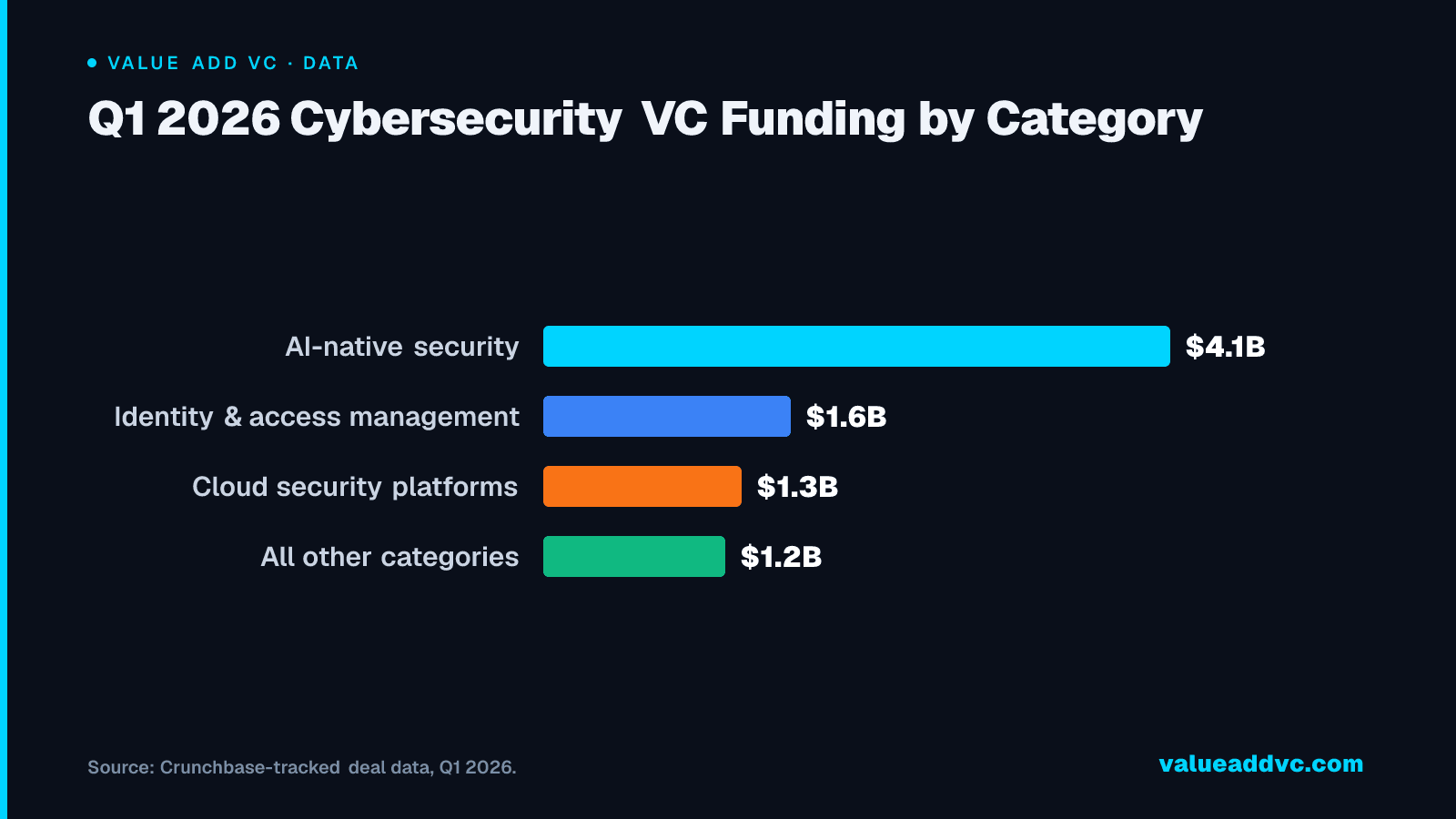
Total cybersecurity venture funding held up in 2026 at roughly $8.2 billion across 340+ deals in Q1 — a 12% increase in dollar volume even as deal count fell 8%, meaning capital is concentrating in fewer, larger rounds. Inside that total, AI-native security is the standout: $4.1 billion of Q1 funding, up 47% year-over-year, and now the fastest-growing category in the sector, ahead of identity and access management, which had been the prior leader. Across the full 2025-2026 window, AI-focused security startups have raised more than $8 billion combined. The categories pulling the most capital are AI-powered threat detection, cloud security platforms, identity and access management, data loss prevention, SOC automation, and application security — with SOC automation drawing particular attention because it directly answers the scale problem: human analysts can't triage AI-generated attack volume, so the pitch for AI-native SOC tooling is defense automation matching offense automation one-for-one. Specialist early-stage firms are concentrating here too: Acrew Capital, a roughly $1.7 billion AUM firm built around a "Data & Security" thesis, has backed cyber-insurer At-Bay alongside compliance-automation company Vanta and network-security firm Cato Networks. That bigger-rounds pattern held through Q3 2026, too: see Q3 2026's biggest cybersecurity funding rounds, ranked, where Keyfactor's $1 billion deal led a group of 15 tracked rounds worth $2.8 billion combined.
Q1 2026 Cybersecurity VC Funding by Category
Crunchbase-tracked deal data, Q1 2026.
Data
| Item | Value |
|---|---|
| AI-native security | $4.1B |
| Identity & access management | $1.6B |
| Cloud security platforms | $1.3B |
| All other categories | $1.2B |
AI Cybersecurity Spending vs. Attack Growth: The Full Comparison
Putting the defense-side spending numbers next to the attack-side growth numbers makes the gap concrete — and makes clear why "securing AI" is the one segment of the security budget growing faster than everything around it.
| Metric | Figure | Source |
|---|---|---|
| Global AI-in-cybersecurity market size, 2026 | $25.5B | MarketsandMarkets |
| Total global infosec spending, 2026 | $248.9B (+12.7% YoY) | Gartner, Q2 2026 forecast |
| YoY growth in AI-powered cyberattacks | 72% | 2026 threat-intelligence data |
| Orgs experiencing an AI-enabled attack (2025) | 87% | 2026 enterprise security survey |
| Average cost of an AI-powered data breach | $5.72M (+13% YoY) | 2025 breach-cost analysis |
| Rise in AI-driven credential theft, 2025 | 160% | 2025-2026 threat data |
| Microsoft phishing threats detected, Q1 2026 | 8.3B | Microsoft threat intelligence |
| Total cybersecurity VC funding, Q1 2026 | $8.2B (340+ deals) | Crunchbase |
| AI-native security VC funding, Q1 2026 | $4.1B (+47% YoY) | Crunchbase-tracked deal data |
Figures are 2026 estimates blended from Gartner, MarketsandMarkets, Crunchbase, Microsoft threat intelligence, and 2025-2026 breach-cost and threat-intelligence research. Market-sizing figures vary by methodology across research firms; deal and funding figures reflect disclosed rounds only.
What Founders and Investors Should Take From the AI Cybersecurity Numbers
The investable thesis here isn't "AI security is hot" — it's that the gap between attack-side AI velocity and defense-side AI deployment is the actual product opportunity, and it's wide enough right now that a well-scoped startup can build a durable wedge. The $4.1 billion in Q1 AI-native security funding, up 47% year-over-year, tells you investors already see this; the question for a founder is which part of the stack still has the widest gap. SOC automation and AI-driven threat detection are the areas worth looking at first, because human analyst headcount simply cannot scale to match 36,000 automated scans per second or 8.3 billion phishing attempts in a quarter — that's a volume problem only software can solve, not a hiring problem.
The other lesson is pricing discipline. A New York-based startup called A Security raised a $37 million seed round led by Lightspeed Venture Partners specifically to address AI-driven threats, and rounds at that size are becoming the norm rather than the exception in this category — deal count in cybersecurity VC actually fell 8% in Q1 2026 even as dollar volume rose 12%, meaning investors are writing fewer, bigger checks into companies they believe can move fast enough to matter. For founders raising into this category, the diligence bar isn't "do you use AI" — every pitch does now — it's whether your detection or response loop actually closes faster than the 72% year-over-year growth rate in the attacks you're built to stop. If it doesn't, you're building a compliance checkbox, not a defense product, and that's a much smaller market than the $25.5 billion headline number suggests.
The category boundary is also the thing to get right in the next 12-18 months: as "securing AI" climbs from 16.3% of security budgets today toward the 20.1% share Gartner projects for 2030, buyers are going to start splitting spend between tools that use AI to defend traditional infrastructure and tools that specifically secure AI systems themselves — model access controls, prompt-injection defense, agent permissioning, and AI supply-chain monitoring. Those are different products sold to different buyers inside the same security org, and conflating them in a pitch deck is one of the fastest ways founders lose a room this year. The startups winning meetings right now pick one side of that split and go deep, rather than claiming to be an "AI security platform" that does both without a clear wedge.
The Bottom Line
The $25.5 billion AI-in-cybersecurity market is growing fast, but the 72% year-over-year rise in AI-powered attacks is growing faster, and that gap — not the headline market size — is what actually matters for founders and investors evaluating this category in 2026. $4.1 billion in Q1 venture funding for AI-native security startups shows the capital is already chasing the gap; whether that capital produces companies that can actually close it, rather than just automate existing detection workflows a little faster, is the question that will separate the winners from the also-rans by the time Gartner's 2029 forecast — AI security overtaking endpoint protection as the largest category — actually arrives.
Latest from the Pulse
Get VC data most people never see
— free to subscribe
Trace's notes on venture, AI and startups, a few times a week. Join 5,000+ subscribers. No spam.
No spam, unsubscribe anytime. Sent via Substack · Privacy · or subscribe on Substack ↗