Financial services spends more on technology as a percentage of revenue than almost any other industry — and yet most banks still cannot tell you in real time whether a customer is a credit risk.
That gap is closing fast. Not because banks finally figured out software. Because AI is good enough now that even a COBOL-encrusted legacy stack can bolt on a modern inference layer and get results that outperform what took armies of analysts to produce five years ago. The question is no longer whether AI transforms financial services. It is who captures the value.
Where AI Is Already Winning in Finance
The deployments that are generating real ROI today are not the flashy ones. They are unglamorous, high-volume, data-rich operations where pattern recognition at scale beats human judgment every time:
Fraud Detection
Stripe and Adyen run 99%+ of fraud decisions through ML
False positive rates have dropped from 1-2% with rules to under 0.3% with AI — a 6x improvement that translates to hundreds of millions in recovered revenue for large processors.
Credit Underwriting
AI-native lenders report 30-50% lower default rates
Upstart, Zest AI, and others have demonstrated that alternative data — cash flow patterns, rent payments, employment signals — predicts creditworthiness better than a three-digit FICO score derived from 1990s methodology.
Customer Operations
Klarna eliminated 700 agents with AI, saving $40M/year
This is not theoretical cost savings. In 2024, Klarna publicly reported its AI assistant handled two-thirds of all customer service chats — equivalent to 700 FTEs — with equivalent or better customer satisfaction scores.
Regulatory Compliance
Banks spend $270B/year globally on compliance
AML transaction monitoring, KYC onboarding, and suspicious activity reporting are among the highest-cost, lowest-margin operations in any bank. AI-native compliance tools like Sardine and ComplyAdvantage are compressing this cost by 40-70%.
Wealth Management
Robo-advisors manage $2.5T+ in AUM globally
The personalization gap in wealth management — where a $500K account historically got generic model portfolios while $5M accounts got private bankers — is collapsing as AI brings individualized tax-loss harvesting and dynamic rebalancing down to sub-$100K minimums.
The Infrastructure vs. Application Layer Problem
The most durable value in financial AI is being built at the data and workflow layer, not the model layer. The banks that are actually winning — JPMorgan with 400+ ML models in production, Capital One with its full cloud-native rebuild — are winning because they spent a decade building data infrastructure before they deployed a single LLM.
Most financial institutions cannot replicate this. They have fragmented data warehouses, 12+ core banking vendors, and data governance policies written when a spreadsheet was the analytical frontier. This is why enterprise AI vendors targeting financial services face a 12-24 month sales cycle and a 60%+ implementation failure rate — not because the AI is bad, but because the plumbing does not exist to feed it.
What the market overestimates
- —AI replacing relationship bankers at scale
- —Generic LLMs solving compliance
- —Off-the-shelf models working on fragmented data
- —Speed of legacy core banking migration
What the market underestimates
- —AI in back-office ops and reconciliation
- —Vertical data platforms as moats
- —Compliance automation at transaction level
- —AI-native insurance underwriting margins
Why Vertical Beats Horizontal in Financial AI
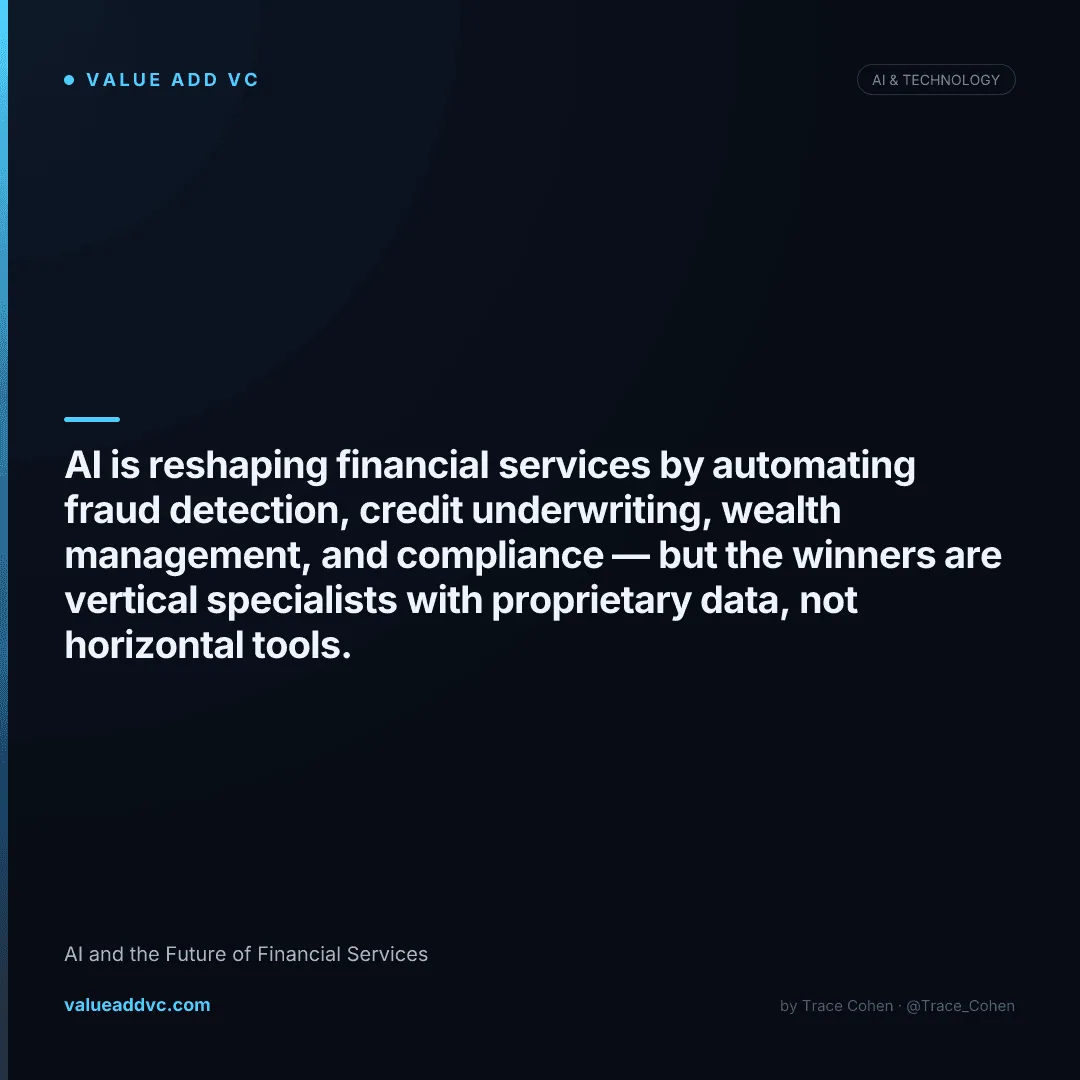
I have looked at hundreds of fintech and AI deals. The pattern is consistent: the companies selling horizontal "AI for banking" platforms are getting commoditized by foundation model providers. The companies going deep on a single workflow — auto lending underwriting, insurance claims triage, SMB cash flow forecasting — are building durable positions because their models are trained on data that no one else has access to.
Consider the difference between a general-purpose LLM and a model trained on 10 million auto loan outcomes across economic cycles. The general-purpose model can write a credit memo. The vertical model can tell you, with 87% accuracy, which borrowers in a specific ZIP code will default in a recession and why. That is not a marginal improvement. That is a different product category.
The best investments I am seeing are not "AI tools for financial services." They are companies that happen to use AI as the engine to deliver a financial outcome — faster underwriting decisions, lower loss ratios, higher take rates — that the incumbent cannot match without rebuilding their data stack from scratch.
What the Next Wave Looks Like
The first wave of AI in fintech was about automation — replacing humans in repetitive tasks. The second wave, which we are entering now, is about intelligence — systems that make decisions no human could make at scale or speed.
Real-time credit limit adjustment based on intraday spending behavior. Insurance pricing that updates continuously rather than at annual renewal. Fraud detection that learns the behavioral fingerprint of every individual account and flags deviations within milliseconds. None of this is science fiction. Pieces of it are live today at the most advanced institutions. The question is when it becomes table stakes.
The answer matters for investors because the companies building this infrastructure today — the data layers, the model pipelines, the workflow ownership — will be extraordinarily difficult to displace once embedded in a regulated institution's operations. Switching costs in financial services are not just technical. They are regulatory. An AI underwriting system that has survived two OCC examinations is not getting ripped out for a competitor with a better demo.
The financial services AI opportunity is not about replacing bankers with chatbots.
It is about rebuilding the data and decision infrastructure of a $25 trillion industry — and the companies that own the workflows will own the margins.
Originally published in the Trace Cohen newsletter. Explore more AI investment theses at Value Add VC.
Latest from the Pulse
Get VC data most people never see
— 100% free
Weekly benchmarks, valuations, and fund data. Join 5,000+ investors. No spam.