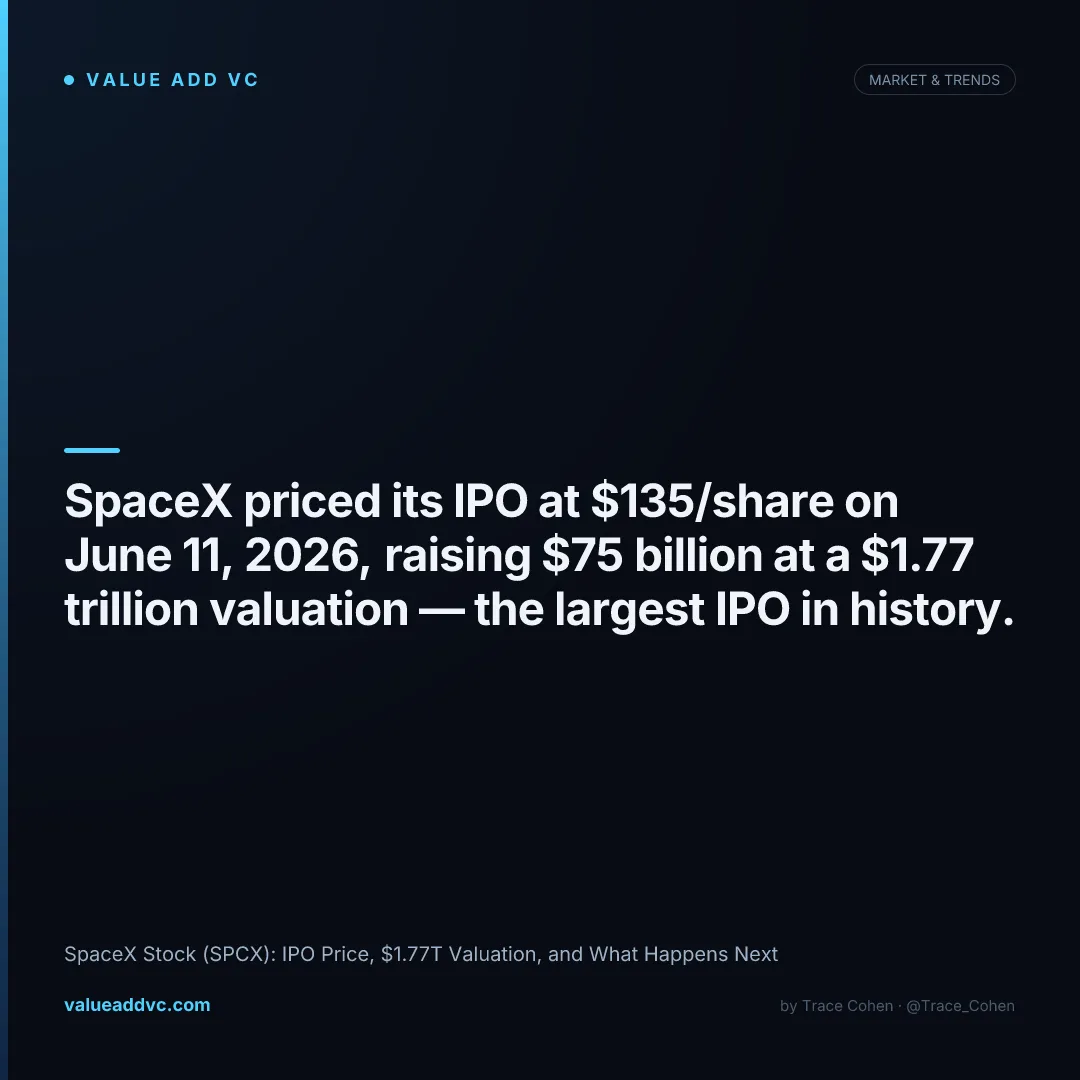
SpaceX raised $75 billion at a $1.77 trillion valuation on June 11, 2026, then closed its first trading day up 19.2% at $161 a share — a $2.11 trillion market cap.
Behind that first print is a five-year run from an $85 billion tender offer to the largest IPO in market history, built almost entirely on Starlink's cash flow rather than rocket launches.
What is SpaceX's valuation in 2026?
SpaceX's valuation is $1.77 trillion as of its June 11, 2026 IPO pricing, rising to a $2.11 trillion market cap after shares closed up 19.2% on their first trading day. That makes it the third most valuable US public company by market cap within days of listing, trailing only Nvidia and Apple, and more than double its $800 billion private valuation from just six months earlier.
The company confidentially filed its S-1 with the SEC on April 1, 2026, went public with the filing on May 20, and priced 555.6 million Class A shares at $135 each — the top of its $1.75 trillion to $2 trillion target range. Shares opened at $150, hit an intraday high of $176.52, and closed at $160.95, with more than 500 million shares changing hands, a volume that approached Facebook's 580-million-share 2012 debut. See where Wall Street's 12-month price targets on SPCX currently sit for how analysts are framing the run so far.
The SpaceX valuation timeline: 2023 to the SPCX IPO
Unlike most IPOs, SpaceX's value didn't step up gradually — it accelerated hard in the final 18 months, driven almost entirely by Starlink's profitability inflection rather than any single rocket milestone.
| Date | Mechanism | Share Price | Valuation |
|---|---|---|---|
| Dec 2023 | Employee tender offer | — | $180B |
| Aug 2024 | Internal tender offer | — | $210B |
| Dec 2024 | Secondary share sale | $185 | $350B |
| Jul 2025 | Tender offer | $212 | $400B |
| Dec 2025 | Insider share sale | $421 | $800B |
| Jun 11, 2026 | IPO pricing (Nasdaq: SPCX) | $135 | $1.77T |
| Jun 12, 2026 | IPO debut-day close | $161 | $2.11T |
Figures blended from Sacra, CNBC, Fortune, and SEC EDGAR filings (CIK 1181412) for Space Exploration Technologies Corp. Pre-IPO figures reflect internal tender offers and secondary share sales, not public market prices.
Why Starlink drove the SpaceX IPO valuation
SpaceX generated $18.67 billion in total 2025 revenue, up 33% from roughly $14.1 billion in 2024. Starlink accounted for $11.39 billion of that — 61% of the total — and posted $4.42 billion in operating income, an 86% year-over-year jump in adjusted profit to $7.17 billion. The launch business, by contrast, generated about $4.1 billion in revenue but lost $657 million, and the AI/xAI-adjacent division ran a $6.35 billion deficit. Public investors are effectively pricing SpaceX as a satellite internet company that happens to also launch rockets.
| Segment | 2025 Revenue | % of Total | Operating Result |
|---|---|---|---|
| Starlink (connectivity) | $11.39B | 61% | +$4.42B |
| Launch (Falcon 9/Heavy) | ~$4.1B | 22% | -$657M |
| AI / other | ~$3.2B | 17% | -$6.35B |
| Total company | $18.67B | 100% | n/a |
| Starlink subscribers (Mar '26) | 10.3M | 155 countries | — |
| Starlink 2026E subscribers (Quilty) | 16.8M | year-end est. | — |
Figures are 2025 fiscal-year and Q1 2026 estimates blended from SpaceX's S-1 disclosures, CNBC, and Quilty Space subscriber projections. AI/other includes xAI-adjacent compute allocations disclosed in the filing.
What the lockup means for 2027
Elon Musk holds roughly 42% of SpaceX's equity but 82% of its voting power through Class B super-voting shares, giving him effective control regardless of how the float trades. His shares — along with early employees and pre-IPO investors — are locked until 366 days after the June 12, 2026 listing date, meaning no insider selling until mid-June 2027. That's a longer lockup than the standard 180 days, likely negotiated to dampen post-IPO volatility given the size of the offering.
For VCs and LPs who backed SpaceX early — Founders Fund's 2008 Series D remains the highest-multiple VC bet in history — the IPO is a mark-to-market event, not a liquidity event, until mid-2027. Track how SpaceX and other mega-cap tech listings are performing on the Tech IPO Tracker at Value Add VC.
SpaceX didn't IPO as a rocket company.
It IPO'd as a $1.77 trillion satellite internet company that also happens to launch rockets — and Starlink's $7.17B adjusted profit is what got it there.
Track mega-cap tech listings on the Tech IPO Tracker at Value Add VC. Originally published in the Trace Cohen newsletter.
Latest from the Pulse
Get VC data most people never see
— 100% free
Weekly benchmarks, valuations, and fund data. Join 5,000+ investors. No spam.