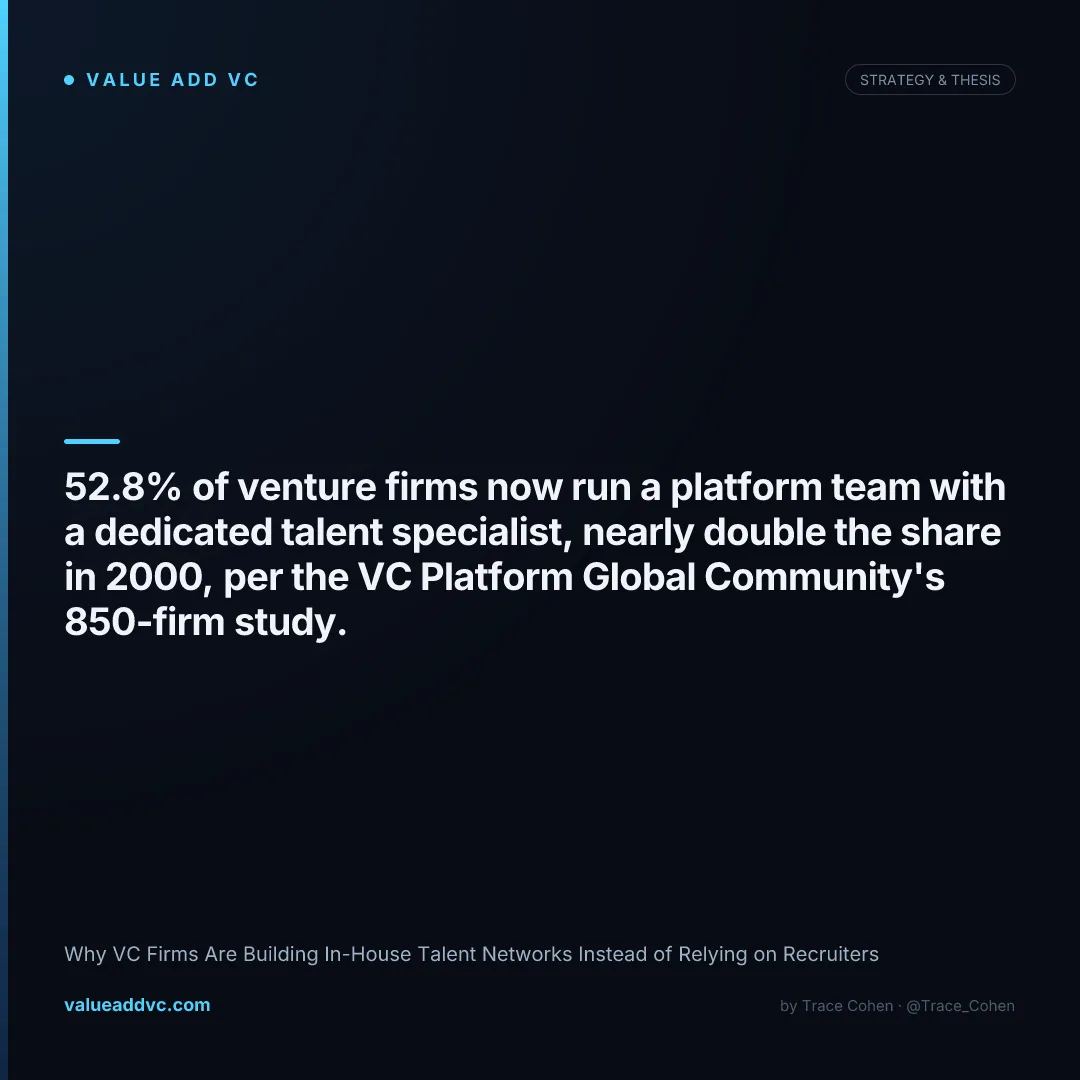
I think the most underrated structural shift happening inside venture firms right now isn't a new fund strategy, it's who's on the payroll. 52.8% of VC firms now run a platform team with Moderate or Significant scope that includes a dedicated talent specialist, nearly double the share that had one in 2000, and the reason isn't that firms suddenly care more about founders. It's that outside recruiters charging 15% to 33% of a hire's first-year pay stopped making sense once a portfolio got big enough to hire that function permanently instead.
VC firms in-house talent network recruiting: how the shift actually happened
VC firms in-house talent network recruiting is now mainstream infrastructure, not a boutique perk. The VC Platform Global Community's "Power of Platform" study, which tracked team composition and AUM at 850 venture firms from 2000 through 2022, found 12.7% of firms had at least one dedicated Talent specialist by 2022, up from 3.8% in 2000. Platform staff overall grew from 6.4% of core team headcount to 13.1% over the same stretch — one in eight people at a typical venture firm now works on Platform, and talent is the single biggest slice of that function.
Greylock is one of the earliest documented movers. In October 2011, TechCrunch reported that Greylock hired Jeff Markowitz, formerly managing director of the venture practice at executive search firm Heidrick & Struggles, as a dedicated talent partner, alongside Dan Portillo from Mozilla and Rypple as VP of Talent. That's a firm poaching two people who used to bill hourly for search and putting them on salary instead — a fairly literal insourcing decision, fifteen years before it became the industry norm this data now shows.
The real driver: recruiter fee economics, not portfolio generosity
The economics are the part that gets skipped in most write-ups of "VC platform teams." Contingency executive search runs 15% to 25% of a hire's first-year base salary, climbing to 25% to 30% for senior or specialist roles, and retained search runs 25% to 33% of total compensation with an $80,000 to $100,000-plus minimum per search, according to Floodgate Medical's 2026 executive search fee breakdown. A firm whose portfolio companies are collectively hiring dozens of engineers and executives a quarter is paying that percentage on every single one of those searches if it routes them all through outside recruiters.
Compare that to what the largest firms have actually built. Andreessen Horowitz runs the Speedrun Talent Network and its own jobs board at jobs.a16z.com, centralizing open roles across a portfolio of roughly 280 companies so candidates can search and get warm introductions without a fee changing hands on either side. Sequoia built the Sequoia People Platform, including a Candidate Offers tool that plugs directly into a portfolio company's existing applicant tracking system rather than routing hires through a third party. Neither firm is running a charity; they're amortizing one internal team's salary across hundreds of open roles instead of paying a percentage fee on each one.
The same logic explains why Getro says it's now used by more than 700 VC platform teams to run a shared portfolio job board and warm-intro layer — most firms can't justify building a16z's or Sequoia's bespoke internal tooling, but they can justify paying for software that gets them most of the way to "in-house" without the headcount. The pattern across all of it is the same: firms are buying or building a fixed-cost talent function once, instead of renting a variable-cost one every time a portfolio company needs to hire.
What this actually means for founders and other GPs
For a founder choosing between two similar term sheets, an active in-house talent network is a genuinely underweighted diligence question. It's the difference between a VC who can put your open VP of Engineering role in front of candidates already vetted for other portfolio companies, and a VC whose "value-add" line in the pitch is a vague promise to "make introductions" that turns into an email forward six weeks later. Ask a firm how many placements its platform team actually made into portfolio companies last year, not whether it has a platform team — the honest answer separates the real programs from the slide.
For other GPs, this is one more piece of infrastructure that widens the gap between funds that can afford to build institutional muscle and funds that can't. A dedicated talent partner is a six-figure fixed salary the fund carries every year regardless of how much hiring its portfolio actually does that quarter, which only pencils out once a portfolio is large enough to generate steady, recurring recruiting volume. That's a scale threshold most emerging managers and sub-$100M funds simply haven't crossed, which is exactly why Getro's customer base skews toward firms buying shared software instead of building their own team.
Where I could be wrong
The IRR number is the part of this argument I'd push back on hardest myself. The VC Platform Global Community's study found funds with platform teams outperformed those without by 1,100 basis points in net IRR and 0.5x in TVPI over the prior decade — but that's a correlation from a self-selected sample of firms, not a controlled comparison. Larger, better-capitalized funds are more likely to both afford a platform team and already win the best deals regardless of it, so some, maybe most, of that outperformance gap is really an AUM and brand story wearing a talent-team costume.
It's also worth being honest that in-house talent networks are strongest exactly where they're least differentiated: mid-level engineering and generalist operating roles, which is high-volume, repeatable hiring a generalist internal team can actually handle. For C-suite and deeply technical searches — a general counsel, a VP of AI research, a CFO who's taken a company public — most of these same firms still quietly pay outside executive search firms the full 25% to 33% fee, because that's exactly the kind of low-volume, high-stakes search an internal generalist team isn't built to run well.
And there's a portfolio-company-side risk worth naming: a talent partner spread across 100-plus portfolio companies has less actual bandwidth per company than an external recruiter you're paying to focus on your search alone. "We have a platform team" can become a reason a founder gets a slower response than they would from someone whose fee depends on filling that exact role.
Bottom line: the data backs the thesis that in-house talent networks have gone from a rare 2011-era bet at firms like Greylock to standard infrastructure at 52.8% of venture firms today, and recruiter fee economics — not generosity — explain why. The honest caveat is that the model works best for high-volume, mid-level hiring at large, well-capitalized funds, while senior executive searches and smaller emerging managers still run mostly through the outside recruiters this trend is supposed to be replacing.
Latest from the Pulse
Get VC data most people never see
— 100% free
Weekly benchmarks, valuations, and fund data. Join 5,000+ investors. No spam.